 Add to Chrome
 Add to Firefox
 Add to Edge
X2-N: A Transformable Wheel-legged Humanoid Robot with Dual-mode Locomotion and Manipulation
Apr 23, 2026
Wheel-legged robots combine the efficiency of wheeled locomotion with the versatility of legged systems, enabling rapid traversal over both continuous and discrete terrains. However, conventional designs typically employ fixed wheels as feet and limited degrees of freedom (DoFs) at the hips, resulting in reduced stability and mobility during legged locomotion compared to humanoids with flat feet. In addition, most existing platforms lack a full upper body with arms, which limits their ability to perform dexterous manipulation tasks. In this letter, we present X2-N, a high-DoF transformable robot with dual-mode locomotion and manipulation. X2-N can operate in both humanoid and wheel-legged forms and transform seamlessly between them through joint reconfiguration. We further propose a reinforcement learning (RL)-based whole-body control framework tailored to this morphology, enabling unified control across hybrid locomotion, transformation, and manipulation. We validate X2-N in a range of challenging locomotion and manipulation tasks, including dynamic skating-like motion, stair climbing and package delivery. Results demonstrate high locomotion efficiency, strong terrain adaptability, and stable loco-manipulation performance of X2-N, highlighting its potential for real-world deployment.

WholeBodyVLA: Towards Unified Latent VLA for Whole-Body Loco-Manipulation Control
Dec 15, 2025Humanoid robots require precise locomotion and dexterous manipulation to perform challenging loco-manipulation tasks. Yet existing approaches, modular or end-to-end, are deficient in manipulation-aware locomotion. This confines the robot to a limited workspace, preventing it from performing large-space loco-manipulation. We attribute this to: (1) the challenge of acquiring loco-manipulation knowledge due to the scarcity of humanoid teleoperation data, and (2) the difficulty of faithfully and reliably executing locomotion commands, stemming from the limited precision and stability of existing RL controllers. To acquire richer loco-manipulation knowledge, we propose a unified latent learning framework that enables Vision-Language-Action (VLA) system to learn from low-cost action-free egocentric videos. Moreover, an efficient human data collection pipeline is devised to augment the dataset and scale the benefits. To execute the desired locomotion commands more precisely, we present a loco-manipulation-oriented (LMO) RL policy specifically tailored for accurate and stable core loco-manipulation movements, such as advancing, turning, and squatting. Building on these components, we introduce WholeBodyVLA, a unified framework for humanoid loco-manipulation. To the best of our knowledge, WholeBodyVLA is one of its kind enabling large-space humanoid loco-manipulation. It is verified via comprehensive experiments on the AgiBot X2 humanoid, outperforming prior baseline by 21.3%. It also demonstrates strong generalization and high extensibility across a broad range of tasks.
Open-sourced Data Ecosystem in Autonomous Driving: the Present and Future
Dec 06, 2023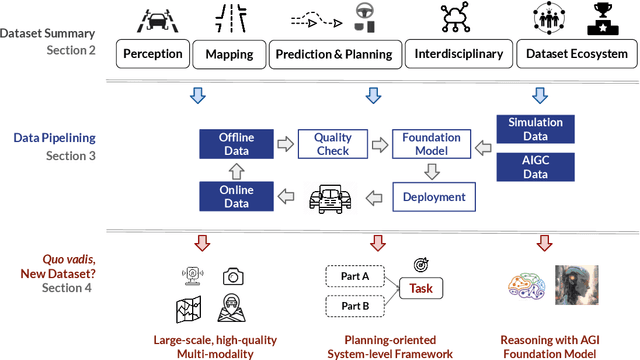
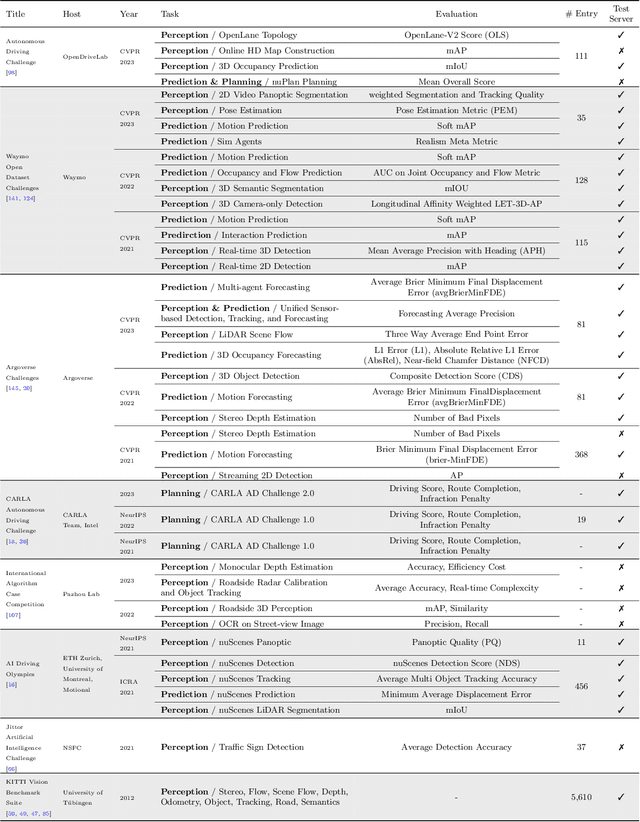
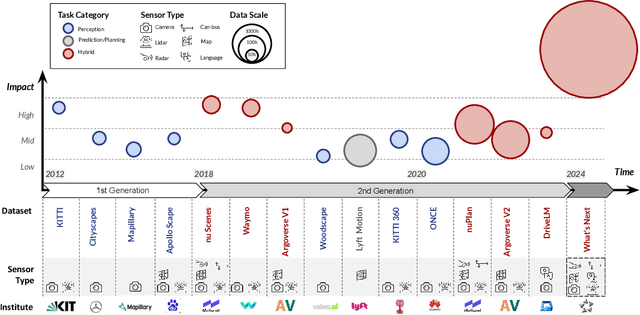
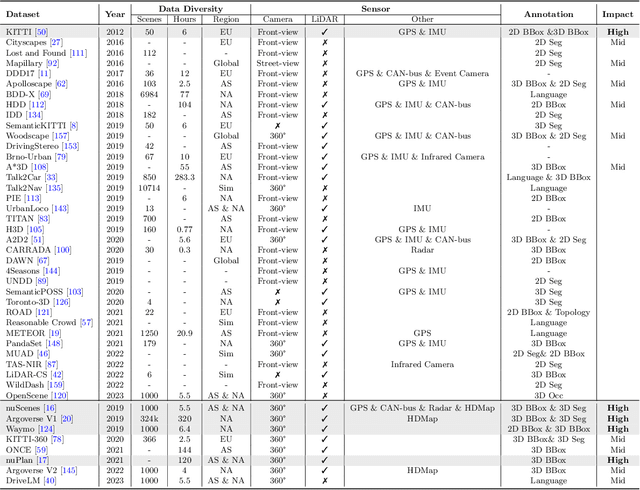
With the continuous maturation and application of autonomous driving technology, a systematic examination of open-source autonomous driving datasets becomes instrumental in fostering the robust evolution of the industry ecosystem. Current autonomous driving datasets can broadly be categorized into two generations. The first-generation autonomous driving datasets are characterized by relatively simpler sensor modalities, smaller data scale, and is limited to perception-level tasks. KITTI, introduced in 2012, serves as a prominent representative of this initial wave. In contrast, the second-generation datasets exhibit heightened complexity in sensor modalities, greater data scale and diversity, and an expansion of tasks from perception to encompass prediction and control. Leading examples of the second generation include nuScenes and Waymo, introduced around 2019. This comprehensive review, conducted in collaboration with esteemed colleagues from both academia and industry, systematically assesses over seventy open-source autonomous driving datasets from domestic and international sources. It offers insights into various aspects, such as the principles underlying the creation of high-quality datasets, the pivotal role of data engine systems, and the utilization of generative foundation models to facilitate scalable data generation. Furthermore, this review undertakes an exhaustive analysis and discourse regarding the characteristics and data scales that future third-generation autonomous driving datasets should possess. It also delves into the scientific and technical challenges that warrant resolution. These endeavors are pivotal in advancing autonomous innovation and fostering technological enhancement in critical domains. For further details, please refer to https://github.com/OpenDriveLab/DriveAGI.