 Add to Chrome
 Add to Firefox
 Add to Edge
Who Pays the Price? Stakeholder-Centric Prompt Injection Benchmarking for Real-world Web Agents
Jun 11, 2026
Web agents driven by large language models (LLMs) are increasingly deployed in real-world environments, where they operate over untrusted web content and execute actions with direct consequences. This makes them vulnerable to prompt-injection attacks, in which seemingly benign content embeds adversarial instructions that manipulate agent behaviour. Existing security benchmarks adopt an \textit{attack-centric} perspective, focusing on the technical feasibility of injections while overlooking the nuanced distribution of resulting harms. In practice, however, prompt-injection risk is victim-dependent: a single exploit can produce asymmetric consequences for different stakeholders, and the same attack pattern may exhibit substantially different effectiveness depending on whom it targets. To capture these properties, we introduce \textbf{\sysname}, a \textit{stakeholder-centric} benchmark to systematically categorize and attribute harm in real-world web agent systems. It distinguishes between affected entities (e.g., user, seller, platform), decomposes the attacks into concrete objectives, and evaluates each case with complementary outcome- and process-level metrics. Our results reveal substantial and heterogeneous vulnerabilities: not a single attack objective is reliably resisted by current agents, and failures distribute across qualitatively distinct modes ranging from \emph{stealthy parasitism} (attack succeeds without disrupting the user's delegated task) to \emph{misaligned disruption} (task disrupted without attack success) and \emph{compounded failure} (both adversarial objective and task integrity simultaneously violated). These patterns are missed by conventional evaluation, highlighting the need for stakeholder-aware assessment of LLM-based agents in real-world deployments. Benchmark is available at https://github.com/StakeBench/SBC.

Multi-Agent Reinforcement Learning for Joint Channel Assignment and Power Allocation in Platoon-Based C-V2X Systems
Nov 09, 2020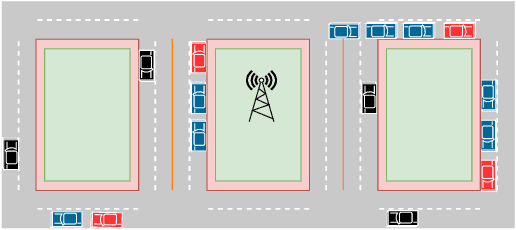
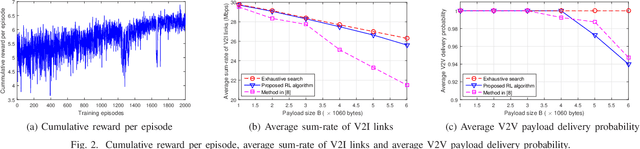
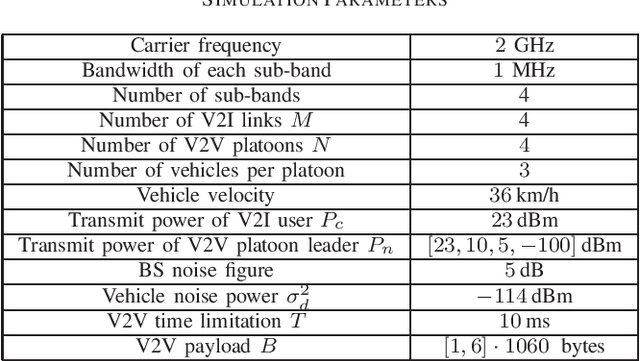
We consider the problem of joint channel assignment and power allocation in underlaid cellular vehicular-to-everything (C-V2X) systems where multiple vehicle-to-infrastructure (V2I) uplinks share the time-frequency resources with multiple vehicle-to-vehicle (V2V) platoons that enable groups of connected and autonomous vehicles to travel closely together. Due to the nature of fast channel variant in vehicular environment, traditional centralized optimization approach relying on global channel information might not be viable in C-V2X systems with large number of users. Utilizing a reinforcement learning (RL) approach, we propose a distributed resource allocation (RA) algorithm to overcome this challenge. Specifically, we model the RA problem as a multi-agent system. Based solely on the local channel information, each platoon leader, who acts as an agent, collectively interacts with each other and accordingly selects the optimal combination of sub-band and power level to transmit its signals. Toward this end, we utilize the double deep Q-learning algorithm to jointly train the agents under the objectives of simultaneously maximizing the V2I sum-rate and satisfying the packet delivery probability of each V2V link in a desired latency limitation. Simulation results show that our proposed RL-based algorithm achieves a close performance compared to that of the well-known exhaustive search algorithm.