 Add to Chrome
 Add to Firefox
 Add to Edge
SHIFT: Self-reconstruction Harnesses Implicit Fine-grained Thinking for Retrieval
Jul 23, 2026
LLM-based retrievers have become a fundamental component of modern information retrieval systems. The paradigm of "rewrite-then-retriev" introduces explicit reasoning before retrieval. In addition, implicit-reasoning retrievers such as GIRCSE and LaSER improve efficiency by replacing explicit reasoning with soft tokens. Although these methods demonstrated competitive performance on reasoning-intensive retrieval benchmarks, they struggle to address the mismatch between the objectives of retrieval and generation. In this work, we propose SHIFT ($\textbf{S}$elf-reconstruction $\textbf{H}$arnesses $\textbf{I}$mplicit $\textbf{F}$ine-grained $\textbf{T}$hinking for Retrieval), a retrieval training framework based on LLMs. Firstly, we transfer LLMs into reasoning-efficient retrievers with residual projection and task-oriented bidirectional attention aggregation in the latent space. Secondly, we alleviate the mismatch between contrastive learning and implicit reasoning using fine-grained next-token-prediction-based reconstruction. Extensive experiments on reasoning-intensive retrieval benchmarks show that SHIFT consistently outperforms other widely used retrievers. We also carried out a detailed analysis to illustrate how our method works.

Synthetic Data Generation for Brain-Computer Interfaces: Overview, Benchmarking, and Future Directions
Mar 11, 2026Deep learning has achieved transformative performance across diverse domains, largely driven by the large-scale, high-quality training data. In contrast, the development of brain-computer interfaces (BCIs) is fundamentally constrained by the limited, heterogeneous, and privacy-sensitive neural recordings. Generating synthetic yet physiologically plausible brain signals has therefore emerged as a compelling way to mitigate data scarcity and enhance model capacity. This survey provides a comprehensive review of brain signal generation for BCIs, covering methodological taxonomies, benchmark experiments, evaluation metrics, and key applications. We systematically categorize existing generative algorithms into four types: knowledge-based, feature-based, model-based, and translation-based approaches. Furthermore, we benchmark existing brain signal generation approaches across four representative BCI paradigms to provide an objective performance comparison. Finally, we discuss the potentials and challenges of current generation approaches and prospect future research on accurate, data-efficient, and privacy-aware BCI systems. The benchmark codebase is publicized at https://github.com/wzwvv/DG4BCI.
Valley2: Exploring Multimodal Models with Scalable Vision-Language Design
Jan 13, 2025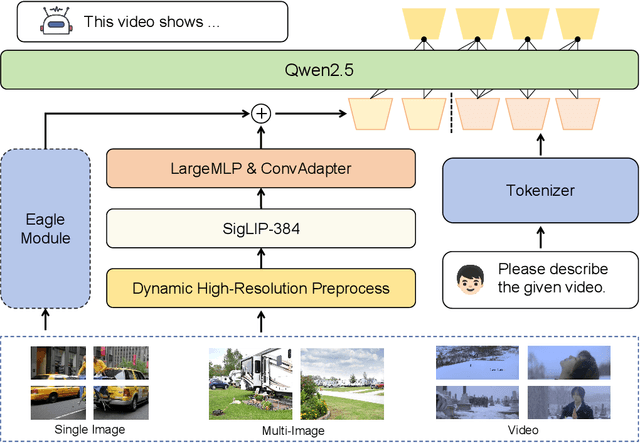
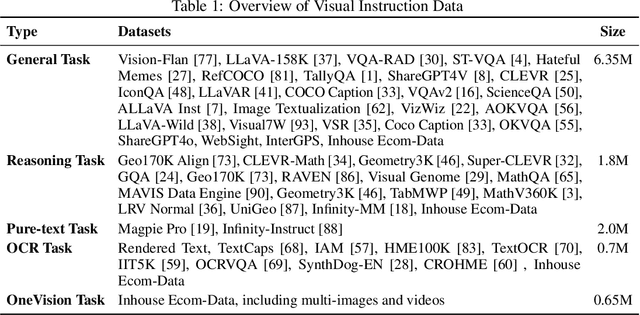
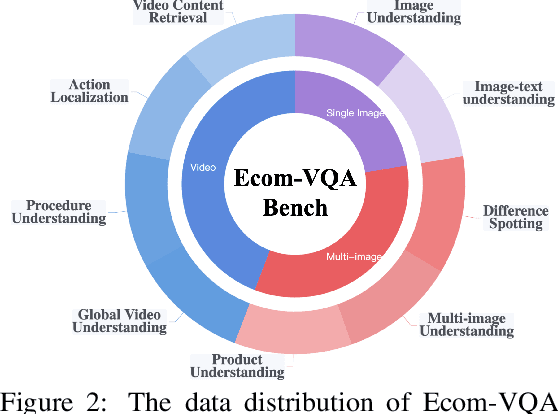
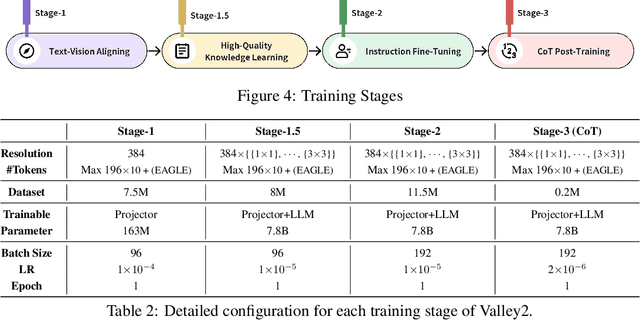
Recently, vision-language models have made remarkable progress, demonstrating outstanding capabilities in various tasks such as image captioning and video understanding. We introduce Valley2, a novel multimodal large language model designed to enhance performance across all domains and extend the boundaries of practical applications in e-commerce and short video scenarios. Notably, Valley2 achieves state-of-the-art (SOTA) performance on e-commerce benchmarks, surpassing open-source models of similar size by a large margin (79.66 vs. 72.76). Additionally, Valley2 ranks second on the OpenCompass leaderboard among models with fewer than 10B parameters, with an impressive average score of 67.4. The code and model weights are open-sourced at https://github.com/bytedance/Valley.
PGNeXt: High-Resolution Salient Object Detection via Pyramid Grafting Network
Aug 02, 2024


We present an advanced study on more challenging high-resolution salient object detection (HRSOD) from both dataset and network framework perspectives. To compensate for the lack of HRSOD dataset, we thoughtfully collect a large-scale high resolution salient object detection dataset, called UHRSD, containing 5,920 images from real-world complex scenarios at 4K-8K resolutions. All the images are finely annotated in pixel-level, far exceeding previous low-resolution SOD datasets. Aiming at overcoming the contradiction between the sampling depth and the receptive field size in the past methods, we propose a novel one-stage framework for HR-SOD task using pyramid grafting mechanism. In general, transformer-based and CNN-based backbones are adopted to extract features from different resolution images independently and then these features are grafted from transformer branch to CNN branch. An attention-based Cross-Model Grafting Module (CMGM) is proposed to enable CNN branch to combine broken detailed information more holistically, guided by different source feature during decoding process. Moreover, we design an Attention Guided Loss (AGL) to explicitly supervise the attention matrix generated by CMGM to help the network better interact with the attention from different branches. Comprehensive experiments on UHRSD and widely-used SOD datasets demonstrate that our method can simultaneously locate salient object and preserve rich details, outperforming state-of-the-art methods. To verify the generalization ability of the proposed framework, we apply it to the camouflaged object detection (COD) task. Notably, our method performs superior to most state-of-the-art COD methods without bells and whistles.