 Add to Chrome
 Add to Firefox
 Add to Edge
UI-Venus-1.5 Technical Report
Feb 09, 2026
GUI agents have emerged as a powerful paradigm for automating interactions in digital environments, yet achieving both broad generality and consistently strong task performance remains challenging.In this report, we present UI-Venus-1.5, a unified, end-to-end GUI Agent designed for robust real-world applications.The proposed model family comprises two dense variants (2B and 8B) and one mixture-of-experts variant (30B-A3B) to meet various downstream application scenarios.Compared to our previous version, UI-Venus-1.5 introduces three key technical advances: (1) a comprehensive Mid-Training stage leveraging 10 billion tokens across 30+ datasets to establish foundational GUI semantics; (2) Online Reinforcement Learning with full-trajectory rollouts, aligning training objectives with long-horizon, dynamic navigation in large-scale environments; and (3) a single unified GUI Agent constructed via Model Merging, which synthesizes domain-specific models (grounding, web, and mobile) into one cohesive checkpoint. Extensive evaluations demonstrate that UI-Venus-1.5 establishes new state-of-the-art performance on benchmarks such as ScreenSpot-Pro (69.6%), VenusBench-GD (75.0%), and AndroidWorld (77.6%), significantly outperforming previous strong baselines. In addition, UI-Venus-1.5 demonstrates robust navigation capabilities across a variety of Chinese mobile apps, effectively executing user instructions in real-world scenarios. Code: https://github.com/inclusionAI/UI-Venus; Model: https://huggingface.co/collections/inclusionAI/ui-venus

Mitigating Conversational Inertia in Multi-Turn Agents
Feb 03, 2026Large language models excel as few-shot learners when provided with appropriate demonstrations, yet this strength becomes problematic in multiturn agent scenarios, where LLMs erroneously mimic their own previous responses as few-shot examples. Through attention analysis, we identify conversational inertia, a phenomenon where models exhibit strong diagonal attention to previous responses, which is associated with imitation bias that constrains exploration. This reveals a tension when transforming few-shot LLMs into agents: longer context enriches environmental feedback for exploitation, yet also amplifies conversational inertia that undermines exploration. Our key insight is that for identical states, actions generated with longer contexts exhibit stronger inertia than those with shorter contexts, enabling construction of preference pairs without environment rewards. Based on this, we propose Context Preference Learning to calibrate model preferences to favor low-inertia responses over highinertia ones. We further provide context management strategies at inference time to balance exploration and exploitation. Experimental results across eight agentic environments and one deep research scenario validate that our framework reduces conversational inertia and achieves performance improvements.
Unified Generation and Self-Verification for Vision-Language Models via Advantage Decoupled Preference Optimization
Jan 04, 2026Parallel test-time scaling typically trains separate generation and verification models, incurring high training and inference costs. We propose Advantage Decoupled Preference Optimization (ADPO), a unified reinforcement learning framework that jointly learns answer generation and self-verification within a single policy. ADPO introduces two innovations: a preference verification reward improving verification capability and a decoupled optimization mechanism enabling synergistic optimization of generation and verification. Specifically, the preference verification reward computes mean verification scores from positive and negative samples as decision thresholds, providing positive feedback when prediction correctness aligns with answer correctness. Meanwhile, the advantage decoupled optimization computes separate advantages for generation and verification, applies token masks to isolate gradients, and combines masked GRPO objectives, preserving generation quality while calibrating verification scores. ADPO achieves up to +34.1% higher verification AUC and -53.5% lower inference time, with significant gains of +2.8%/+1.4% accuracy on MathVista/MMMU, +1.9 cIoU on ReasonSeg, and +1.7%/+1.0% step success rate on AndroidControl/GUI Odyssey.
MVP: Multiple View Prediction Improves GUI Grounding
Dec 09, 2025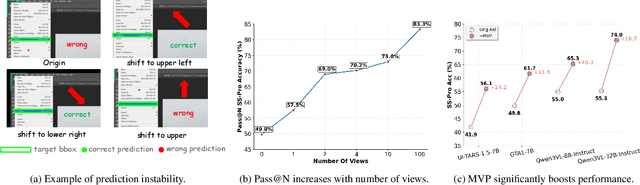
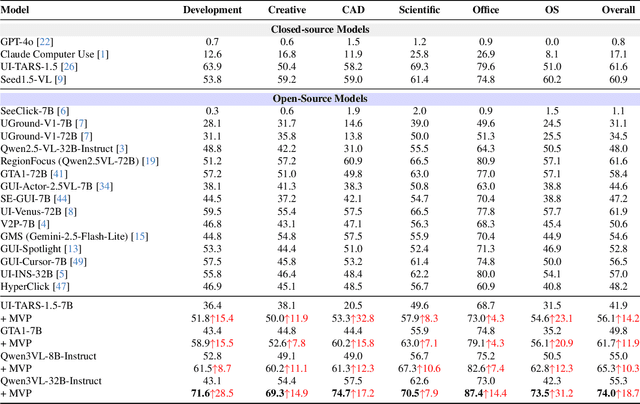
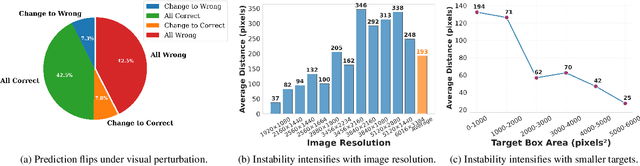
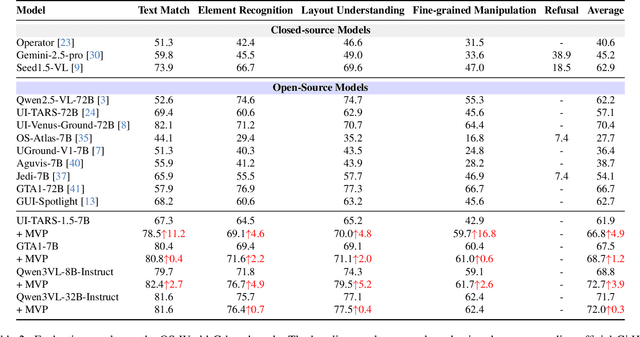
GUI grounding, which translates natural language instructions into precise pixel coordinates, is essential for developing practical GUI agents. However, we observe that existing grounding models exhibit significant coordinate prediction instability, minor visual perturbations (e.g. cropping a few pixels) can drastically alter predictions, flipping results between correct and incorrect. This instability severely undermines model performance, especially for samples with high-resolution and small UI elements. To address this issue, we propose Multi-View Prediction (MVP), a training-free framework that enhances grounding performance through multi-view inference. Our key insight is that while single-view predictions may be unstable, aggregating predictions from multiple carefully cropped views can effectively distinguish correct coordinates from outliers. MVP comprises two components: (1) Attention-Guided View Proposal, which derives diverse views guided by instruction-to-image attention scores, and (2) Multi-Coordinates Clustering, which ensembles predictions by selecting the centroid of the densest spatial cluster. Extensive experiments demonstrate MVP's effectiveness across various models and benchmarks. Notably, on ScreenSpot-Pro, MVP boosts UI-TARS-1.5-7B to 56.1%, GTA1-7B to 61.7%, Qwen3VL-8B-Instruct to 65.3%, and Qwen3VL-32B-Instruct to 74.0%. The code is available at https://github.com/ZJUSCL/MVP.