 Add to Chrome
 Add to Firefox
 Add to Edge
MVP: Multiple View Prediction Improves GUI Grounding
Dec 09, 2025
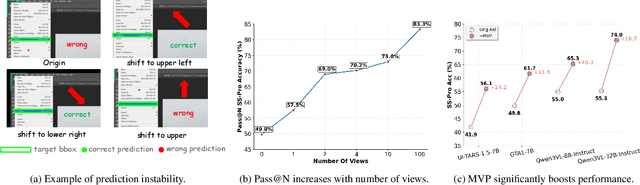
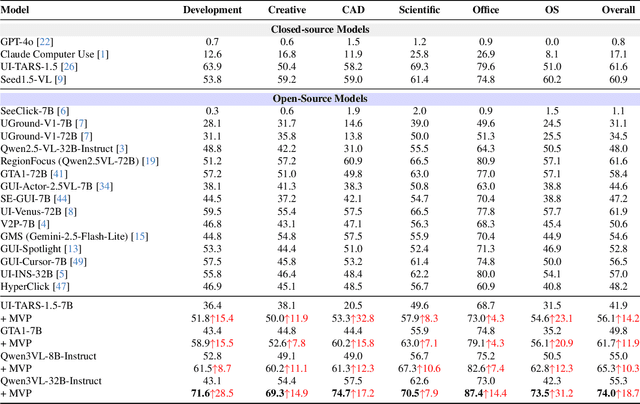
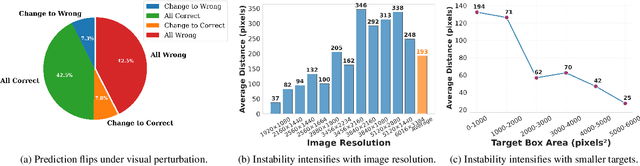
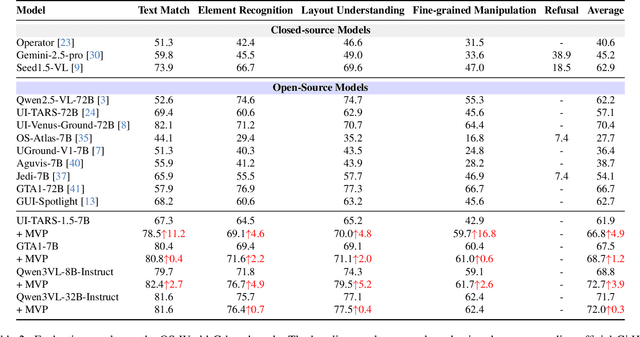
GUI grounding, which translates natural language instructions into precise pixel coordinates, is essential for developing practical GUI agents. However, we observe that existing grounding models exhibit significant coordinate prediction instability, minor visual perturbations (e.g. cropping a few pixels) can drastically alter predictions, flipping results between correct and incorrect. This instability severely undermines model performance, especially for samples with high-resolution and small UI elements. To address this issue, we propose Multi-View Prediction (MVP), a training-free framework that enhances grounding performance through multi-view inference. Our key insight is that while single-view predictions may be unstable, aggregating predictions from multiple carefully cropped views can effectively distinguish correct coordinates from outliers. MVP comprises two components: (1) Attention-Guided View Proposal, which derives diverse views guided by instruction-to-image attention scores, and (2) Multi-Coordinates Clustering, which ensembles predictions by selecting the centroid of the densest spatial cluster. Extensive experiments demonstrate MVP's effectiveness across various models and benchmarks. Notably, on ScreenSpot-Pro, MVP boosts UI-TARS-1.5-7B to 56.1%, GTA1-7B to 61.7%, Qwen3VL-8B-Instruct to 65.3%, and Qwen3VL-32B-Instruct to 74.0%. The code is available at https://github.com/ZJUSCL/MVP.

Detecting Machine-Generated Long-Form Content with Latent-Space Variables
Oct 04, 2024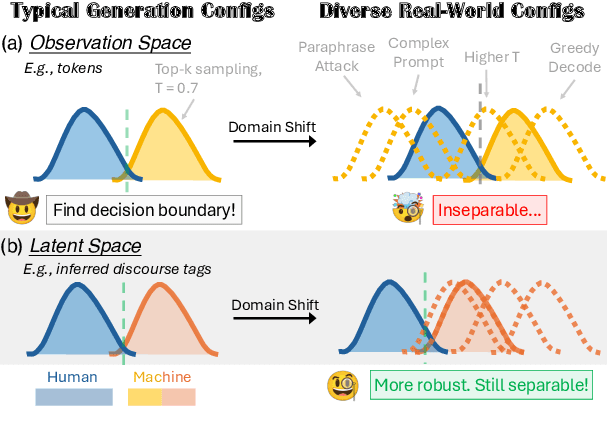
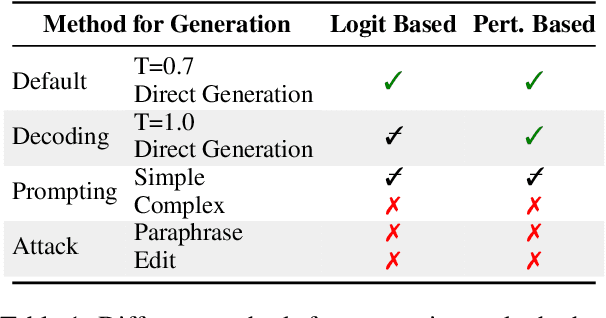
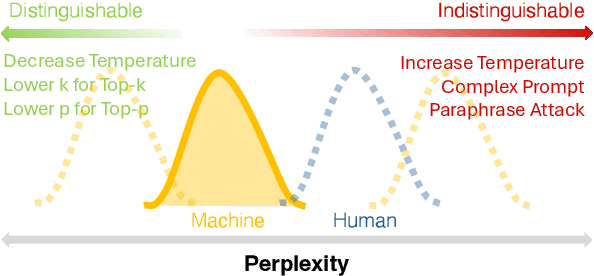
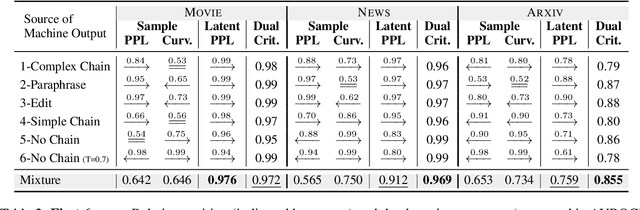
The increasing capability of large language models (LLMs) to generate fluent long-form texts is presenting new challenges in distinguishing machine-generated outputs from human-written ones, which is crucial for ensuring authenticity and trustworthiness of expressions. Existing zero-shot detectors primarily focus on token-level distributions, which are vulnerable to real-world domain shifts, including different prompting and decoding strategies, and adversarial attacks. We propose a more robust method that incorporates abstract elements, such as event transitions, as key deciding factors to detect machine versus human texts by training a latent-space model on sequences of events or topics derived from human-written texts. In three different domains, machine-generated texts, which are originally inseparable from human texts on the token level, can be better distinguished with our latent-space model, leading to a 31% improvement over strong baselines such as DetectGPT. Our analysis further reveals that, unlike humans, modern LLMs like GPT-4 generate event triggers and their transitions differently, an inherent disparity that helps our method to robustly detect machine-generated texts.