 Add to Chrome
 Add to Firefox
 Add to Edge
Multi-Granularity 3D Kidney Lesion Characterization from CT Volumes
Jun 03, 2026
Radiology reports describe kidney lesions by type, size, enhancement, and attenuation, yet existing 3D methods predict only at the patient or organ level. We reformulate kidney CT characterization as a per-lesion set-prediction task: one model emits a variable number of lesions per kidney, each with four clinical attributes. We curated 2,619 CT volumes from 788 patients at one academic medical center, with multi-granularity side- and per-lesion labels, and used KiTS23 (489 cases) for zero-shot external validation. We propose \textbf{LesionDETR}, a DETR-style architecture with size-distance Hungarian matching and a hierarchical loss that aggregates per-slot outputs to side-level objectives. Across four input representations and six encoder initializations, two design choices dominate: a segmentation mask as an input channel, and same-domain abdominal pretraining (SuPreM); generic large-corpus pretraining is no better than random initialization. LesionDETR reaches bilateral side-level abnormality AUC $0.799 \pm 0.009$ on UF-Health and $0.817 \pm 0.072$ on KiTS23. A count-conditioned variant reaches per-lesion mAP $0.190 \pm 0.083$ on cystic lesions; rare solid-lesion AP stays at the noise floor, pointing to targeted data collection, not architecture, as the next bottleneck. The framework yields verified per-lesion predictions for downstream structured report generation.

Enhancing Renal Tumor Malignancy Prediction: Deep Learning with Automatic 3D CT Organ Focused Attention
Feb 25, 2026Accurate prediction of malignancy in renal tumors is crucial for informing clinical decisions and optimizing treatment strategies. However, existing imaging modalities lack the necessary accuracy to reliably predict malignancy before surgical intervention. While deep learning has shown promise in malignancy prediction using 3D CT images, traditional approaches often rely on manual segmentation to isolate the tumor region and reduce noise, which enhances predictive performance. Manual segmentation, however, is labor-intensive, costly, and dependent on expert knowledge. In this study, a deep learning framework was developed utilizing an Organ Focused Attention (OFA) loss function to modify the attention of image patches so that organ patches attend only to other organ patches. Hence, no segmentation of 3D renal CT images is required at deployment time for malignancy prediction. The proposed framework achieved an AUC of 0.685 and an F1-score of 0.872 on a private dataset from the UF Integrated Data Repository (IDR), and an AUC of 0.760 and an F1-score of 0.852 on the publicly available KiTS21 dataset. These results surpass the performance of conventional models that rely on segmentation-based cropping for noise reduction, demonstrating the frameworks ability to enhance predictive accuracy without explicit segmentation input. The findings suggest that this approach offers a more efficient and reliable method for malignancy prediction, thereby enhancing clinical decision-making in renal cancer diagnosis.
MicroSegNet: A Deep Learning Approach for Prostate Segmentation on Micro-Ultrasound Images
May 31, 2023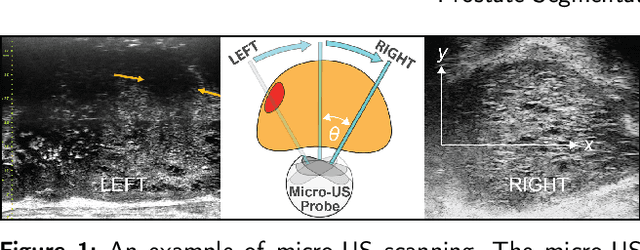


Micro-ultrasound (micro-US) is a novel 29-MHz ultrasound technique that provides 3-4 times higher resolution than traditional ultrasound, delivering comparable accuracy for diagnosing prostate cancer to MRI but at a lower cost. Accurate prostate segmentation is crucial for prostate volume measurement, cancer diagnosis, prostate biopsy, and treatment planning. This paper proposes a deep learning approach for automated, fast, and accurate prostate segmentation on micro-US images. Prostate segmentation on micro-US is challenging due to artifacts and indistinct borders between the prostate, bladder, and urethra in the midline. We introduce MicroSegNet, a multi-scale annotation-guided Transformer UNet model to address this challenge. During the training process, MicroSegNet focuses more on regions that are hard to segment (challenging regions), where expert and non-expert annotations show discrepancies. We achieve this by proposing an annotation-guided cross entropy loss that assigns larger weight to pixels in hard regions and lower weight to pixels in easy regions. We trained our model using micro-US images from 55 patients, followed by evaluation on 20 patients. Our MicroSegNet model achieved a Dice coefficient of 0.942 and a Hausdorff distance of 2.11 mm, outperforming several state-of-the-art segmentation methods, as well as three human annotators with different experience levels. We will make our code and dataset publicly available to promote transparency and collaboration in research.