 Add to Chrome
 Add to Firefox
 Add to Edge
Key-Value Pair-Free Continual Learner via Task-Specific Prompt-Prototype
Jan 08, 2026
Continual learning aims to enable models to acquire new knowledge while retaining previously learned information. Prompt-based methods have shown remarkable performance in this domain; however, they typically rely on key-value pairing, which can introduce inter-task interference and hinder scalability. To overcome these limitations, we propose a novel approach employing task-specific Prompt-Prototype (ProP), thereby eliminating the need for key-value pairs. In our method, task-specific prompts facilitate more effective feature learning for the current task, while corresponding prototypes capture the representative features of the input. During inference, predictions are generated by binding each task-specific prompt with its associated prototype. Additionally, we introduce regularization constraints during prompt initialization to penalize excessively large values, thereby enhancing stability. Experiments on several widely used datasets demonstrate the effectiveness of the proposed method. In contrast to mainstream prompt-based approaches, our framework removes the dependency on key-value pairs, offering a fresh perspective for future continual learning research.

TD-RD: A Top-Down Benchmark with Real-Time Framework for Road Damage Detection
Jan 24, 2025


Object detection has witnessed remarkable advancements over the past decade, largely driven by breakthroughs in deep learning and the proliferation of large scale datasets. However, the domain of road damage detection remains relatively under explored, despite its critical significance for applications such as infrastructure maintenance and road safety. This paper addresses this gap by introducing a novel top down benchmark that offers a complementary perspective to existing datasets, specifically tailored for road damage detection. Our proposed Top Down Road Damage Detection Dataset (TDRD) includes three primary categories of road damage cracks, potholes, and patches captured from a top down viewpoint. The dataset consists of 7,088 high resolution images, encompassing 12,882 annotated instances of road damage. Additionally, we present a novel real time object detection framework, TDYOLOV10, designed to handle the unique challenges posed by the TDRD dataset. Comparative studies with state of the art models demonstrate competitive baseline results. By releasing TDRD, we aim to accelerate research in this crucial area. A sample of the dataset will be made publicly available upon the paper's acceptance.
HGTDP-DTA: Hybrid Graph-Transformer with Dynamic Prompt for Drug-Target Binding Affinity Prediction
Jun 25, 2024

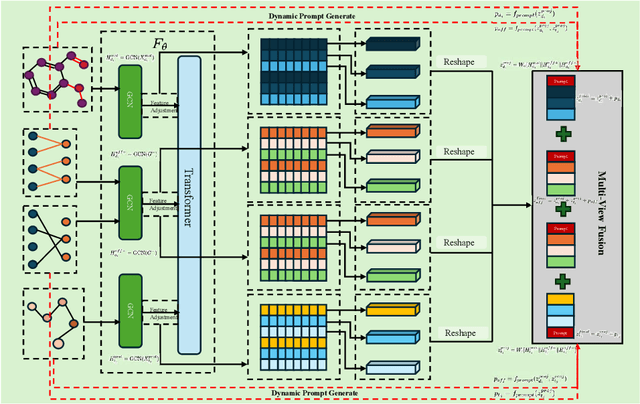
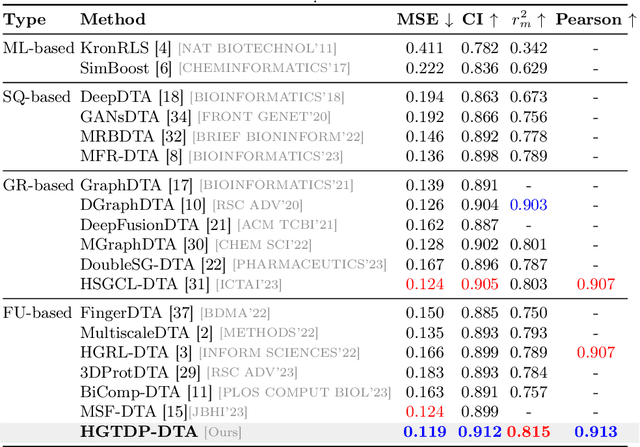
Drug target binding affinity (DTA) is a key criterion for drug screening. Existing experimental methods are time-consuming and rely on limited structural and domain information. While learning-based methods can model sequence and structural information, they struggle to integrate contextual data and often lack comprehensive modeling of drug-target interactions. In this study, we propose a novel DTA prediction method, termed HGTDP-DTA, which utilizes dynamic prompts within a hybrid Graph-Transformer framework. Our method generates context-specific prompts for each drug-target pair, enhancing the model's ability to capture unique interactions. The introduction of prompt tuning further optimizes the prediction process by filtering out irrelevant noise and emphasizing task-relevant information, dynamically adjusting the input features of the molecular graph. The proposed hybrid Graph-Transformer architecture combines structural information from Graph Convolutional Networks (GCNs) with sequence information captured by Transformers, facilitating the interaction between global and local information. Additionally, we adopted the multi-view feature fusion method to project molecular graph views and affinity subgraph views into a common feature space, effectively combining structural and contextual information. Experiments on two widely used public datasets, Davis and KIBA, show that HGTDP-DTA outperforms state-of-the-art DTA prediction methods in both prediction performance and generalization ability.
Cycle-YOLO: A Efficient and Robust Framework for Pavement Damage Detection
May 28, 2024
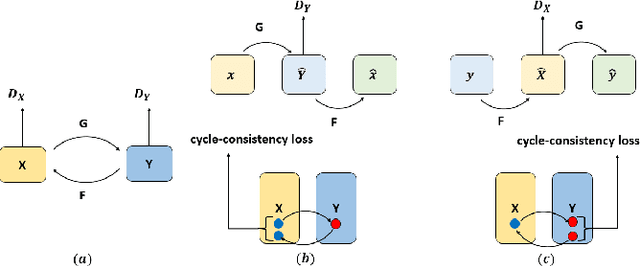
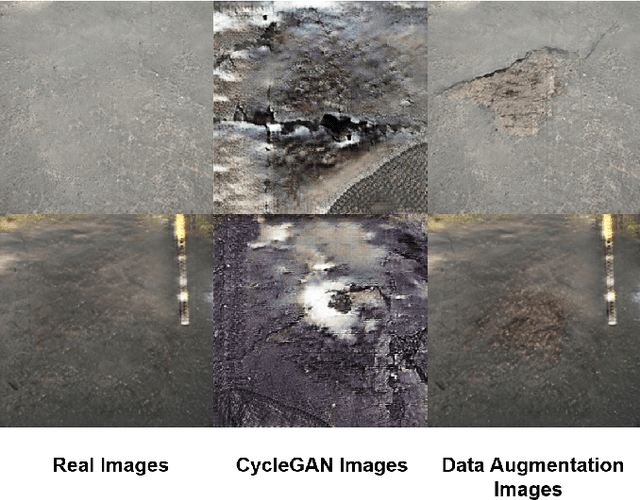

With the development of modern society, traffic volume continues to increase in most countries worldwide, leading to an increase in the rate of pavement damage Therefore, the real-time and highly accurate pavement damage detection and maintenance have become the current need. In this paper, an enhanced pavement damage detection method with CycleGAN and improved YOLOv5 algorithm is presented. We selected 7644 self-collected images of pavement damage samples as the initial dataset and augmented it by CycleGAN. Due to a substantial difference between the images generated by CycleGAN and real road images, we proposed a data enhancement method based on an improved Scharr filter, CycleGAN, and Laplacian pyramid. To improve the target recognition effect on a complex background and solve the problem that the spatial pyramid pooling-fast module in the YOLOv5 network cannot handle multiscale targets, we introduced the convolutional block attention module attention mechanism and proposed the atrous spatial pyramid pooling with squeeze-and-excitation structure. In addition, we optimized the loss function of YOLOv5 by replacing the CIoU with EIoU. The experimental results showed that our algorithm achieved a precision of 0.872, recall of 0.854, and mean average precision@0.5 of 0.882 in detecting three main types of pavement damage: cracks, potholes, and patching. On the GPU, its frames per second reached 68, meeting the requirements for real-time detection. Its overall performance even exceeded the current more advanced YOLOv7 and achieved good results in practical applications, providing a basis for decision-making in pavement damage detection and prevention.