 Add to Chrome
 Add to Firefox
 Add to Edge
AEGIS: A Mechanism-Guided Defense against Visual Synonym Jailbreaks in Text-to-Image Models
Jul 07, 2026
Text-to-image diffusion models have achieved high visual fidelity and broad adoption, but remain vulnerable to safety violations when adversaries exploit them to synthesize illicit content. Existing alignment paradigms, from input sanitization to structural feature pruning, are largely organized around unsafe concepts explicitly exposed during filtering, editing, or localization. This leaves a blind spot for visual synonym attacks (VSA), a jailbreak where benign-looking prompts elicit prohibited imagery through implicit visual associations. As a result, current defenses face a safety-utility dilemma: they may either under-mitigate VSA threats or over-suppress visually similar benign concepts. The core challenge is that VSA hides the unsafe target at the textual surface while revealing it through generation-time visual-semantic convergence. In this work, we therefore shift from static suppression of pre-specified unsafe concepts to dynamic tracing of how unsafe semantics emerge during generation. Our mechanistic analysis shows that VSA and explicit unsafe prompts converge through sparse semantic-injecting attention heads, which serve as inference-time bottlenecks for prohibited visual semantics. Based on this insight, we propose AEGIS (Adaptive Evasion Guard via Identification and Steering), an inference-time defense that applies similarity-aware repulsion only at the identified vulnerable heads. Evaluated against 16 baselines, AEGIS improves both safety and utility. On SD 1.4, it reduces ASR to $\mathbf{0.00}/\mathbf{0.03}$ for in-domain violence/nudity VSA and achieves ASRs $\le \mathbf{0.09}$ on out-of-domain explicit and adversarial attacks. It preserves benign fidelity, avoids suppressing hard-negative concepts, and transfers to SD 2.1 and FLUX.1 after re-identifying the critical heads for each backbone.

FairFlow: Demystifying and Mitigating Stereotype Bias in Text-to-Image Diffusion Transformers
Jul 03, 2026Multimodal diffusion transformers (MM-DiTs) have emerged as the prevalent backbone for modern text-to-image generation systems. However, they exhibit critical alignment vulnerabilities, systematically manifesting severe stereotype biases even under benign prompts. This poses a significant risk of algorithmic discrimination in deployed systems. Since most existing mitigation strategies were tailored for legacy U-Net architectures, the precise remediation of these vulnerabilities in MM-DiTs remains a critical open challenge. In this work, we first investigate the root cause of this vulnerability via mechanistic analysis. We reveal that bias representations in MM-DiTs are not uniformly distributed across depth, but are mediated by a sparse set of layers functioning as internal semantic binding hubs. These hubs exhibit a stage-wise propagation driving bias manifestation: early hubs establish the structural templates susceptible to bias, middle hubs actively extract core stereotypical concepts from textual conditioning, and late hubs globally solidify these biases through visual self-attention. Leveraging these architectural insights, we propose FairFlow, an intrinsic, mechanism-guided mitigation framework. FairFlow acts as an internal regulator by employing sparse steering: it learns attribute-specific fair directions and injects them exclusively at the identified semantic hubs within a constrained inference window. Evaluations on FLUX.1-dev and Stable Diffusion~3 demonstrate that FairFlow effectively neutralizes these stereotypical vulnerabilities across gender, race, and intersectional settings, achieving an optimal fairness-fidelity balance. With near-zero inference overhead and robustness to complex prompts, FairFlow provides a lightweight and practical bias mitigation for large-scale deployed MM-DiT systems. Code and datasets will be publicly released upon acceptance.
From Anchors to Supervision: Memory-Graph Guided Corpus-Free Unlearning for Large Language Models
Apr 15, 2026Large language models (LLMs) may memorize sensitive or copyrighted content, raising significant privacy and legal concerns. While machine unlearning has emerged as a potential remedy, prevailing paradigms rely on user-provided forget sets, making unlearning requests difficult to audit and exposing systems to secondary leakage and malicious abuse. We propose MAGE, a Memory-grAph Guided Erasure framework for user-minimized, corpus-free unlearning. Given only a lightweight user anchor that identifies a target entity, MAGE probes the target LLM to recover target-related memorization, organizes it into a weighted local memory graph, and synthesizes scoped supervision for unlearning. MAGE is model-agnostic, can be plugged into standard unlearning methods, and requires no access to the original training corpus. Experiments on two benchmarks, TOFU and RWKU, demonstrate that MAGE's self-generated supervision achieves effective unlearning performance comparable to supervision generated with external reference, while preserving overall utility. These results support a practical and auditable unlearning workflow driven by minimal anchors rather than user-supplied forget corpora.
ReDiPrune: Relevance-Diversity Pre-Projection Token Pruning for Efficient Multimodal LLMs
Mar 25, 2026Recent multimodal large language models are computationally expensive because Transformers must process a large number of visual tokens. We present \textbf{ReDiPrune}, a training-free token pruning method applied before the vision-language projector, where visual features remain rich and discriminative. Unlike post-projection pruning methods that operate on compressed representations, ReDiPrune selects informative tokens directly from vision encoder outputs, preserving fine-grained spatial and semantic cues. Each token is scored by a lightweight rule that jointly consider text-conditioned relevance and max-min diversity, ensuring the selected tokens are both query-relevant and non-redundant. ReDiPrune is fully plug-and-play, requiring no retraining or architectural modifications, and can be seamlessly inserted between the encoder and projector. Across four video and five image benchmarks, it consistently improves the accuracy-efficiency trade-off. For example, on EgoSchema with LLaVA-NeXT-Video-7B, retaining only 15\% of visual tokens yields a +2.0\% absolute accuracy gain while reducing computation by more than $6\times$ in TFLOPs. Code is available at https://github.com/UA-CVML/ReDiPrune.
SMART: Shot-Aware Multimodal Video Moment Retrieval with Audio-Enhanced MLLM
Nov 18, 2025Video Moment Retrieval is a task in video understanding that aims to localize a specific temporal segment in an untrimmed video based on a natural language query. Despite recent progress in moment retrieval from videos using both traditional techniques and Multimodal Large Language Models (MLLM), most existing methods still rely on coarse temporal understanding and a single visual modality, limiting performance on complex videos. To address this, we introduce \textit{S}hot-aware \textit{M}ultimodal \textit{A}udio-enhanced \textit{R}etrieval of \textit{T}emporal \textit{S}egments (SMART), an MLLM-based framework that integrates audio cues and leverages shot-level temporal structure. SMART enriches multimodal representations by combining audio and visual features while applying \textbf{Shot-aware Token Compression}, which selectively retains high-information tokens within each shot to reduce redundancy and preserve fine-grained temporal details. We also refine prompt design to better utilize audio-visual cues. Evaluations on Charades-STA and QVHighlights show that SMART achieves significant improvements over state-of-the-art methods, including a 1.61\% increase in R1@0.5 and 2.59\% gain in R1@0.7 on Charades-STA.
A New Benchmark and Model for Challenging Image Manipulation Detection
Nov 23, 2023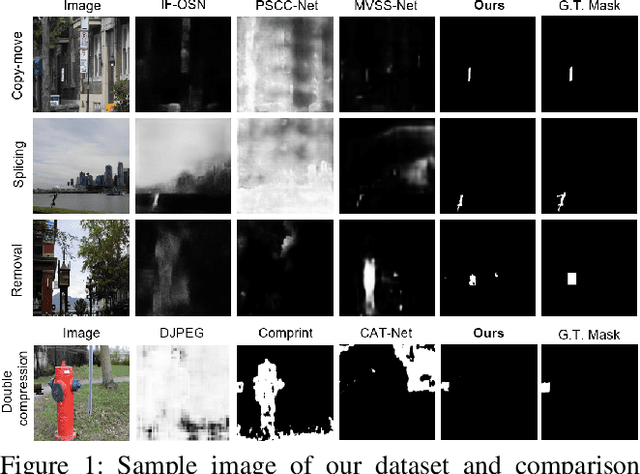
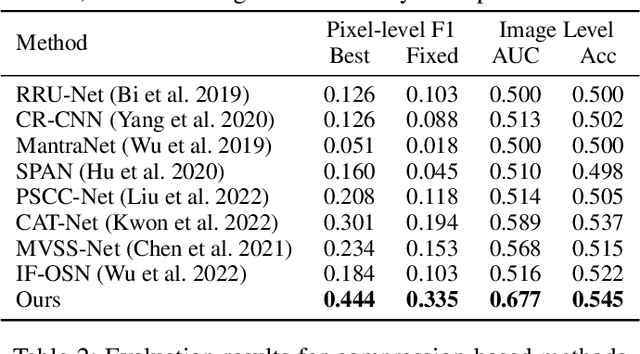
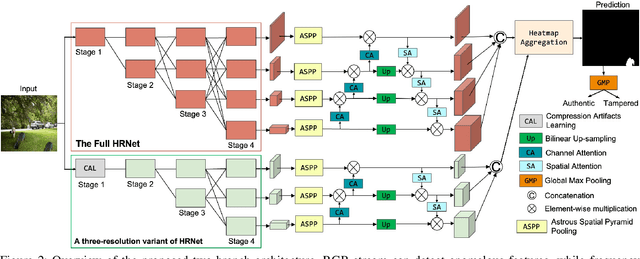
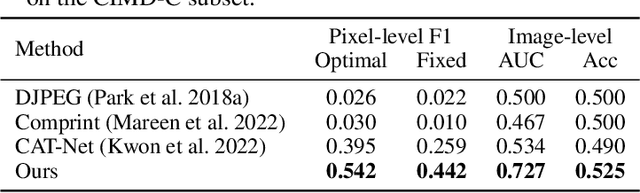
The ability to detect manipulation in multimedia data is vital in digital forensics. Existing Image Manipulation Detection (IMD) methods are mainly based on detecting anomalous features arisen from image editing or double compression artifacts. All existing IMD techniques encounter challenges when it comes to detecting small tampered regions from a large image. Moreover, compression-based IMD approaches face difficulties in cases of double compression of identical quality factors. To investigate the State-of-The-Art (SoTA) IMD methods in those challenging conditions, we introduce a new Challenging Image Manipulation Detection (CIMD) benchmark dataset, which consists of two subsets, for evaluating editing-based and compression-based IMD methods, respectively. The dataset images were manually taken and tampered with high-quality annotations. In addition, we propose a new two-branch network model based on HRNet that can better detect both the image-editing and compression artifacts in those challenging conditions. Extensive experiments on the CIMD benchmark show that our model significantly outperforms SoTA IMD methods on CIMD.
Improving Text to Image Generation using Mode-seeking Function
Sep 18, 2020
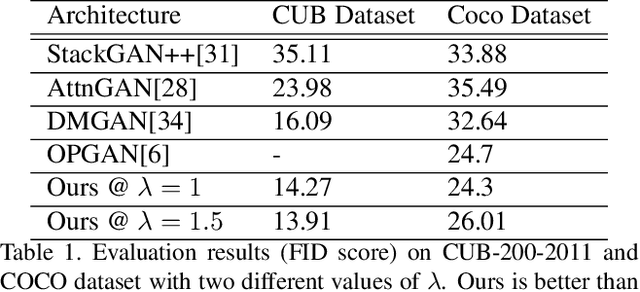
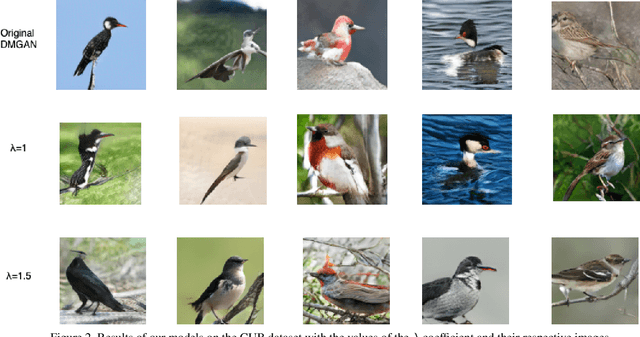
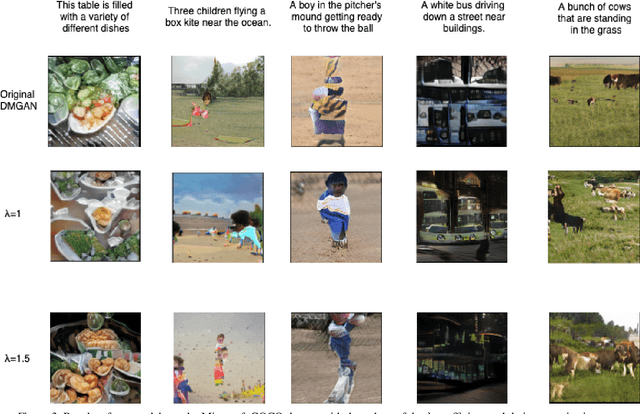
Generative Adversarial Networks (GANs) have long been used to understand the semantic relationship between the text and image. However, there are problems with mode collapsing in the image generation that causes some preferred output modes. Our aim is to improve the training of the network by using a specialized mode-seeking loss function to avoid this issue. In the text to image synthesis, our loss function differentiates two points in latent space for the generation of distinct images. We validate our model on the Caltech Birds (CUB) dataset and the Microsoft COCO dataset by changing the intensity of the loss function during the training. Experimental results demonstrate that our model works very well compared to some state-of-the-art approaches.