 Add to Chrome
 Add to Firefox
 Add to Edge
ReDiPrune: Relevance-Diversity Pre-Projection Token Pruning for Efficient Multimodal LLMs
Mar 25, 2026
Recent multimodal large language models are computationally expensive because Transformers must process a large number of visual tokens. We present \textbf{ReDiPrune}, a training-free token pruning method applied before the vision-language projector, where visual features remain rich and discriminative. Unlike post-projection pruning methods that operate on compressed representations, ReDiPrune selects informative tokens directly from vision encoder outputs, preserving fine-grained spatial and semantic cues. Each token is scored by a lightweight rule that jointly consider text-conditioned relevance and max-min diversity, ensuring the selected tokens are both query-relevant and non-redundant. ReDiPrune is fully plug-and-play, requiring no retraining or architectural modifications, and can be seamlessly inserted between the encoder and projector. Across four video and five image benchmarks, it consistently improves the accuracy-efficiency trade-off. For example, on EgoSchema with LLaVA-NeXT-Video-7B, retaining only 15\% of visual tokens yields a +2.0\% absolute accuracy gain while reducing computation by more than $6\times$ in TFLOPs. Code is available at https://github.com/UA-CVML/ReDiPrune.

SMART: Shot-Aware Multimodal Video Moment Retrieval with Audio-Enhanced MLLM
Nov 18, 2025Video Moment Retrieval is a task in video understanding that aims to localize a specific temporal segment in an untrimmed video based on a natural language query. Despite recent progress in moment retrieval from videos using both traditional techniques and Multimodal Large Language Models (MLLM), most existing methods still rely on coarse temporal understanding and a single visual modality, limiting performance on complex videos. To address this, we introduce \textit{S}hot-aware \textit{M}ultimodal \textit{A}udio-enhanced \textit{R}etrieval of \textit{T}emporal \textit{S}egments (SMART), an MLLM-based framework that integrates audio cues and leverages shot-level temporal structure. SMART enriches multimodal representations by combining audio and visual features while applying \textbf{Shot-aware Token Compression}, which selectively retains high-information tokens within each shot to reduce redundancy and preserve fine-grained temporal details. We also refine prompt design to better utilize audio-visual cues. Evaluations on Charades-STA and QVHighlights show that SMART achieves significant improvements over state-of-the-art methods, including a 1.61\% increase in R1@0.5 and 2.59\% gain in R1@0.7 on Charades-STA.
DeepEyesV2: Toward Agentic Multimodal Model
Nov 10, 2025Agentic multimodal models should not only comprehend text and images, but also actively invoke external tools, such as code execution environments and web search, and integrate these operations into reasoning. In this work, we introduce DeepEyesV2 and explore how to build an agentic multimodal model from the perspectives of data construction, training methods, and model evaluation. We observe that direct reinforcement learning alone fails to induce robust tool-use behavior. This phenomenon motivates a two-stage training pipeline: a cold-start stage to establish tool-use patterns, and reinforcement learning stage to further refine tool invocation. We curate a diverse, moderately challenging training dataset, specifically including examples where tool use is beneficial. We further introduce RealX-Bench, a comprehensive benchmark designed to evaluate real-world multimodal reasoning, which inherently requires the integration of multiple capabilities, including perception, search, and reasoning. We evaluate DeepEyesV2 on RealX-Bench and other representative benchmarks, demonstrating its effectiveness across real-world understanding, mathematical reasoning, and search-intensive tasks. Moreover, DeepEyesV2 exhibits task-adaptive tool invocation, tending to use image operations for perception tasks and numerical computations for reasoning tasks. Reinforcement learning further enables complex tool combinations and allows model to selectively invoke tools based on context. We hope our study can provide guidance for community in developing agentic multimodal models.
LLaVA-MR: Large Language-and-Vision Assistant for Video Moment Retrieval
Nov 21, 2024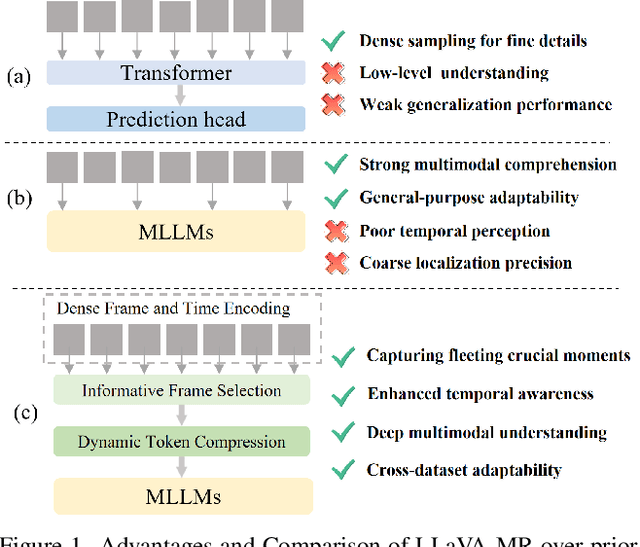
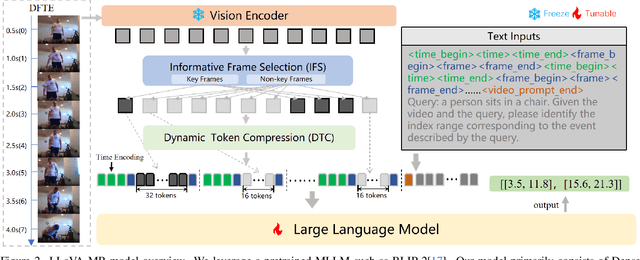
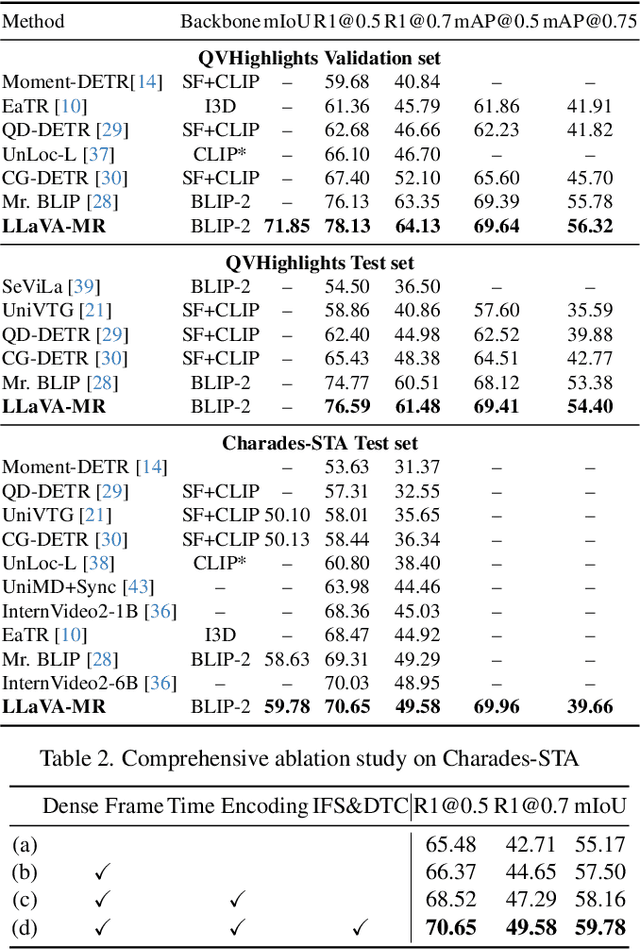
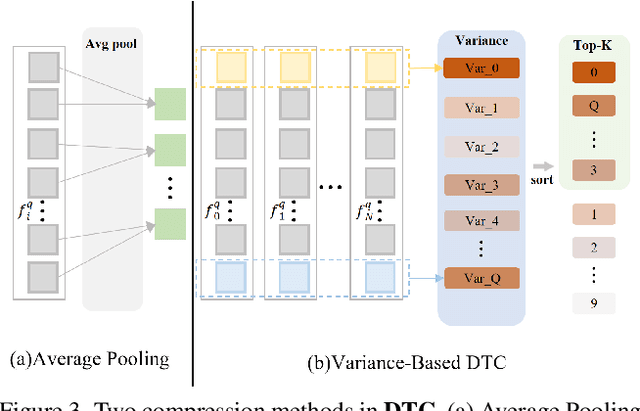
Multimodal Large Language Models (MLLMs) are widely used for visual perception, understanding, and reasoning. However, long video processing and precise moment retrieval remain challenging due to LLMs' limited context size and coarse frame extraction. We propose the Large Language-and-Vision Assistant for Moment Retrieval (LLaVA-MR), which enables accurate moment retrieval and contextual grounding in videos using MLLMs. LLaVA-MR combines Dense Frame and Time Encoding (DFTE) for spatial-temporal feature extraction, Informative Frame Selection (IFS) for capturing brief visual and motion patterns, and Dynamic Token Compression (DTC) to manage LLM context limitations. Evaluations on benchmarks like Charades-STA and QVHighlights demonstrate that LLaVA-MR outperforms 11 state-of-the-art methods, achieving an improvement of 1.82% in R1@0.5 and 1.29% in mAP@0.5 on the QVHighlights dataset. Our implementation will be open-sourced upon acceptance.
A Survey on Benchmarks of Multimodal Large Language Models
Aug 16, 2024Multimodal Large Language Models (MLLMs) are gaining increasing popularity in both academia and industry due to their remarkable performance in various applications such as visual question answering, visual perception, understanding, and reasoning. Over the past few years, significant efforts have been made to examine MLLMs from multiple perspectives. This paper presents a comprehensive review of \textbf{180 benchmarks} and evaluation for MLLMs, focusing on (1)perception and understanding, (2)cognition and reasoning, (3)specific domains, (4)key capabilities, and (5)other modalities. Finally, we discuss the limitations of the current evaluation methods for MLLMs and explore promising future directions. Our key argument is that evaluation should be regarded as a crucial discipline to better support the development of MLLMs. For more details, please visit our GitHub repository: https://github.com/swordlidev/Evaluation-Multimodal-LLMs-Survey.