 Add to Chrome
 Add to Firefox
 Add to Edge
Unified Safe In-context Image Generation in Multimodal Diffusion Transformers via Restricting Unsafe Information Flows
Jun 05, 2026
Diffusion transformers (DiTs) equipped with multimodal attention (MM-Attn) have become a dominant paradigm for image generation. However, preventing the generation of harmful content remains a critical challenge, particularly in image-to-image (I2I) editing tasks. Existing safety mechanisms are primarily designed for text-to-image (T2I) synthesis or U-Net-based architectures, which limits their effectiveness for unified safety mitigation in DiT-based frameworks. To bridge this gap, we propose Unified Visual Safety Regulator (UVR), a training-free safe generation framework that regulates unsafe semantics in generated images. UVR is grounded in an analysis of attention dynamics from the perspective of information flow in MM-Attn. We identify a task-independent start-up stage, during which unsafe semantics in output patches rapidly emerge and can be accurately localized, followed by task-specific semantic amplification and interference stages, where harmful signals are further propagated and entangled with benign content. Based on these observations, UVR mitigates unsafe generation through unified, targeted attention modulation and explicit restriction of harmful information flow over the identified unsafe output patches. Experiments across various concepts show that UVR achieves state-of-the-art safety performance by achieving 91% and 77% erase rate in image synthesis and editing tasks, while preserving visual quality and fidelity with minimal degradation. Code is available at https://github.com/deng12yx/UVR.

From Anchors to Supervision: Memory-Graph Guided Corpus-Free Unlearning for Large Language Models
Apr 15, 2026Large language models (LLMs) may memorize sensitive or copyrighted content, raising significant privacy and legal concerns. While machine unlearning has emerged as a potential remedy, prevailing paradigms rely on user-provided forget sets, making unlearning requests difficult to audit and exposing systems to secondary leakage and malicious abuse. We propose MAGE, a Memory-grAph Guided Erasure framework for user-minimized, corpus-free unlearning. Given only a lightweight user anchor that identifies a target entity, MAGE probes the target LLM to recover target-related memorization, organizes it into a weighted local memory graph, and synthesizes scoped supervision for unlearning. MAGE is model-agnostic, can be plugged into standard unlearning methods, and requires no access to the original training corpus. Experiments on two benchmarks, TOFU and RWKU, demonstrate that MAGE's self-generated supervision achieves effective unlearning performance comparable to supervision generated with external reference, while preserving overall utility. These results support a practical and auditable unlearning workflow driven by minimal anchors rather than user-supplied forget corpora.
MAGIC: Detecting Advanced Persistent Threats via Masked Graph Representation Learning
Oct 15, 2023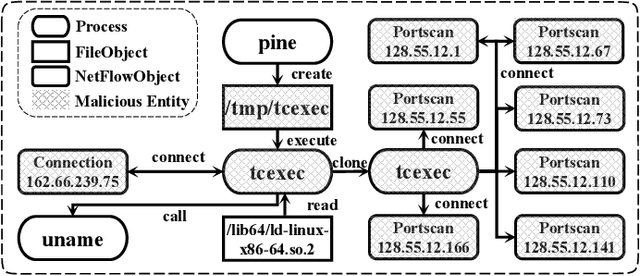
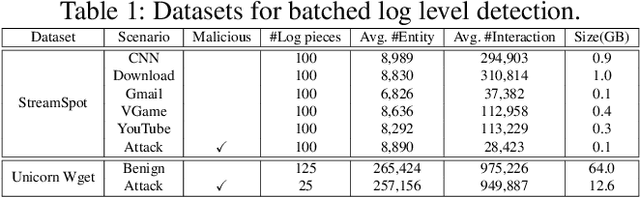
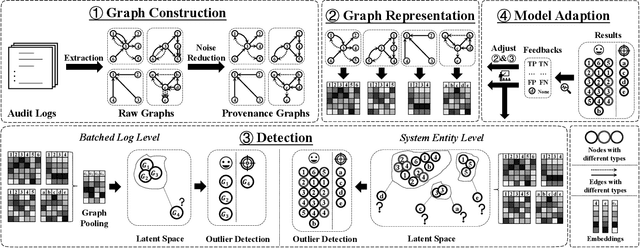
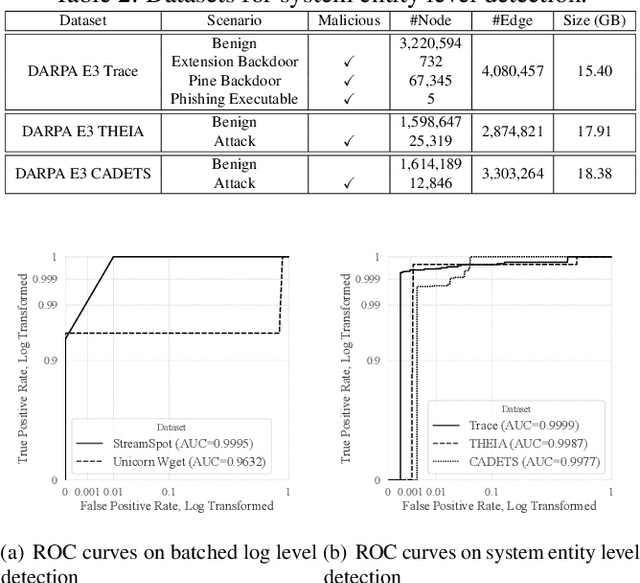
Advance Persistent Threats (APTs), adopted by most delicate attackers, are becoming increasing common and pose great threat to various enterprises and institutions. Data provenance analysis on provenance graphs has emerged as a common approach in APT detection. However, previous works have exhibited several shortcomings: (1) requiring attack-containing data and a priori knowledge of APTs, (2) failing in extracting the rich contextual information buried within provenance graphs and (3) becoming impracticable due to their prohibitive computation overhead and memory consumption. In this paper, we introduce MAGIC, a novel and flexible self-supervised APT detection approach capable of performing multi-granularity detection under different level of supervision. MAGIC leverages masked graph representation learning to model benign system entities and behaviors, performing efficient deep feature extraction and structure abstraction on provenance graphs. By ferreting out anomalous system behaviors via outlier detection methods, MAGIC is able to perform both system entity level and batched log level APT detection. MAGIC is specially designed to handle concept drift with a model adaption mechanism and successfully applies to universal conditions and detection scenarios. We evaluate MAGIC on three widely-used datasets, including both real-world and simulated attacks. Evaluation results indicate that MAGIC achieves promising detection results in all scenarios and shows enormous advantage over state-of-the-art APT detection approaches in performance overhead.