 Add to Chrome
 Add to Firefox
 Add to Edge
StartupBench: Benchmarking General-Purpose Agents on Market-Validated End-to-End Workflows
Aug 18, 2026
Recent advances in Large Language Models(LLMs) and agents have substantially improved the ability of AI systems to execute complex tasks. Yet existing benchmarks largely rely on researcher-selected tasks, leaving uncertain whether such progress extends to the work that real-world users actually demand from AI systems. We introduce \textbf{StartupBench}, an E2E agent benchmark grounded in market-validated AI startup products. Rather than defining tasks from pre-defined assumptions about useful agent capabilities, we systematically study AI products with demonstrated adoption, together with their product workflows and users, to identify real-world tasks for which AI has established practical demand across diverse professional domains. We translate these workflows into complete deliverable-oriented tasks and evaluate them with fine-grained rubrics capturing their complex requirements. Across representative models evaluated under a unified agent harness, even the strongest model successfully completes only approximately 30\% of StartupBench, despite making substantial partial progress on many tasks. Further analysis identifies aspects like complex instruction following and domain-specific expertise as major sources of failure. Our results reveal that many market-validated workflows remain beyond the reliable capabilities of current general-purpose agents, establishing StartupBench as an empirical measure of progress toward E2E completions of real-world user tasks.

WPFed: Web-based Personalized Federation for Decentralized Systems
Oct 15, 2024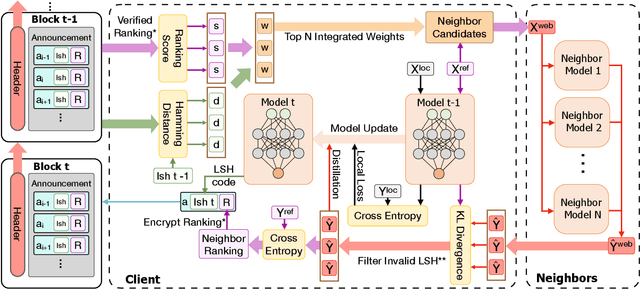

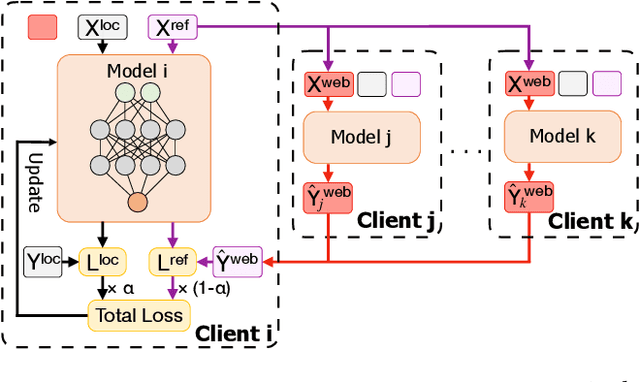

Decentralized learning has become crucial for collaborative model training in environments where data privacy and trust are paramount. In web-based applications, clients are liberated from traditional fixed network topologies, enabling the establishment of arbitrary peer-to-peer (P2P) connections. While this flexibility is highly promising, it introduces a fundamental challenge: the optimal selection of neighbors to ensure effective collaboration. To address this, we introduce WPFed, a fully decentralized, web-based learning framework designed to enable globally optimal neighbor selection. WPFed employs a dynamic communication graph and a weighted neighbor selection mechanism. By assessing inter-client similarity through Locality-Sensitive Hashing (LSH) and evaluating model quality based on peer rankings, WPFed enables clients to identify personalized optimal neighbors on a global scale while preserving data privacy. To enhance security and deter malicious behavior, WPFed integrates verification mechanisms for both LSH codes and performance rankings, leveraging blockchain-driven announcements to ensure transparency and verifiability. Through extensive experiments on multiple real-world datasets, we demonstrate that WPFed significantly improves learning outcomes and system robustness compared to traditional federated learning methods. Our findings highlight WPFed's potential to facilitate effective and secure decentralized collaborative learning across diverse and interconnected web environments.