 Add to Chrome
 Add to Firefox
 Add to Edge
Range-Aided LiDAR-Inertial Multi-Vehicle Mapping in Degenerate Environment
Mar 15, 2023
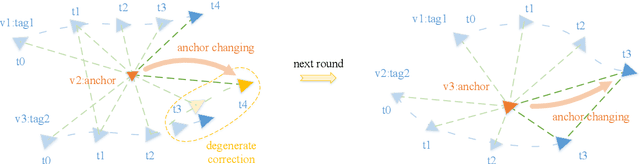
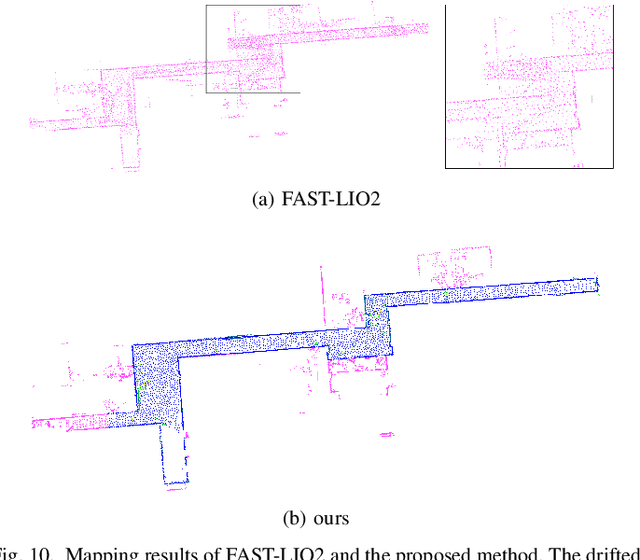
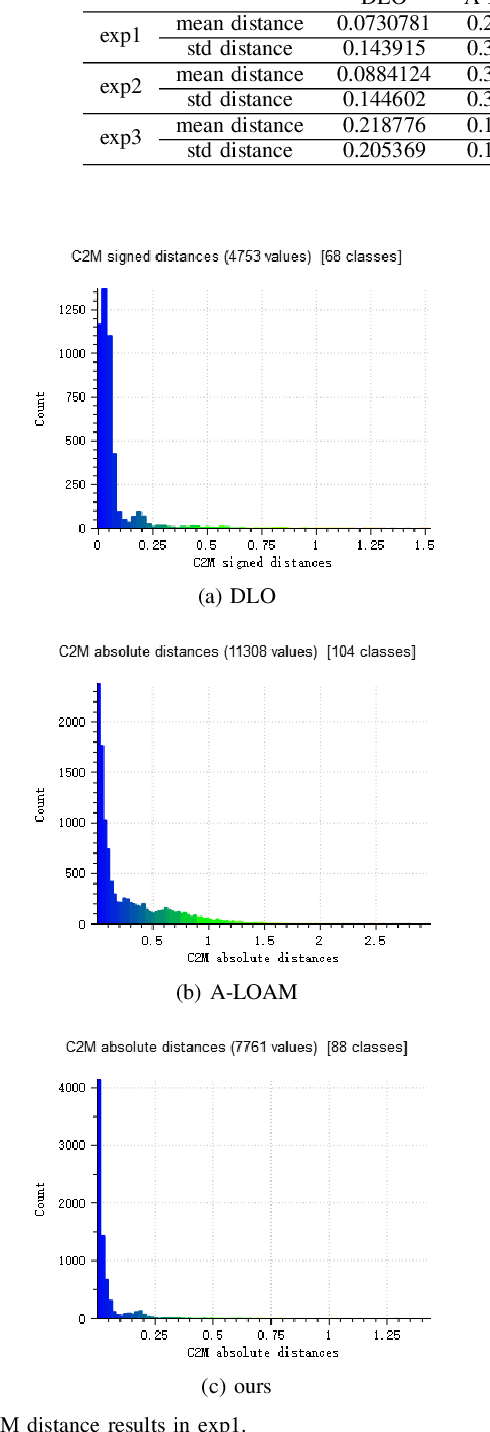

This paper presents a range-aided LiDAR-inertial multi-vehicle mapping system (RaLI-Multi). Firstly, we design a multi-metric weights LiDAR-inertial odometry by fusing observations from an inertial measurement unit (IMU) and a light detection and ranging sensor (LiDAR). The degenerate level and direction are evaluated by analyzing the distribution of normal vectors of feature point clouds and are used to activate the degeneration correction module in which range measurements correct the pose estimation from the degeneration direction. We then design a multi-vehicle mapping system in which a centralized vehicle receives local maps of each vehicle and range measurements between vehicles to optimize a global pose graph. The global map is broadcast to other vehicles for localization and mapping updates, and the centralized vehicle is dynamically fungible. Finally, we provide three experiments to verify the effectiveness of the proposed RaLI-Multi. The results show its superiority in degeneration environments

Reconstruct Face from Features Using GAN Generator as a Distribution Constraint
Jun 09, 2022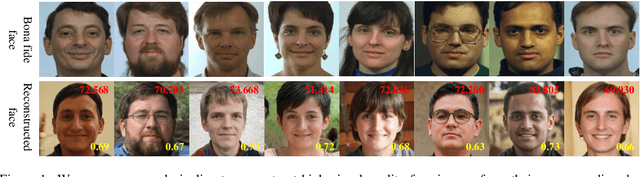
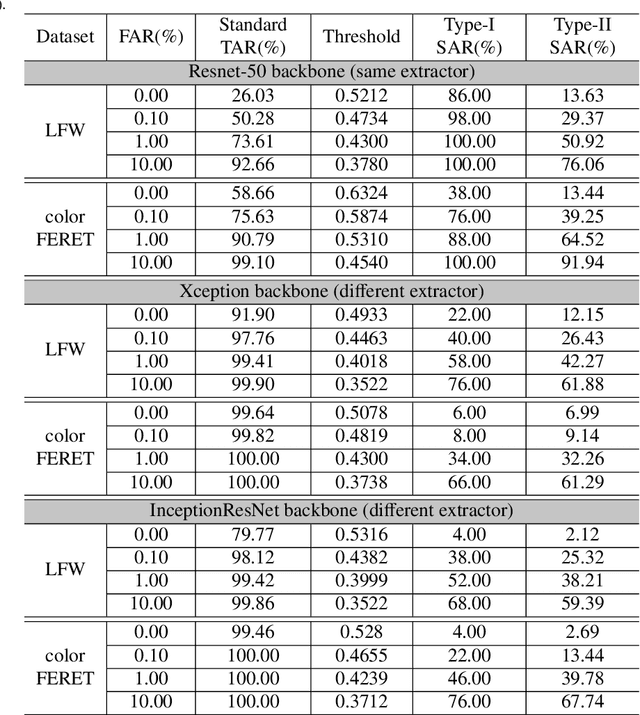
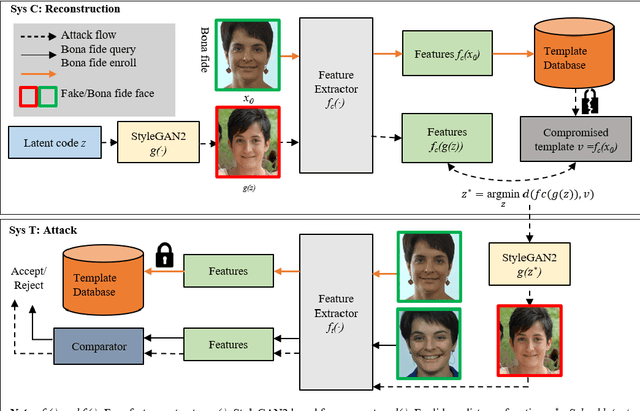
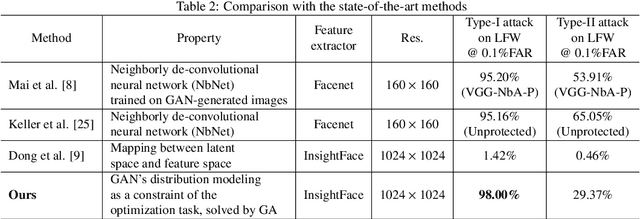
Face recognition based on the deep convolutional neural networks (CNN) shows superior accuracy performance attributed to the high discriminative features extracted. Yet, the security and privacy of the extracted features from deep learning models (deep features) have been often overlooked. This paper proposes the reconstruction of face images from deep features without accessing the CNN network configurations as a constrained optimization problem. Such optimization minimizes the distance between the features extracted from the original face image and the reconstructed face image. Instead of directly solving the optimization problem in the image space, we innovatively reformulate the problem by looking for a latent vector of a GAN generator, then use it to generate the face image. The GAN generator serves as a dual role in this novel framework, i.e., face distribution constraint of the optimization goal and a face generator. On top of the novel optimization task, we also propose an attack pipeline to impersonate the target user based on the generated face image. Our results show that the generated face images can achieve a state-of-the-art successful attack rate of 98.0\% on LFW under type-I attack @ FAR of 0.1\%. Our work sheds light on the biometric deployment to meet the privacy-preserving and security policies.
Abandoning the Bayer-Filter to See in the Dark
Mar 22, 2022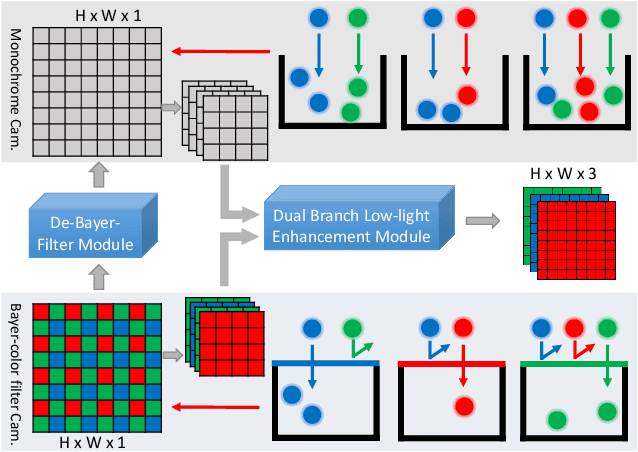
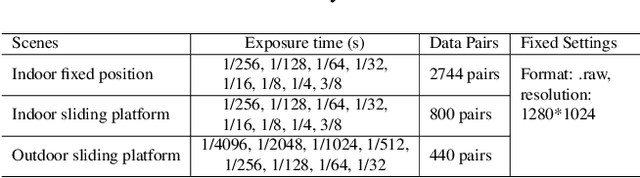
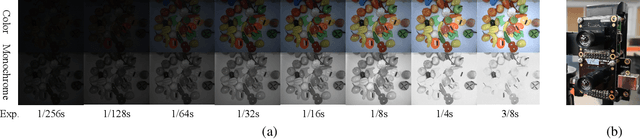
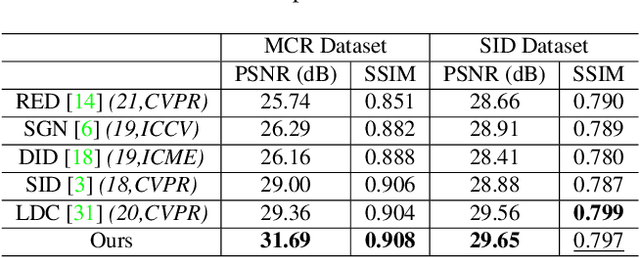
Low-light image enhancement - a pervasive but challenging problem, plays a central role in enhancing the visibility of an image captured in a poor illumination environment. Due to the fact that not all photons can pass the Bayer-Filter on the sensor of the color camera, in this work, we first present a De-Bayer-Filter simulator based on deep neural networks to generate a monochrome raw image from the colored raw image. Next, a fully convolutional network is proposed to achieve the low-light image enhancement by fusing colored raw data with synthesized monochrome raw data. Channel-wise attention is also introduced to the fusion process to establish a complementary interaction between features from colored and monochrome raw images. To train the convolutional networks, we propose a dataset with monochrome and color raw pairs named Mono-Colored Raw paired dataset (MCR) collected by using a monochrome camera without Bayer-Filter and a color camera with Bayer-Filter. The proposed pipeline take advantages of the fusion of the virtual monochrome and the color raw images and our extensive experiments indicate that significant improvement can be achieved by leveraging raw sensor data and data-driven learning.
A Generalized Approach for Cancellable Template and Its Realization for Minutia Cylinder-Code
Mar 02, 2022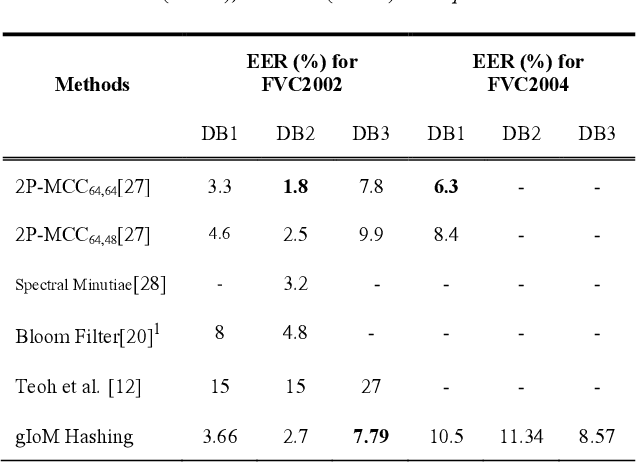
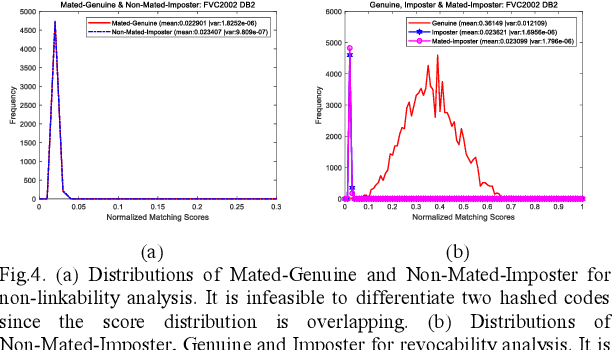
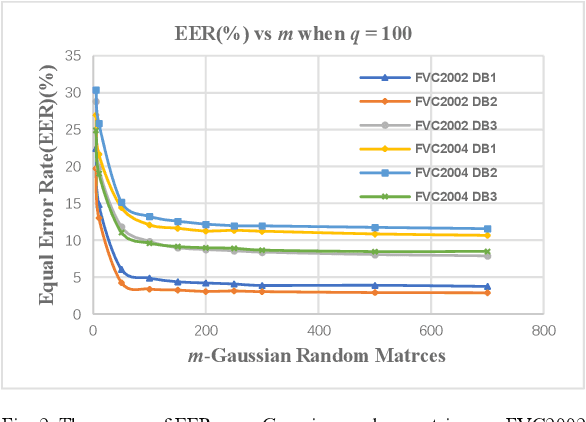
Hashing technology gains much attention in protecting the biometric template lately. For instance, Index-of-Max (IoM), a recent reported hashing technique, is a ranking-based locality sensitive hashing technique, which illustrates the feasibility to protect the ordered and fixed-length biometric template. However, biometric templates are not always in the form of ordered and fixed-length, rather it may be an unordered and variable size point set e.g. fingerprint minutiae, which restricts the usage of the traditional hashing technology. In this paper, we proposed a generalized version of IoM hashing namely gIoM, and therefore the unordered and variable size biometric template can be used. We demonstrate a realization using a well-known variable size feature vector, fingerprint Minutia Cylinder-Code (MCC). The gIoM transforms MCC into index domain to form indexing-based feature representation. Consequently, the inversion of MCC from the transformed representation is computational infeasible, thus to achieve non-invertibility while the performance is preserved. Public fingerprint databases FVC2002 and FVC2004 are employed for experiment as benchmark to demonstrate a fair comparison with other methods. Moreover, the security and privacy analysis suggest that gIoM meets the criteria of template protection: non-invertibility, revocability, and non-linkability.
Similarity-based Gray-box Adversarial Attack Against Deep Face Recognition
Jan 12, 2022


The majority of adversarial attack techniques perform well against deep face recognition when the full knowledge of the system is revealed (\emph{white-box}). However, such techniques act unsuccessfully in the gray-box setting where the face templates are unknown to the attackers. In this work, we propose a similarity-based gray-box adversarial attack (SGADV) technique with a newly developed objective function. SGADV utilizes the dissimilarity score to produce the optimized adversarial example, i.e., similarity-based adversarial attack. This technique applies to both white-box and gray-box attacks against authentication systems that determine genuine or imposter users using the dissimilarity score. To validate the effectiveness of SGADV, we conduct extensive experiments on face datasets of LFW, CelebA, and CelebA-HQ against deep face recognition models of FaceNet and InsightFace in both white-box and gray-box settings. The results suggest that the proposed method significantly outperforms the existing adversarial attack techniques in the gray-box setting. We hence summarize that the similarity-base approaches to develop the adversarial example could satisfactorily cater to the gray-box attack scenarios for de-authentication.
Multi-spectral Facial Landmark Detection
Jun 09, 2020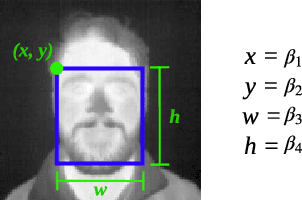
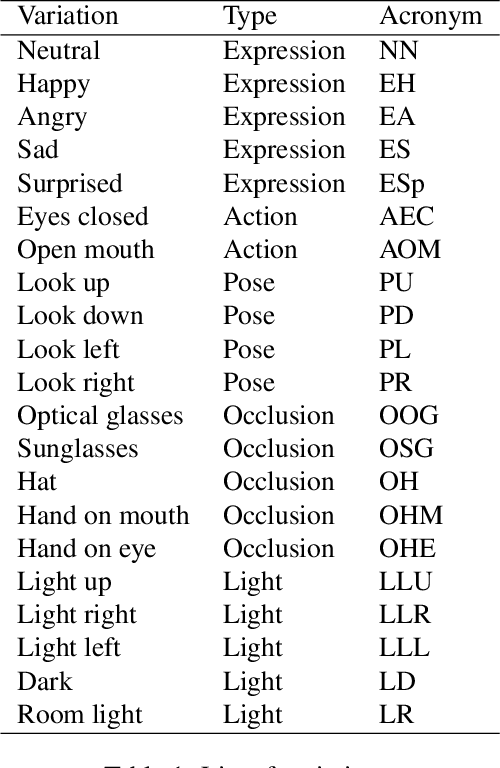
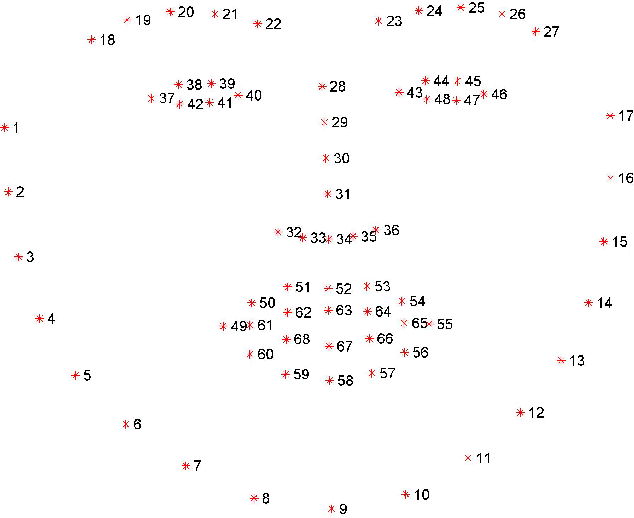
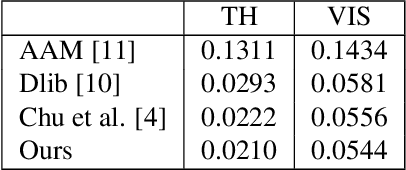
Thermal face image analysis is favorable for certain circumstances. For example, illumination-sensitive applications, like nighttime surveillance; and privacy-preserving demanded access control. However, the inadequate study on thermal face image analysis calls for attention in responding to the industry requirements. Detecting facial landmark points are important for many face analysis tasks, such as face recognition, 3D face reconstruction, and face expression recognition. In this paper, we propose a robust neural network enabled facial landmark detection, namely Deep Multi-Spectral Learning (DMSL). Briefly, DMSL consists of two sub-models, i.e. face boundary detection, and landmark coordinates detection. Such an architecture demonstrates the capability of detecting the facial landmarks on both visible and thermal images. Particularly, the proposed DMSL model is robust in facial landmark detection where the face is partially occluded, or facing different directions. The experiment conducted on Eurecom's visible and thermal paired database shows the superior performance of DMSL over the state-of-the-art for thermal facial landmark detection. In addition to that, we have annotated a thermal face dataset with their respective facial landmark for the purpose of experimentation.
On the Reliability of Cancelable Biometrics: Revisit the Irreversibility
Oct 22, 2019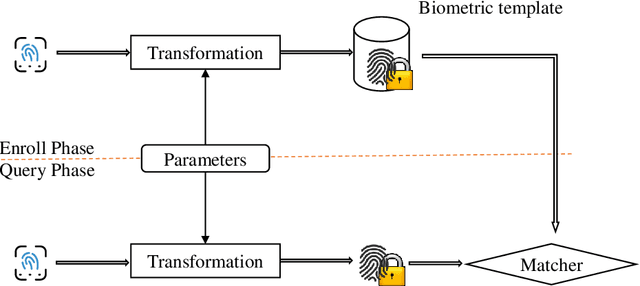
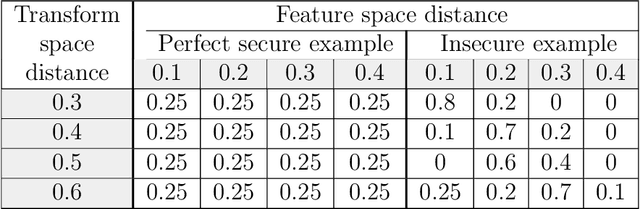
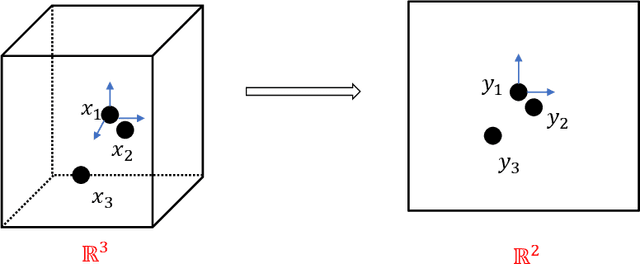
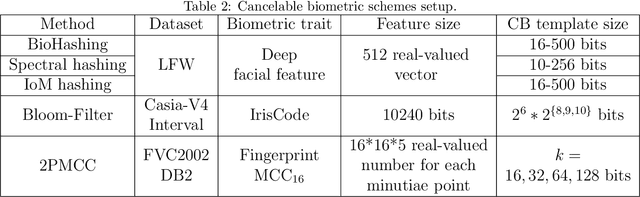
Over the years, many biometric template protection schemes, primarily based on the notion of "cancelable biometrics" have been proposed. A cancelable biometric algorithm needs to satisfy four biometric template protection criteria, i.e., irreversibility, revocability, unlinkability, and performance preservation. However, a systematic analysis of irreversibility has been often neglected. In this paper, the common distance correlation characteristic of cancelable biometrics is analyzed. Next, a similarity-based attack is formulated to break the irreversibility of cancelable biometric under the Kerckhoffs's assumption where the cancelable biometrics algorithm and parameter are known to the attackers. The irreversibility based on the mutual information is also redefined, and a framework to measure the information leakage from the distance correlation characteristic is proposed. The results achieved on face, iris, and fingerprint prove that it is theoretically hard to meet full irreversibility. To have a good biometric system, a balance has to be achieved between accuracy and security.
A Genetic Algorithm Enabled Similarity-Based Attack on Cancellable Biometrics
May 08, 2019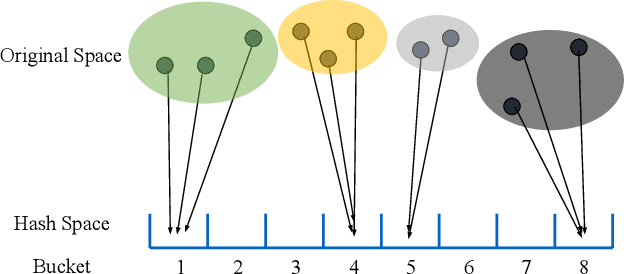
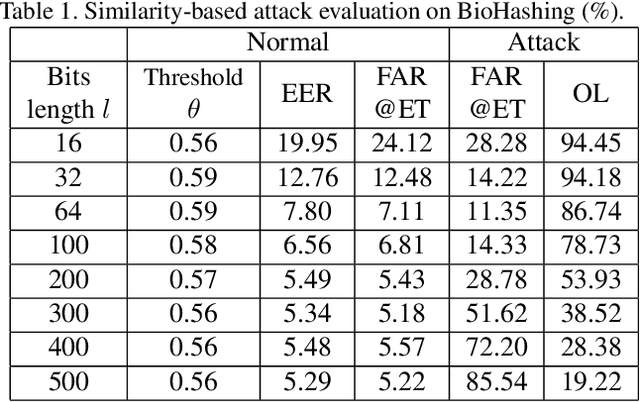
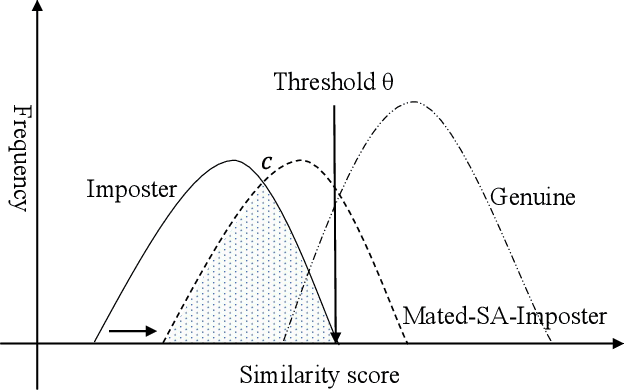
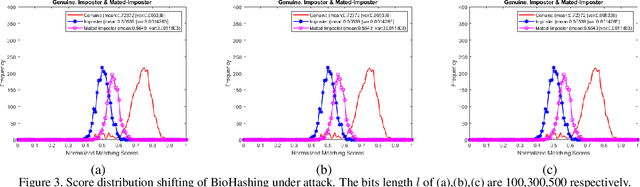
Cancellable biometrics (CB) as a means for biometric template protection approach refers to an irreversible yet similarity preserving transformation on the original template. With similarity preserving property, the matching between template and query instance can be performed in the transform domain without jeopardizing accuracy performance. Unfortunately, this trait invites a class of attack, namely similarity-based attack (SA). SA produces a preimage, an inverse of transformed template, which can be exploited for impersonation and cross-matching. In this paper, we propose a Genetic Algorithm enabled similarity-based attack framework (GASAF) to demonstrate that CB schemes whose possess similarity preserving property are highly vulnerable to similarity-based attack. Besides that, a set of new metrics is designed to measure the effectiveness of the similarity-based attack. We conduct the experiment on two representative CB schemes, i.e. BioHashing and Bloom-filter. The experimental results attest the vulnerability under this type of attack.
A Symmetric Keyring Encryption Scheme for Biometric Cryptosystems
Sep 28, 2018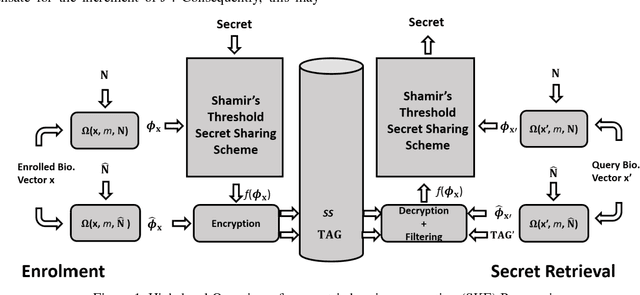
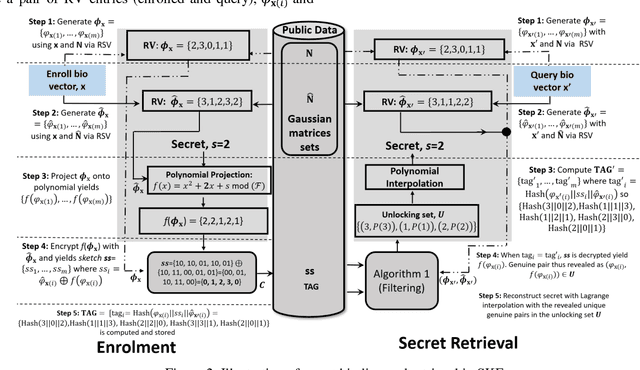
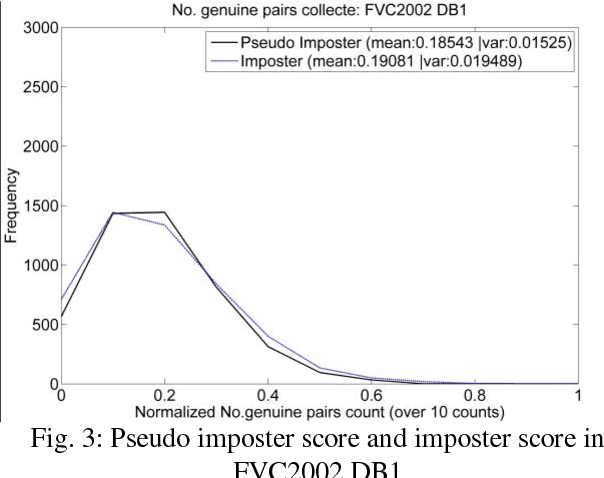
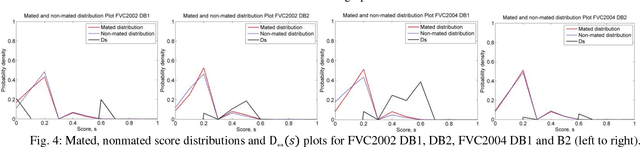
In this paper, we propose a novel biometric cryptosystem for vectorial biometrics named symmetric keyring encryption (SKE) inspired by Rivest's keyring model (2016). Unlike conventional biometric secret-binding primitives, such as fuzzy commitment and fuzzy vault, the proposed scheme reframes the biometric secret-binding problem as a fuzzy symmetric encryption problem with a notion called resilient vector pair. In this study, the pair resembles the encryption-decryption key pair in symmetric key cryptosystems. This notion is realized using the index of maximum hashed vectors - a special instance of the ranking-based locality-sensitive hashing function. With a simple filtering mechanism and [m,k] Shamir's secret-sharing scheme, we show that SKE, both in theoretical and empirical evaluation, can retrieve the exact secret with overwhelming probability for a genuine input yet negligible probability for an imposter input. Though SKE can be applied to any vectorial biometrics, we adopt the fingerprint vector as a case of study in this work. The experiments have been performed under several subsets of FVC 2002, 2004, and 2006 datasets. We formalize and analyze the threat model of SKE that encloses several major security attacks.
Ranking Based Locality Sensitive Hashing Enabled Cancelable Biometrics: Index-of-Max Hashing
Sep 17, 2017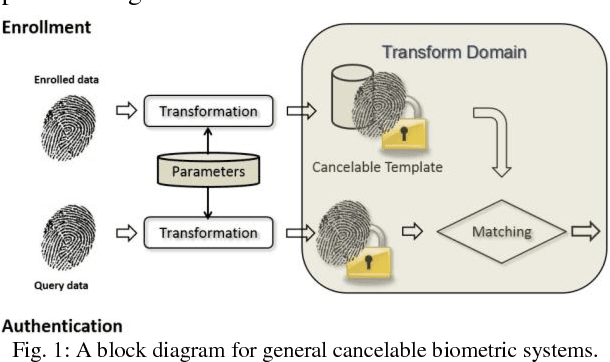
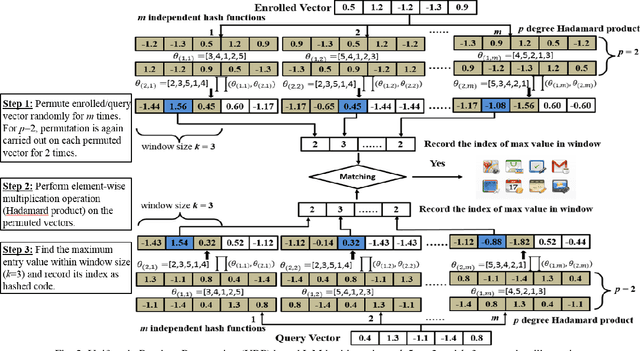
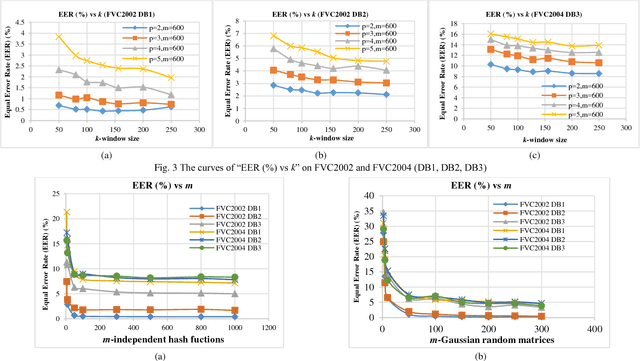
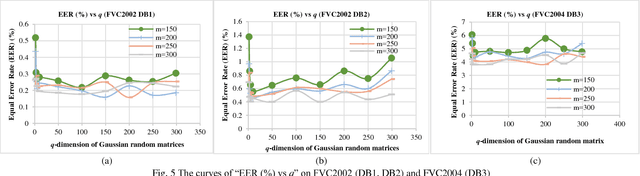
In this paper, we propose a ranking based locality sensitive hashing inspired two-factor cancelable biometrics, dubbed "Index-of-Max" (IoM) hashing for biometric template protection. With externally generated random parameters, IoM hashing transforms a real-valued biometric feature vector into discrete index (max ranked) hashed code. We demonstrate two realizations from IoM hashing notion, namely Gaussian Random Projection based and Uniformly Random Permutation based hashing schemes. The discrete indices representation nature of IoM hashed codes enjoy serveral merits. Firstly, IoM hashing empowers strong concealment to the biometric information. This contributes to the solid ground of non-invertibility guarantee. Secondly, IoM hashing is insensitive to the features magnitude, hence is more robust against biometric features variation. Thirdly, the magnitude-independence trait of IoM hashing makes the hash codes being scale-invariant, which is critical for matching and feature alignment. The experimental results demonstrate favorable accuracy performance on benchmark FVC2002 and FVC2004 fingerprint databases. The analyses justify its resilience to the existing and newly introduced security and privacy attacks as well as satisfy the revocability and unlinkability criteria of cancelable biometrics.