 Add to Chrome
 Add to Firefox
 Add to Edge
Sparse View Distractor-Free Gaussian Splatting
Mar 02, 2026
3D Gaussian Splatting (3DGS) enables efficient training and fast novel view synthesis in static environments. To address challenges posed by transient objects, distractor-free 3DGS methods have emerged and shown promising results when dense image captures are available. However, their performance degrades significantly under sparse input conditions. This limitation primarily stems from the reliance on the color residual heuristics to guide the training, which becomes unreliable with limited observations. In this work, we propose a framework to enhance distractor-free 3DGS under sparse-view conditions by incorporating rich prior information. Specifically, we first adopt the geometry foundation model VGGT to estimate camera parameters and generate a dense set of initial 3D points. Then, we harness the attention maps from VGGT for efficient and accurate semantic entity matching. Additionally, we utilize Vision-Language Models (VLMs) to further identify and preserve the large static regions in the scene. We also demonstrate how these priors can be seamlessly integrated into existing distractor-free 3DGS methods. Extensive experiments confirm the effectiveness and robustness of our approach in mitigating transient distractors for sparse-view 3DGS training.

PDF-HR: Pose Distance Fields for Humanoid Robots
Feb 04, 2026Pose and motion priors play a crucial role in humanoid robotics. Although such priors have been widely studied in human motion recovery (HMR) domain with a range of models, their adoption for humanoid robots remains limited, largely due to the scarcity of high-quality humanoid motion data. In this work, we introduce Pose Distance Fields for Humanoid Robots (PDF-HR), a lightweight prior that represents the robot pose distribution as a continuous and differentiable manifold. Given an arbitrary pose, PDF-HR predicts its distance to a large corpus of retargeted robot poses, yielding a smooth measure of pose plausibility that is well suited for optimization and control. PDF-HR can be integrated as a reward shaping term, a regularizer, or a standalone plausibility scorer across diverse pipelines. We evaluate PDF-HR on various humanoid tasks, including single-trajectory motion tracking, general motion tracking, style-based motion mimicry, and general motion retargeting. Experiments show that this plug-and-play prior consistently and substantially strengthens strong baselines. Code and models will be released.
Diffusion Model-based Reinforcement Learning for Version Age of Information Scheduling: Average and Tail-Risk-Sensitive Control
Jan 26, 2026Ensuring timely and semantically accurate information delivery is critical in real-time wireless systems. While Age of Information (AoI) quantifies temporal freshness, Version Age of Information (VAoI) captures semantic staleness by accounting for version evolution between transmitters and receivers. Existing VAoI scheduling approaches primarily focus on minimizing average VAoI, overlooking rare but severe staleness events that can compromise reliability under stochastic packet arrivals and unreliable channels. This paper investigates both average-oriented and tail-risk-sensitive VAoI scheduling in a multi-user status update system with long-term transmission cost constraints. We first formulate the average VAoI minimization problem as a constrained Markov decision process and introduce a deep diffusion-based Soft Actor-Critic (D2SAC) algorithm. By generating actions through a diffusion-based denoising process, D2SAC enhances policy expressiveness and establishes a strong baseline for mean performance. Building on this foundation, we put forth RS-D3SAC, a risk-sensitive deep distributional diffusion-based Soft Actor-Critic algorithm. RS-D3SAC integrates a diffusion-based actor with a quantile-based distributional critic, explicitly modeling the full VAoI return distribution. This enables principled tail-risk optimization via Conditional Value-at-Risk (CVaR) while satisfying long-term transmission cost constraints. Extensive simulations show that, while D2SAC reduces average VAoI, RS-D3SAC consistently achieves substantial reductions in CVaR without sacrificing mean performance. The dominant gain in tail-risk reduction stems from the distributional critic, with the diffusion-based actor providing complementary refinement to stabilize and enrich policy decisions, highlighting their effectiveness for robust and risk-aware VAoI scheduling in multi-user wireless systems.
Sharpening Your Density Fields: Spiking Neuron Aided Fast Geometry Learning
Dec 13, 2024


Neural Radiance Fields (NeRF) have achieved remarkable progress in neural rendering. Extracting geometry from NeRF typically relies on the Marching Cubes algorithm, which uses a hand-crafted threshold to define the level set. However, this threshold-based approach requires laborious and scenario-specific tuning, limiting its practicality for real-world applications. In this work, we seek to enhance the efficiency of this method during the training time. To this end, we introduce a spiking neuron mechanism that dynamically adjusts the threshold, eliminating the need for manual selection. Despite its promise, directly training with the spiking neuron often results in model collapse and noisy outputs. To overcome these challenges, we propose a round-robin strategy that stabilizes the training process and enables the geometry network to achieve a sharper and more precise density distribution with minimal computational overhead. We validate our approach through extensive experiments on both synthetic and real-world datasets. The results show that our method significantly improves the performance of threshold-based techniques, offering a more robust and efficient solution for NeRF geometry extraction.
Robust SG-NeRF: Robust Scene Graph Aided Neural Surface Reconstruction
Nov 20, 2024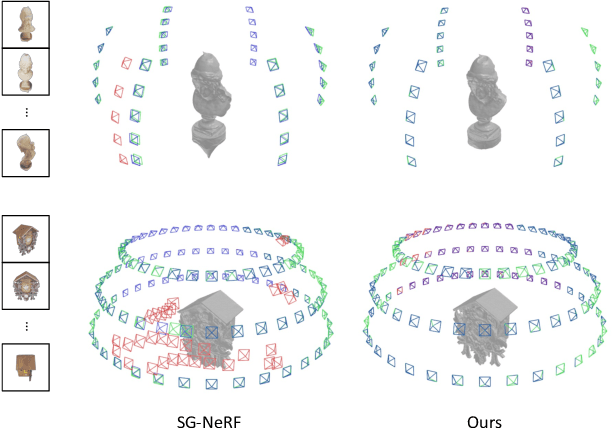
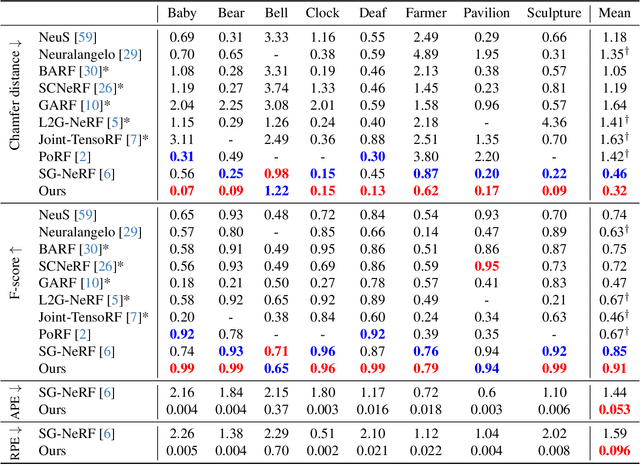
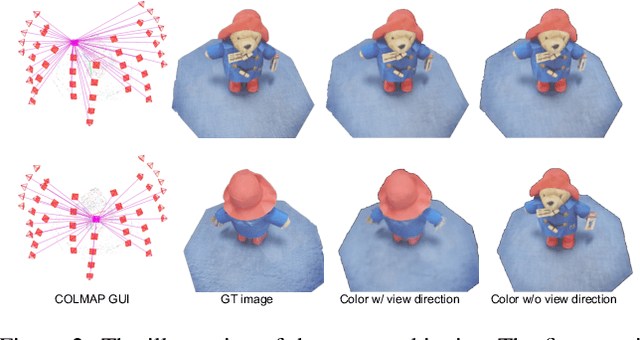
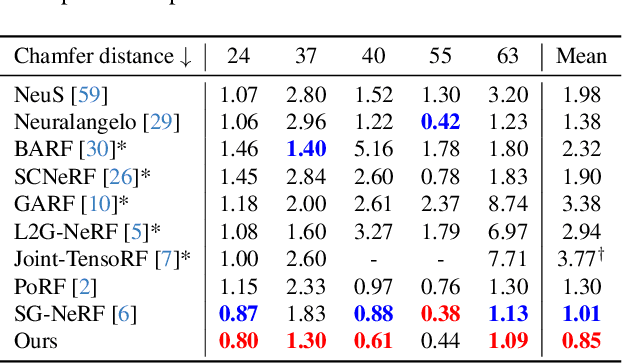
Neural surface reconstruction relies heavily on accurate camera poses as input. Despite utilizing advanced pose estimators like COLMAP or ARKit, camera poses can still be noisy. Existing pose-NeRF joint optimization methods handle poses with small noise (inliers) effectively but struggle with large noise (outliers), such as mirrored poses. In this work, we focus on mitigating the impact of outlier poses. Our method integrates an inlier-outlier confidence estimation scheme, leveraging scene graph information gathered during the data preparation phase. Unlike previous works directly using rendering metrics as the reference, we employ a detached color network that omits the viewing direction as input to minimize the impact caused by shape-radiance ambiguities. This enhanced confidence updating strategy effectively differentiates between inlier and outlier poses, allowing us to sample more rays from inlier poses to construct more reliable radiance fields. Additionally, we introduce a re-projection loss based on the current Signed Distance Function (SDF) and pose estimations, strengthening the constraints between matching image pairs. For outlier poses, we adopt a Monte Carlo re-localization method to find better solutions. We also devise a scene graph updating strategy to provide more accurate information throughout the training process. We validate our approach on the SG-NeRF and DTU datasets. Experimental results on various datasets demonstrate that our methods can consistently improve the reconstruction qualities and pose accuracies.
User Centric Semantic Communications
Nov 05, 2024Current studies on semantic communications mainly focus on efficiently extracting semantic information to reduce bandwidth usage between a transmitter and a user. Although significant process has been made in the semantic communications, a fundamental design problem is that the semantic information is extracted based on certain criteria at the transmitter side along, without considering the user's actual requirements. As a result, critical information that is of primary concern to the user may be lost. In such cases, the semantic transmission becomes meaningless to the user, as all received information is irrelevant to the user's interests. To solve this problem, this paper presents a user centric semantic communication system, where the user sends its request for the desired semantic information to the transmitter at the start of each transmission. Then, the transmitter extracts the required semantic information accordingly. A key challenge is how the transmitter can understand the user's requests for semantic information and extract the required semantic information in a reasonable and robust manner. We solve this challenge by designing a well-structured framework and leveraging off-the-shelf products, such as GPT-4, along with several specialized tools for detection and estimation. Evaluation results demonstrate the feasibility and effectiveness of the proposed user centric semantic communication system.
Finding Defective Elements in Intelligent Reflecting Surface via Over-the-Air Measurements
Aug 01, 2024Due to circuit failures, defective elements that cannot adaptively adjust the phase shifts of their impinging signals in a desired manner may exist on an intelligent reflecting surface (IRS). Traditional way to find these defective IRS elements requires a thorough diagnosis of all the circuits belonging to a huge number of IRS elements, which is practically challenging. In this paper, we will devise a novel approach under which a transmitter sends known pilot signals and a receiver localizes all the defective IRS elements just based on its over-the-air measurements reflected from the IRS. The key lies in the fact that the over-the-air measurements at the receiver side are functions of the set of defective IRS elements. Based on this observation, we propose a bisection based method to localize all the defective IRS elements. Specifically, at each time slot, we properly control the desired phase shifts of all the IRS elements such that half of the considered regime that is not useful to localize the defective elements can be found based on the received signals and removed. Via numerical results, it is shown that our proposed bisection method can exploit the over-the-air measurements to localize all the defective IRS elements quickly and accurately.
When Spiking neural networks meet temporal attention image decoding and adaptive spiking neuron
Jun 05, 2024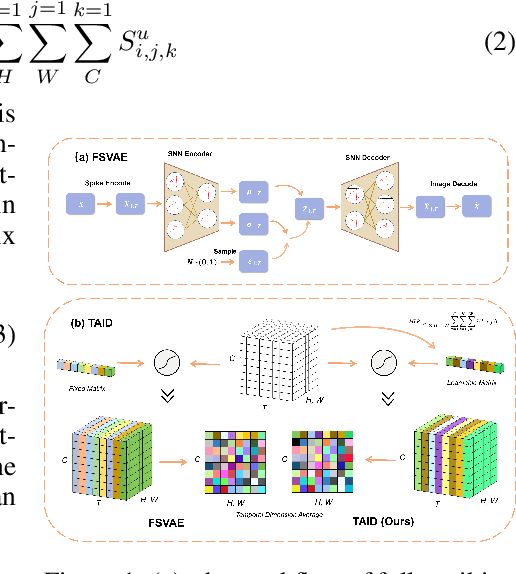
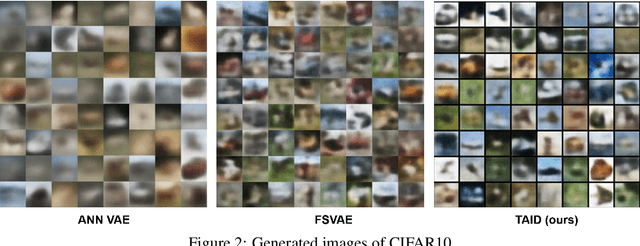

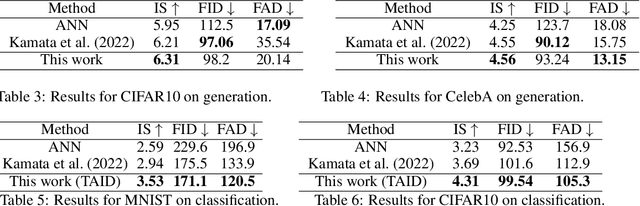
Spiking Neural Networks (SNNs) are capable of encoding and processing temporal information in a biologically plausible way. However, most existing SNN-based methods for image tasks do not fully exploit this feature. Moreover, they often overlook the role of adaptive threshold in spiking neurons, which can enhance their dynamic behavior and learning ability. To address these issues, we propose a novel method for image decoding based on temporal attention (TAID) and an adaptive Leaky-Integrate-and-Fire (ALIF) neuron model. Our method leverages the temporal information of SNN outputs to generate high-quality images that surpass the state-of-the-art (SOTA) in terms of Inception score, Fr\'echet Inception Distance, and Fr\'echet Autoencoder Distance. Furthermore, our ALIF neuron model achieves remarkable classification accuracy on MNIST (99.78\%) and CIFAR-10 (93.89\%) datasets, demonstrating the effectiveness of learning adaptive thresholds for spiking neurons. The code is available at https://github.com/bollossom/ICLR_TINY_SNN.
Rethinking Grant-Free Protocol in mMTC
Apr 24, 2024This paper revisits the identity detection problem under the current grant-free protocol in massive machine-type communications (mMTC) by asking the following question: for stable identity detection performance, is it enough to permit active devices to transmit preambles without any handshaking with the base station (BS)? Specifically, in the current grant-free protocol, the BS blindly allocates a fixed length of preamble to devices for identity detection as it lacks the prior information on the number of active devices $K$. However, in practice, $K$ varies dynamically over time, resulting in degraded identity detection performance especially when $K$ is large. Consequently, the current grant-free protocol fails to ensure stable identity detection performance. To address this issue, we propose a two-stage communication protocol which consists of estimation of $K$ in Phase I and detection of identities of active devices in Phase II. The preamble length for identity detection in Phase II is dynamically allocated based on the estimated $K$ in Phase I through a table lookup manner such that the identity detection performance could always be better than a predefined threshold. In addition, we design an algorithm for estimating $K$ in Phase I, and exploit the estimated $K$ to reduce the computational complexity of the identity detector in Phase II. Numerical results demonstrate the effectiveness of the proposed two-stage communication protocol and algorithms.
Combating Multi-path Interference to Improve Chirp-based Underwater Acoustic Communication
Nov 29, 2023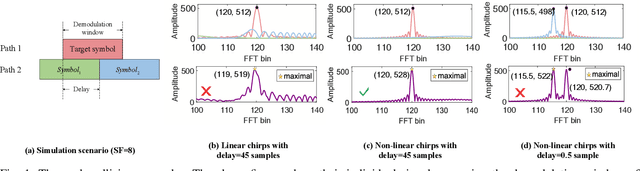
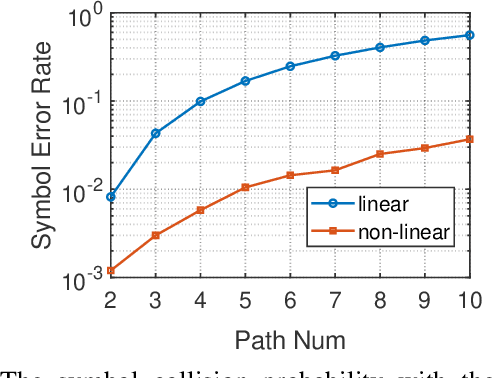
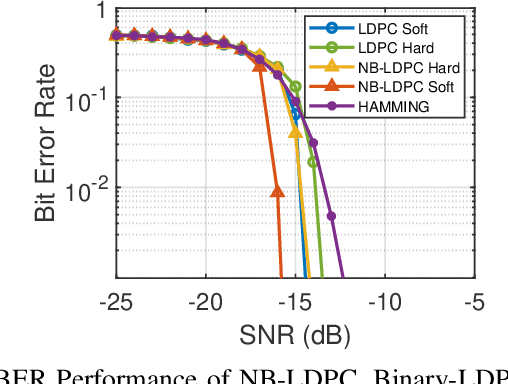
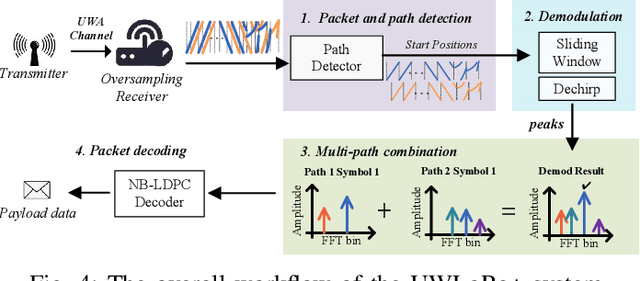
Linear chirp-based underwater acoustic communication has been widely used due to its reliability and long-range transmission capability. However, unlike the counterpart chirp technology in wireless -- LoRa, its throughput is severely limited by the number of modulated chirps in a symbol. The fundamental challenge lies in the underwater multi-path channel, where the delayed copied of one symbol may cause inter-symbol and intra-symbol interfere. In this paper, we present UWLoRa+, a system that realizes the same chirp modulation as LoRa with higher data rate, and enhances LoRa's design to address the multi-path challenge via the following designs: a) we replace the linear chirp used by LoRa with the non-linear chirp to reduce the signal interference range and the collision probability; b) we design an algorithm that first demodulates each path and then combines the demodulation results of detected paths; and c) we replace the Hamming codes used by LoRa with the non-binary LDPC codes to mitigate the impact of the inevitable collision.Experiment results show that the new designs improve the bit error rate (BER) by 3x, and the packet error rate (PER) significantly, compared with the LoRa's naive design. Compared with an state-of-the-art system for decoding underwater LoRa chirp signal, UWLoRa+ improves the throughput by up to 50 times.