 Add to Chrome
 Add to Firefox
 Add to Edge
Scale Up Strategically: Learning Compositional Generalization via Bias-Aware Evaluation and Data Collection for Robotic Manipulation
Jul 23, 2026
Compositional generalization is essential for robot to follow diverse instructions. However, pretrained policies are known to take shortcuts, deferring to salient cues rather than grounding language. We introduce a diagnostic framework that localizes this failure to individual \textit{instruction factors}, \textit{e.g.,} reusable semantic components such as color, verb, object, size, and spatial attribute. Our framework formalizes instruction factor bias, the tendency of fine-tuned policies to over-rely on dominant factors as shortcuts, and quantifies it through two metrics: Factor Dominance Rate (FDR), capturing pairwise bias between factors, and Factor Dominance Hierarchy (FDH), aggregating these into a global ranking. Evaluation on six foundation policies reveals broadly consistent ordering, \textit{i.e.}, color $\geq$ object $\geq$ spatial $\geq$ verb $\geq$ size, with color dominant, and verb and size most under-grounded. We further show the diagnosis is actionable: a bias-aware data collection strategy that reallocates a fixed budget toward under-grounded factors outperforms baselines in simulation and on a real robot using half the demonstrations, thereby enabling more sample-efficient and generalizable policy learning.

Pix2Act: Image-Space Manipulation Policies with Equivariant Augmentation
Jul 13, 2026Representing manipulation actions as 2D trajectories in the camera plane provides a compact and interpretable basis for learning complex 3D manipulation policies. However, it also creates challenges from out-of-frame trajectories and limited precision. We propose Pix2Act, an imitation learning method that addresses these challenges by generating continuous image-space keypoint trajectories in each camera plane and losslessly recovering end-effector poses via triangulation. This reformulates high-dimensional 3D control as a simpler, more learnable 2D prediction problem. Crucially, it aligns observations and actions in the same coordinate space, enabling equivariant transformations to jointly rotate individual camera images together with their image-space actions. We analyze the symmetry properties of this augmentation and design a network architecture that can fuse multiple camera views while respecting their per-view rotations. As a result, Pix2Act implicitly enlarges the support of the data distribution and learns invariant action structures across transformations, yielding improved generalization and overall performance. Across diverse simulated and real-world manipulation tasks, Pix2Act outperforms state-of-the-art baselines and remains robust under camera perturbations.
Action Map Policy: Learning 3D Closed-loop Manipulation via Pixel Classification
Jul 12, 2026The action space poses a major challenge in robot learning, since it is often high-dimensional, can span long time horizons, and frequently admits multi-modal optimal solutions. A good choice of action representation and loss function can help to address these concerns, but there are often trade offs. We propose Action Map Policy (AMP), which casts 3D closed-loop manipulation policy learning as a classification problem in image space. While classification has been an effective formulation in generative language models, applying it to robot action learning is difficult because naively discretizing high-dimensional continuous actions explodes the token vocabulary. Our key idea is to project 3D actions onto the camera image planes and treat each pixel location as a discrete class, thus controlling dimensionality while retaining multi-modality. This method supports millimeter-level precision for high-dimensional actions without requiring a prohibitively large vocabulary, while preserving fine-grained pixel-wise visual signals. Furthermore, it can predict the entire action chunk in a single forward pass, avoiding complex noise scheduling and iterative denoising while achieving substantially faster inference than diffusion policies. Experiments on various manipulation tasks show that AMP outperforms strong baselines, achieving higher success rates, faster inference, and enhanced spatial reasoning.
Residual Rotation Correction using Tactile Equivariance
Nov 11, 2025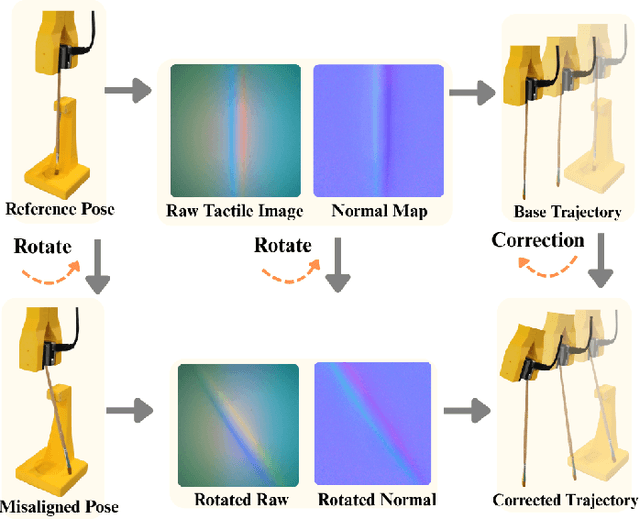
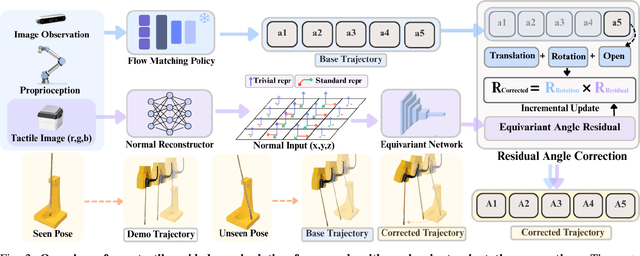
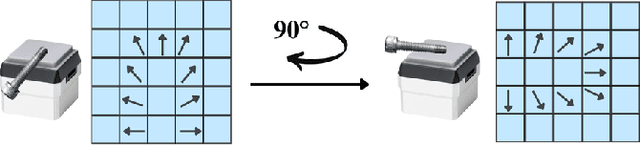
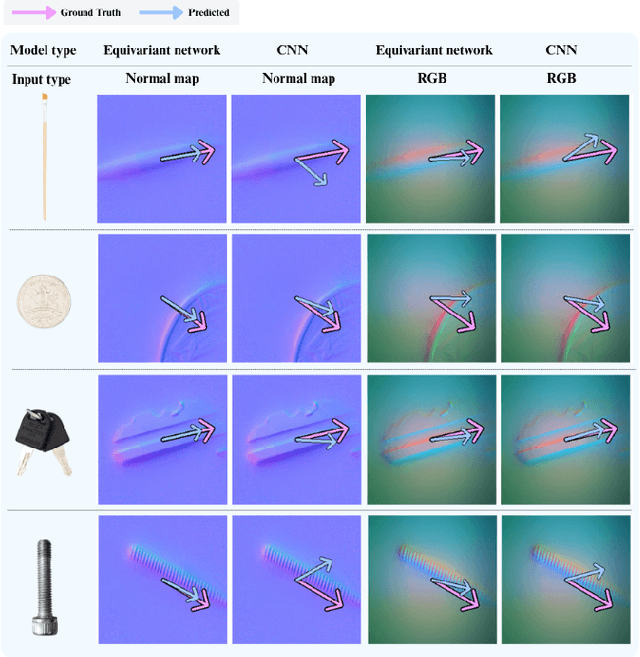
Visuotactile policy learning augments vision-only policies with tactile input, facilitating contact-rich manipulation. However, the high cost of tactile data collection makes sample efficiency the key requirement for developing visuotactile policies. We present EquiTac, a framework that exploits the inherent SO(2) symmetry of in-hand object rotation to improve sample efficiency and generalization for visuotactile policy learning. EquiTac first reconstructs surface normals from raw RGB inputs of vision-based tactile sensors, so rotations of the normal vector field correspond to in-hand object rotations. An SO(2)-equivariant network then predicts a residual rotation action that augments a base visuomotor policy at test time, enabling real-time rotation correction without additional reorientation demonstrations. On a real robot, EquiTac accurately achieves robust zero-shot generalization to unseen in-hand orientations with very few training samples, where baselines fail even with more training data. To our knowledge, this is the first tactile learning method to explicitly encode tactile equivariance for policy learning, yielding a lightweight, symmetry-aware module that improves reliability in contact-rich tasks.