 Add to Chrome
 Add to Firefox
 Add to Edge
Temporal Evidence Routing with Structured Visual Evidence for TimeLogicQA
May 31, 2026
TimeLogicQA evaluates whether video question answering systems can reason over temporal relations such as event existence, ordering, persistence, boundary conditions, and overlap. We address this task with a visual evidence routing pipeline that separates perception from symbolic temporal reasoning. The system first parses each question into event targets, answer mode, candidate options, and temporal operators. It then routes videos according to duration and operator difficulty, using ordered full-frame evidence for short clips and event-focused candidate windows for long videos. A multimodal large language model produces structured visual evidence for the relevant events, while programmatic verifiers recover dense action intervals and a deterministic reducer applies operator-specific temporal rules to produce the final answer. Conservative fusion accepts an answer only when the visual evidence, temporal program, and confidence checks agree, reducing noisy answer flips. On the official test evaluation, our final system achieves an AvgAcc of 81.8.

Adaptive Dense Evidence Refinement for Video Relational Reasoning for VRR-QA Challenge
May 31, 2026VRR-QA evaluates whether video-language systems can infer spatial, temporal, viewpoint, depth, and visibility relations that are not always resolved by a single frame. We present an inference-only system built around adaptive test-time computation. The system first answers each question with a direct video-language model pass, then uses multiple lightweight views to find unstable questions. Only these difficult questions are routed to a high-budget dense evidence module that constructs timestamped frame observations, relation-specific probes, candidate verification, and conservative temporal aggregation. This design separates two problems that are often confused in video question answering: finding plausible alternative answers and deciding when a current answer should actually be changed. On the test split, the final system obtains 90.07 average accuracy and 87.81 macro average accuracy. The report focuses on the final test system and the implementation settings required to reproduce the adaptive dense verifier.
Dual-Route Top-K Retrieval with 1v1 VLM Reranking for the CoVR-R
May 31, 2026We describe \emph{Dual-Route Top-K Retrieval with 1v1 VLM Reranking} for the CoVR-R challenge. The method treats composed video retrieval as two coupled problems: finding a sufficiently complete top-k candidate set, and then safely deciding whether any candidate should replace a strong current top-1. We first improve the reasoning/text seed with a VLM slot selector over existing candidates, without introducing DFN visual retrieval. We then add a visual route from contact-sheet embeddings using DFN-H/DFN-L. The routes are merged into a top-10 candidate set, after which a VLM final reranker performs conservative 1v1 comparisons between the current top-1 and each challenger. On the hidden test split, the final system reaches 95.28 R@1, 97.47 R@5, 98.48 R@10, and 99.66 R@50. The main lesson is that CoVR-R benefits more from recall-selection decoupling than from broad text reranking or direct multi-candidate VLM classification.
CHASM: Cross-frequency Harmonized Axis-Separable Mixing for Spectral Token Operators
May 14, 2026Spectral token mixers based on Fourier transforms provide an efficient way to model global interactions in visual feature maps. Existing designs often either apply filter-wise spectral responses along fixed channel axes, or learn adaptive frequency-indexed channel mixing without explicitly aligning the channel directions used across frequencies. We propose CHASM, a Cross-frequency Harmonized Axis-Separable Mixer, as a structured middle ground. CHASM separates what should be shared from what should remain frequency-specific: all frequencies share a learned channel eigenbasis, while each frequency retains its own positive spectral gains. The shared basis makes channel directions comparable across the spectrum, whereas the positive gains preserve local spectral adaptivity. CHASM applies this structured operator separably along the height and width axes and is used as a drop-in replacement mixer inside existing backbones. We provide a structural characterization of the shared-basis operator family and evaluate CHASM through controlled same-backbone comparisons. Across accelerated MRI reconstruction, undersampled MRI segmentation, and natural-image reconstruction, CHASM consistently improves over same-backbone spectral-mixer baselines. Ablations show that removing the shared-basis constraint weakens performance, and randomizing coherent sampling geometry substantially reduces the gain, supporting cross-frequency harmonization as a useful inductive bias for spectral token operators.
Hi-ResNet: A High-Resolution Remote Sensing Network for Semantic Segmentation
May 23, 2023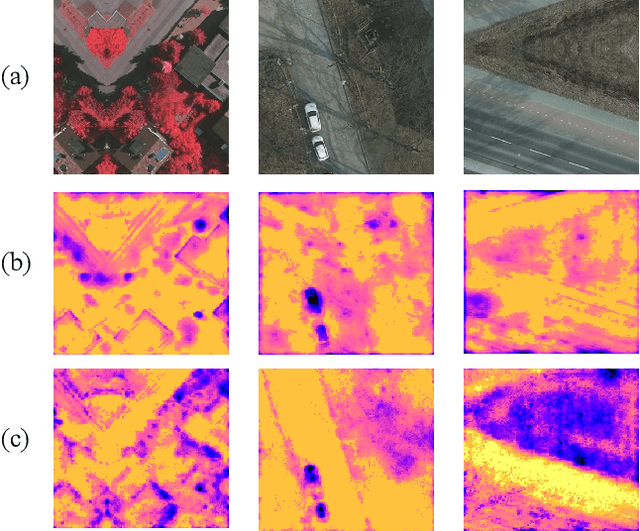
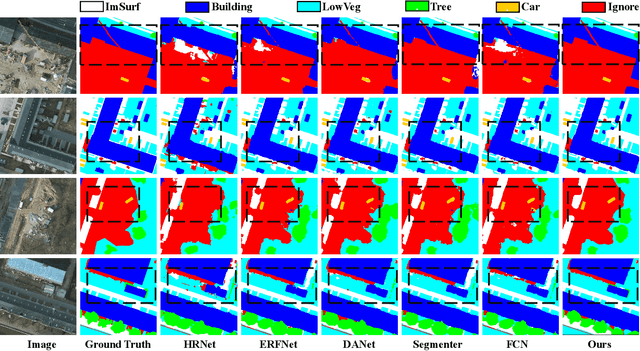
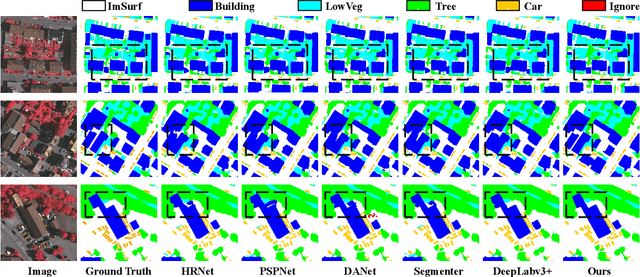
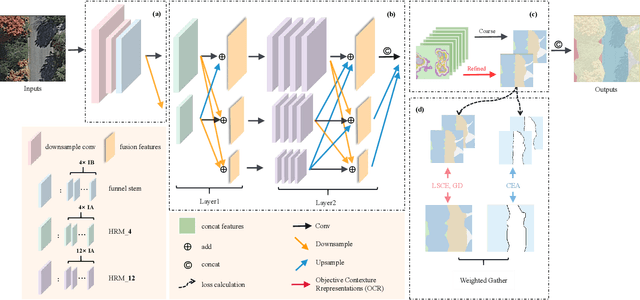
High-resolution remote sensing (HRS) semantic segmentation extracts key objects from high-resolution coverage areas. However, objects of the same category within HRS images generally show significant differences in scale and shape across diverse geographical environments, making it difficult to fit the data distribution. Additionally, a complex background environment causes similar appearances of objects of different categories, which precipitates a substantial number of objects into misclassification as background. These issues make existing learning algorithms sub-optimal. In this work, we solve the above-mentioned problems by proposing a High-resolution remote sensing network (Hi-ResNet) with efficient network structure designs, which consists of a funnel module, a multi-branch module with stacks of information aggregation (IA) blocks, and a feature refinement module, sequentially, and Class-agnostic Edge Aware (CEA) loss. Specifically, we propose a funnel module to downsample, which reduces the computational cost, and extract high-resolution semantic information from the initial input image. Secondly, we downsample the processed feature images into multi-resolution branches incrementally to capture image features at different scales and apply IA blocks, which capture key latent information by leveraging attention mechanisms, for effective feature aggregation, distinguishing image features of the same class with variant scales and shapes. Finally, our feature refinement module integrate the CEA loss function, which disambiguates inter-class objects with similar shapes and increases the data distribution distance for correct predictions. With effective pre-training strategies, we demonstrated the superiority of Hi-ResNet over state-of-the-art methods on three HRS segmentation benchmarks.