 Add to Chrome
 Add to Firefox
 Add to Edge
Robot Trajectron V3: A Probabilistic Shared Control Framework for SE(3) Manipulation
Jul 10, 2026
We aim to address the challenge of teleoperating robotic arms for high-degree-of-freedom (high-DoF) manipulation tasks, which is cognitively demanding and error-prone, particularly when relying on low-bandwidth interfaces. We propose Robot Trajectron V3 (RT-V3), a probabilistic shared control framework designed for $SE(3)$ grasping tasks. RT-V3 formulates shared control as Bayesian inference by learning a prior over user intent and combining it with real-time user commands to estimate the posterior intent distribution. The prior models user intent as a distribution over future trajectories conditioned on past robot dynamics and visual scene context. The intent prior is parameterized by a transformer-based conditional generative model that reasons over point clouds and candidate grasp poses, together with a factorized translation-rotation representation that improves learning efficiency in high-dimensional action spaces. During execution, RT-V3 continuously estimates the posterior distribution over future trajectories by combining the learned intent prior with a user-command likelihood derived from the observed control input, enabling continuous intent refinement and shared assistance. Comprehensive experiments demonstrate that RT-V3 achieves high accuracy in trajectory prediction and competitive performance in reactive planning. Furthermore, real-world user studies indicate that RT-V3 significantly outperforms baseline methods in terms of success rate and efficiency, while substantially reducing the user's physical and mental workload.

Assistron: Bayesian Shared Autonomy with Off-the-shelf Vision-Language-Action Models
Jun 22, 2026We propose Assistron, a shared autonomy model that leverages Vision-Language-Action (VLA) models to assist the user in daily activities. Our approach is grounded in two core principles: (1)~minimizing human cognitive and physical effort by leveraging VLA-driven autonomy for macro-movements, and (2)~prioritizing human intervention specifically at critical failure points. Driven by the user's verbal language commands, Assistron utilizes the VLA to autonomously execute macro-reaching trajectories, saving users' effort. In contact-rich interactions where VLAs tend to fail, Assistron employs a phase-aware interaction detection mechanism and solicits the user to intervene, in turn adjusting the VLA's action generation via flow matching guidance. Critically, our formulation eliminates the need for VLA fine-tuning, protecting its broad behavioral priors from catastrophic forgetting and ensuring the model does not become a narrow specialist. We validate our approach on a comprehensive multi-task scene recovery benchmark encompassing diverse daily manipulation skills. Empirical results demonstrate that Assistron significantly improves task success rates over pure autonomous baselines while significantly reducing human cognitive and physical workload compared to traditional teleoperation, offering a scalable, smooth, and effortless paradigm for assistive manipulation. The code is available in https://github.com/mousecpn/Assistron.git.
FF-JEPA: Long-Horizon Planning in World Models with Latent Planners
Jun 08, 2026Joint Embedding Predictive Architectures (JEPAs) have shown promising world modeling capabilities, enabling planning in latent space by optimizing action trajectories using methods like the Cross-Entropy Method (CEM). These methods are, however, too computationally expensive and ineffective for long-horizon planning. Furthermore, these methods typically require an explicit image of the goal state, which is not always possible in real-world tasks. In this work, we tackle these limitations by proposing Forward-Forward-JEPA (FF-JEPA), a hierarchical approach leveraging two forward dynamics models. Alongside a standard action-conditioned forward model, we introduce an action-free latent planner that predicts the next subgoal given the current state. This approach removes the need for goal images and enables long-horizon planning by decomposing complex trajectories into a sequence of tractable, short-term optimization problems. Preliminary results on PushT demonstrate that FF-JEPA successfully overcomes flat world models' long-horizon collapse, highlighting this approach as a promising direction for goal-free planning.
NeRF-based Spacecraft Reconstruction from Monocular Imagery Under Illumination Variability and Pose Uncertainty
May 20, 2026Autonomous rendezvous and proximity operations around uncooperative, unknown spacecraft are critical for active debris removal and on-orbit servicing missions. A key component of such operations is the offline reconstruction of a 3D model of the target from a set of 2D images. This task is challenging due to two main factors. First, in-orbit illumination conditions exhibit considerable variability, and change rapidly over time. Second, the inaccuracy of pose information in the images, results in 3D reconstruction uncertainty. To overcome these challenges, we propose to extend Neural Radiance Fields with per-image degrees of freedom: a learnable appearance embedding that captures the illumination conditions specific to each image, and an image-specific pose correction term that refines its noisy pose label to increase 3D consistency across images. These parameters add minimal complexity, as they are learned jointly with the NeRF, yet they substantially improve robustness to illumination variability and pose inaccuracies. We validate our approach on three image sets representative of in-orbit operations, demonstrating its effectiveness for offline reconstruction and highlighting its suitability for online reconstruction, an open problem in the field.
CAD-Free Learning of Spacecraft Pose Estimators via NeRF-Based Augmentations
May 20, 2026Spacecraft pose estimation networks require tens of thousands of CAD-rendered images to be trained. This reliance on synthetic CAD data (i) limits applicability to targets with reliable geometry prior, excluding uncooperative or poorly documented spacecraft, and (ii) causes poor generalization to real on-orbit conditions due to unrealistic illumination and material appearance. This paper introduces a NeRF-based image augmentation method that enables the learning of spacecraft pose estimators from only a few tens to a few hundreds of images. The method learns a Neural Radiance Field of the target and generates a large, diverse dataset through geometrically-consistent viewpoint and appearance augmentation. This augmented dataset enables the training of accurate target-specific pose estimators without requiring a CAD model or large synthetic datasets. Experiments show that our approach supports the training of accurate pose estimators from only 25 to 400 realistic images, even under severe illumination variations. When applied on large CAD-based synthetic datasets, the NeRF-based augmentation also enhances out-of-domain generalization, yielding improved robustness to real on-orbit conditions.
ELVIS: Ensemble-Calibrated Latent Imagination for Long-Horizon Visual MPC
May 06, 2026A central challenge of visual control with model-based reinforcement learning (RL) is reliable long-horizon planning: long rollouts with learned latent dynamics exhibit branching futures and multi-modal action-value distributions. In addition, compounding model errors amplified by visual occlusions make deep imagination brittle. We present ELVIS, a latent model predictive controller (MPC) designed to make long-horizon planning practical. ELVIS plans in a Dreamer-style recurrent state space model (RSSM) and replaces standard unimodal model predictive path integral (MPPI) with a Gaussian-mixture MPPI that maintains multiple coherent hypotheses over long horizons, avoiding mode averaging under branching rollouts. In parallel, ELVIS stabilizes deep imagination with a shared uncertainty-aware lambda-return: an ensemble of latent critics defines an upper-confidence-bound (UCB) score that gates a time-varying lambda, adaptively trading off bootstrapping versus look-ahead to limit compounding error during planning. The same return is used both to train an actor-critic prior from imagined rollouts and to score candidate trajectories inside GMM-MPPI, aligning RL objectives with the planner's long-horizon optimization. On fourteen DeepMind Control Suite visual tasks, ELVIS establishes state-of-the-art performance compared with TD-MPC2 and DreamerV3. Finally, ELVIS transfers zero-shot to a real-world sand-spraying task with severe occlusions, improving surface-quality metrics and demonstrating robustness beyond simulation.
AR-VLA: True Autoregressive Action Expert for Vision-Language-Action Models
Mar 10, 2026We propose a standalone autoregressive (AR) Action Expert that generates actions as a continuous causal sequence while conditioning on refreshable vision-language prefixes. In contrast to existing Vision-Language-Action (VLA) models and diffusion policies that reset temporal context with each new observation and predict actions reactively, our Action Expert maintains its own history through a long-lived memory and is inherently context-aware. This structure addresses the frequency mismatch between fast control and slow reasoning, enabling efficient independent pretraining of kinematic syntax and modular integration with heavy perception backbones, naturally ensuring spatio-temporally consistent action generation across frames. To synchronize these asynchronous hybrid V-L-A modalities, we utilize a re-anchoring mechanism that mathematically accounts for perception staleness during both training and inference. Experiments on simulated and real-robot manipulation tasks demonstrate that the proposed method can effectively replace traditional chunk-based action heads for both specialist and generalist policies. AR-VLA exhibits superior history awareness and substantially smoother action trajectories while maintaining or exceeding the task success rates of state-of-the-art reactive VLAs. Overall, our work introduces a scalable, context-aware action generation schema that provides a robust structural foundation for training effective robotic policies.
NeRF-based Visualization of 3D Cues Supporting Data-Driven Spacecraft Pose Estimation
Sep 18, 2025On-orbit operations require the estimation of the relative 6D pose, i.e., position and orientation, between a chaser spacecraft and its target. While data-driven spacecraft pose estimation methods have been developed, their adoption in real missions is hampered by the lack of understanding of their decision process. This paper presents a method to visualize the 3D visual cues on which a given pose estimator relies. For this purpose, we train a NeRF-based image generator using the gradients back-propagated through the pose estimation network. This enforces the generator to render the main 3D features exploited by the spacecraft pose estimation network. Experiments demonstrate that our method recovers the relevant 3D cues. Furthermore, they offer additional insights on the relationship between the pose estimation network supervision and its implicit representation of the target spacecraft.
Train a Multi-Task Diffusion Policy on RLBench-18 in One Day with One GPU
May 14, 2025We present a method for training multi-task vision-language robotic diffusion policies that reduces training time and memory usage by an order of magnitude. This improvement arises from a previously underexplored distinction between action diffusion and the image diffusion techniques that inspired it: image generation targets are high-dimensional, while robot actions lie in a much lower-dimensional space. Meanwhile, the vision-language conditions for action generation remain high-dimensional. Our approach, Mini-Diffuser, exploits this asymmetry by introducing Level-2 minibatching, which pairs multiple noised action samples with each vision-language condition, instead of the conventional one-to-one sampling strategy. To support this batching scheme, we introduce architectural adaptations to the diffusion transformer that prevent information leakage across samples while maintaining full conditioning access. In RLBench simulations, Mini-Diffuser achieves 95\% of the performance of state-of-the-art multi-task diffusion policies, while using only 5\% of the training time and 7\% of the memory. Real-world experiments further validate that Mini-Diffuser preserves the key strengths of diffusion-based policies, including the ability to model multimodal action distributions and produce behavior conditioned on diverse perceptual inputs. Code available at github.com/utomm/mini-diffuse-actor.
Domain Generalization for 6D Pose Estimation Through NeRF-based Image Synthesis
Jul 15, 2024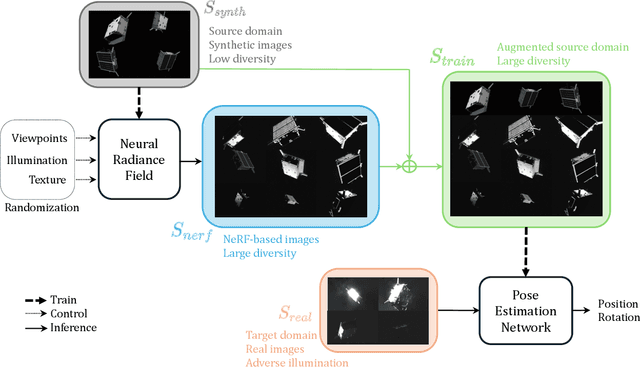
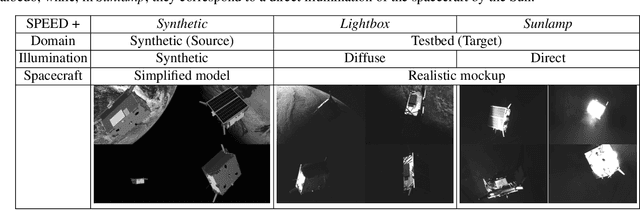


This work introduces a novel augmentation method that increases the diversity of a train set to improve the generalization abilities of a 6D pose estimation network. For this purpose, a Neural Radiance Field is trained from synthetic images and exploited to generate an augmented set. Our method enriches the initial set by enabling the synthesis of images with (i) unseen viewpoints, (ii) rich illumination conditions through appearance extrapolation, and (iii) randomized textures. We validate our augmentation method on the challenging use-case of spacecraft pose estimation and show that it significantly improves the pose estimation generalization capabilities. On the SPEED+ dataset, our method reduces the error on the pose by 50% on both target domains.