 Add to Chrome
 Add to Firefox
 Add to Edge
On the Limits of Token Reduction for Efficient Unified Vision Language Training
May 31, 2026
Unified vision-language models (VLMs) integrate visual understanding and visual generation within a single autoregressive backbone, but their joint training is computationally expensive and largely overlooked from an efficiency perspective. In this work, we study the feasibility and limits of token-reduction-based acceleration for unified VLM training. Through a systematic analysis of layerwise attention allocation, we uncover a fundamental asymmetry: visual understanding exhibits substantial late-layer visual redundancy, whereas visual generation maintains persistent dependence on image tokens across depth. Guided by this observation, we design task-specific accelerators that selectively reduce image-token computation for each objective. While these methods achieve significant efficiency gains in isolated settings, we observe a consistent synergy loss under unified training -- task-specific token dropping necessitates divergent parameter pathways and eliminates the mutual performance gains typically observed in joint optimization. Our findings suggest that efficient unified modeling requires preserving shared cross-task structures, highlighting the need for synergy-aware acceleration strategies. Project page: https://chicychen.github.io/TokenReductionUnifiedVLM/.

VibeToken: Scaling 1D Image Tokenizers and Autoregressive Models for Dynamic Resolution Generations
Apr 27, 2026We introduce an efficient, resolution-agnostic autoregressive (AR) image synthesis approach that generalizes to arbitrary resolutions and aspect ratios, narrowing the gap to diffusion models at scale. At its core is VibeToken, a novel resolution-agnostic 1D Transformer-based image tokenizer that encodes images into a dynamic, user-controllable sequence of 32-256 tokens, achieving a state-of-the-art efficiency and performance trade-off. Building on VibeToken, we present VibeToken-Gen, a class-conditioned AR generator with out-of-the-box support for arbitrary resolutions while requiring significantly fewer compute resources. Notably, VibeToken-Gen synthesizes 1024x1024 images using only 64 tokens and achieves 3.94 gFID; by comparison, a diffusion-based state-of-the-art alternative requires 1,024 tokens and attains 5.87 gFID. In contrast to fixed-resolution AR models such as LlamaGen -- whose inference FLOPs grow quadratically with resolution (11T FLOPs at 1024x1024) -- VibeToken-Gen maintains a constant 179G FLOPs (63.4x efficient) independent of resolution. We hope VibeToken can help unlock the wide adoption of AR visual generative models in production use cases.
IRIS: Implicit Reward-Guided Internal Sifting for Mitigating Multimodal Hallucination
Feb 03, 2026Hallucination remains a fundamental challenge for Multimodal Large Language Models (MLLMs). While Direct Preference Optimization (DPO) is a key alignment framework, existing approaches often rely heavily on costly external evaluators for scoring or rewriting, incurring off-policy learnability gaps and discretization loss. Due to the lack of access to internal states, such feedback overlooks the fine-grained conflicts between different modalities that lead to hallucinations during generation. To address this issue, we propose IRIS (Implicit Reward-Guided Internal Sifting), which leverages continuous implicit rewards in the native log-probability space to preserve full information density and capture internal modal competition. This on-policy paradigm eliminates learnability gaps by utilizing self-generated preference pairs. By sifting these pairs based on multimodal implicit rewards, IRIS ensures that optimization is driven by signals that directly resolve modal conflicts. Extensive experiments demonstrate that IRIS achieves highly competitive performance on key hallucination benchmarks using only 5.7k samples, without requiring any external feedback during preference alignment. These results confirm that IRIS provides an efficient and principled paradigm for mitigating MLLM hallucinations.
Addressing Catastrophic Forgetting in Federated Class-Continual Learning
Mar 13, 2023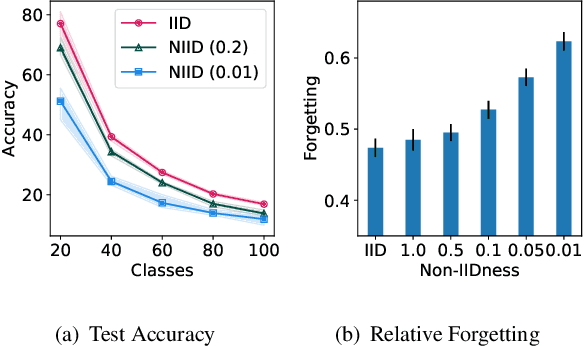
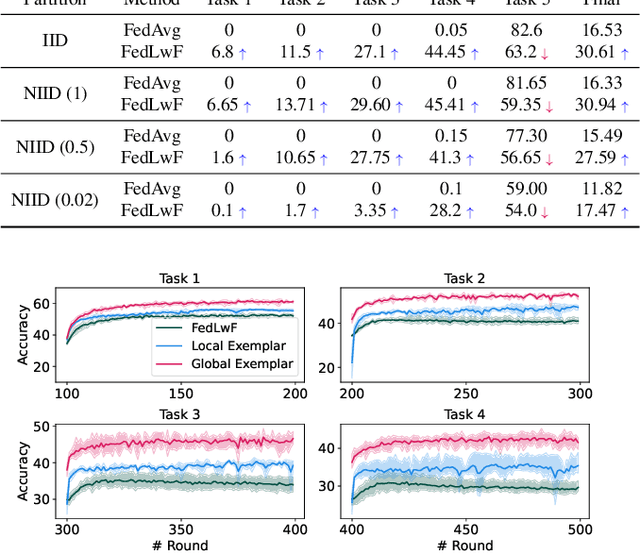
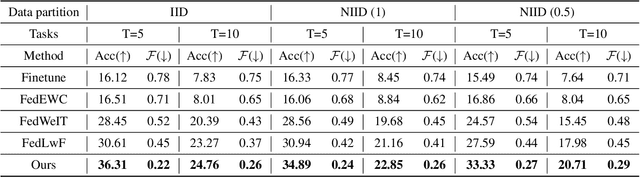
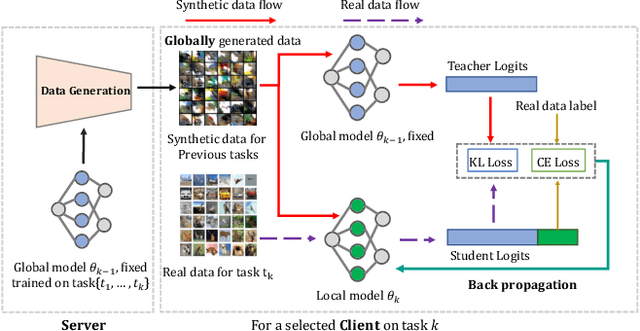
This paper focuses on an under-explored yet important problem: Federated Class-Continual Learning (FCCL), where new classes are dynamically added in federated learning. Existing FCCL works suffer from various limitations, such as requiring additional datasets or storing the private data from previous tasks. In response, we first demonstrate that non-IID data exacerbates catastrophic forgetting issue in FL. Then we propose a novel method called TARGET (federat\textbf{T}ed cl\textbf{A}ss-continual lea\textbf{R}nin\textbf{G} via \textbf{E}xemplar-free dis\textbf{T}illation), which alleviates catastrophic forgetting in FCCL while preserving client data privacy. Our proposed method leverages the previously trained global model to transfer knowledge of old tasks to the current task at the model level. Moreover, a generator is trained to produce synthetic data to simulate the global distribution of data on each client at the data level. Compared to previous FCCL methods, TARGET does not require any additional datasets or storing real data from previous tasks, which makes it ideal for data-sensitive scenarios.