 Add to Chrome
 Add to Firefox
 Add to Edge
M100: An Orchestrated Dataflow Architecture Powering General AI Computing
Apr 20, 2026
As deep learning-based AI technologies gain momentum, the demand for general-purpose AI computing architectures continues to grow. While GPGPU-based architectures offer versatility for diverse AI workloads, they often fall short in efficiency and cost-effectiveness. Various Domain-Specific Architectures (DSAs) excel at particular AI tasks but struggle to extend across broader applications or adapt to the rapidly evolving AI landscape. M100 is Li Auto's response: a performant, cost-effective architecture for AI inference in Autonomous Driving (AD), Large Language Models (LLMs), and intelligent human interactions, domains crucial to today's most competitive automobile platforms. M100 employs a dataflow parallel architecture, where compiler-architecture co-design orchestrates not only computation but, more critically, data movement across time and space. Leveraging dataflow computing efficiency, our hardware-software co-design improves system performance while reducing hardware complexity and cost. M100 largely eliminates caching: tensor computations are driven by compiler- and runtime-managed data streams flowing between computing elements and on/off-chip memories, yielding greater efficiency and scalability than cache-based systems. Another key principle was selecting the right operational granularity for scheduling, issuing, and execution across compiler, firmware, and hardware. Recognizing commonalities in AI workloads, we chose the tensor as the fundamental data element. M100 demonstrates general AI computing capability across diverse inference applications, including UniAD (for AD) and LLaMA (for LLMs). Benchmarks show M100 outperforms GPGPU architectures in AD applications with higher utilization, representing a promising direction for future general AI computing.

SpiLiFormer: Enhancing Spiking Transformers with Lateral Inhibition
Mar 20, 2025Spiking Neural Networks (SNNs) based on Transformers have garnered significant attention due to their superior performance and high energy efficiency. However, the spiking attention modules of most existing Transformer-based SNNs are adapted from those of analog Transformers, failing to fully address the issue of over-allocating attention to irrelevant contexts. To fix this fundamental yet overlooked issue, we propose a Lateral Inhibition-inspired Spiking Transformer (SpiLiFormer). It emulates the brain's lateral inhibition mechanism, guiding the model to enhance attention to relevant tokens while suppressing attention to irrelevant ones. Our model achieves state-of-the-art (SOTA) performance across multiple datasets, including CIFAR-10 (+0.45%), CIFAR-100 (+0.48%), CIFAR10-DVS (+2.70%), N-Caltech101 (+1.94%), and ImageNet-1K (+1.6%). Notably, on the ImageNet-1K dataset, SpiLiFormer (69.9M parameters, 4 time steps, 384 resolution) outperforms E-SpikeFormer (173.0M parameters, 8 time steps, 384 resolution), a SOTA spiking Transformer, by 0.46% using only 39% of the parameters and half the time steps. Our code and training checkpoints will be released upon acceptance.
Zero-shot Robotic Manipulation with Language-guided Instruction and Formal Task Planning
Jan 25, 2025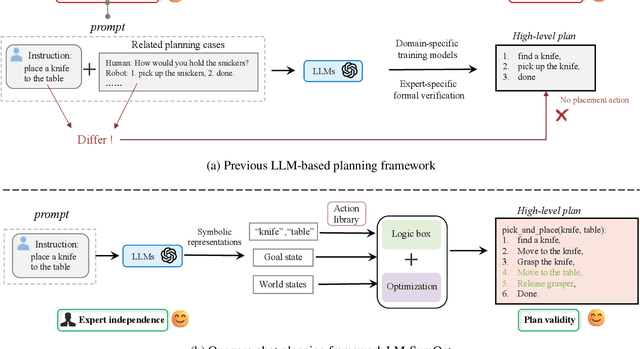
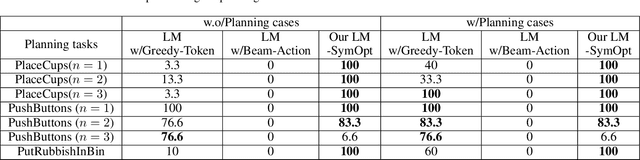
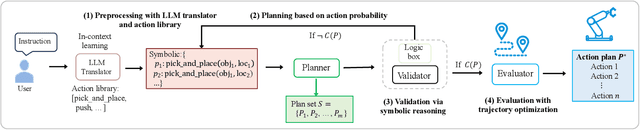
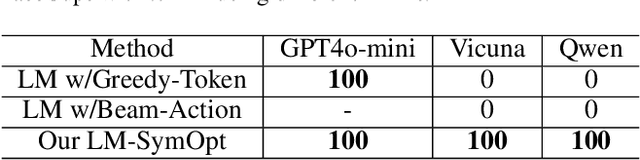
Robotic manipulation is often challenging due to the long-horizon tasks and the complex object relationships. A common solution is to develop a task and motion planning framework that integrates planning for high-level task and low-level motion. Recently, inspired by the powerful reasoning ability of Large Language Models (LLMs), LLM-based planning approaches have achieved remarkable progress. However, these methods still heavily rely on expert-specific knowledge, often generating invalid plans for unseen and unfamiliar tasks. To address this issue, we propose an innovative language-guided symbolic task planning (LM-SymOpt) framework with optimization. It is the first expert-free planning framework since we combine the world knowledge from LLMs with formal reasoning, resulting in improved generalization capability to new tasks. Specifically, differ to most existing work, our LM-SymOpt employs LLMs to translate natural language instructions into symbolic representations, thereby representing actions as high-level symbols and reducing the search space for planning. Next, after evaluating the action probability of completing the task using LLMs, a weighted random sampling method is introduced to generate candidate plans. Their feasibility is assessed through symbolic reasoning and their cost efficiency is then evaluated using trajectory optimization for selecting the optimal planning. Our experimental results show that LM-SymOpt outperforms existing LLM-based planning approaches.