 Add to Chrome
 Add to Firefox
 Add to Edge
SLIP: Segmentation with Low-latency Interactive Prompting for 3D Medical Images
Jul 24, 2026
Interactive deep image segmentation enables efficient medical image annotation by iteratively refining predictions from user prompts, such as positive and negative clicks. Recent patch-based methods, including nnInteractive, achieve strong segmentation performance but remain limited in annotation workflows by high interaction latency, limited responsiveness to successive interactions, and the lack of support for reversible prompting. Furthermore, evaluation relies predominantly on simulated rather than controlled real-user interaction studies. We present SLIP, an end-to-end trainable framework for interactive 3D medical image segmentation that decouples image encoding from prompt-guided refinement. Image features are computed once and reused, while a lightweight patch memory bank maintains an interaction-aware segmentation state shared across patches. This representation enables prediction updates by propagating interaction context throughout the image, supports reversible prompting without recomputing image features, and substantially reduces interaction latency. By separating image representation from interactive reasoning, SLIP remains compatible with a wide range of image encoders. We train a single SLIP model for general interactive segmentation across diverse anatomical structures and imaging modalities. Beyond standard simulated evaluation, we conduct a controlled prospective user study comparing manual segmentation, nnInteractive, and SLIP across three clinical annotation tasks, six expert participants, and subjective usability measures, addressing the limited human validation of interactive segmentation methods. SLIP achieves SOTA interactive segmentation performance across 13 public datasets while providing lower interaction latency, greater responsiveness, support for reversible prompting, and higher user preference than existing approaches.

Not Every Rubric Teaches Equally: Policy-Aware Rubric Rewards for RLVR
May 19, 2026Reinforcement learning with verifiable rewards has made post-training highly effective when correctness can be checked automatically. However, many important model behaviors require satisfying several qualitative criteria at once. Rubric-based rewards address this setting by grading prompt-specific criteria and aggregating them into a scalar reward. Yet standard static aggregations conflate a criterion's human-assigned importance with its current usefulness as an optimization signal. We show that this assumption breaks down in rubric RL: many important criteria are already saturated or currently unreachable, while criteria that distinguish rollouts are not necessarily those with the largest human weights. We introduce POW3R, a policy-aware rubric reward framework that preserves human weights and category balance as the rubric objective while adapting criterion-level reward weights during training. POW3R uses rollout-level contrast to emphasize criteria that currently separate the policy's outputs, making the GRPO reward more informative without changing the underlying evaluation target. Across three base policies on two datasets spanning multimodal and text-only settings, POW3R wins $24$ of $30$ base-policy/metric comparisons, improving both mean rubric reward and strict completion (the fraction of prompts whose response satisfies every required rubric criterion) over vanilla GRPO with rubric rewards, and reaches the same plateau in $2.5$--$4\times$ fewer training steps. Rubric rewards should therefore distinguish what should matter in the final answer from what can teach the current policy.
From Measurement to Mitigation: Quantifying and Reducing Identity Leakage in Image Representation Encoders with Linear Subspace Removal
Apr 07, 2026Frozen visual embeddings (e.g., CLIP, DINOv2/v3, SSCD) power retrieval and integrity systems, yet their use on face-containing data is constrained by unmeasured identity leakage and a lack of deployable mitigations. We take an attacker-aware view and contribute: (i) a benchmark of visual embeddings that reports open-set verification at low false-accept rates, a calibrated diffusion-based template inversion check, and face-context attribution with equal-area perturbations; and (ii) propose a one-shot linear projector that removes an estimated identity subspace while preserving the complementary space needed for utility, which for brevity we denote as the identity sanitization projection ISP. Across CelebA-20 and VGGFace2, we show that these encoders are robust under open-set linear probes, with CLIP exhibiting relatively higher leakage than DINOv2/v3 and SSCD, robust to template inversion, and are context-dominant. In addition, we show that ISP drives linear access to near-chance while retaining high non-biometric utility, and transfers across datasets with minor degradation. Our results establish the first attacker-calibrated facial privacy audit of non-FR encoders and demonstrate that linear subspace removal achieves strong privacy guarantees while preserving utility for visual search and retrieval.
TRUSTED: The Paired 3D Transabdominal Ultrasound and CT Human Data for Kidney Segmentation and Registration Research
Oct 19, 2023Inter-modal image registration (IMIR) and image segmentation with abdominal Ultrasound (US) data has many important clinical applications, including image-guided surgery, automatic organ measurement and robotic navigation. However, research is severely limited by the lack of public datasets. We propose TRUSTED (the Tridimensional Renal Ultra Sound TomodEnsitometrie Dataset), comprising paired transabdominal 3DUS and CT kidney images from 48 human patients (96 kidneys), including segmentation, and anatomical landmark annotations by two experienced radiographers. Inter-rater segmentation agreement was over 94 (Dice score), and gold-standard segmentations were generated using the STAPLE algorithm. Seven anatomical landmarks were annotated, important for IMIR systems development and evaluation. To validate the dataset's utility, 5 competitive Deep Learning models for automatic kidney segmentation were benchmarked, yielding average DICE scores from 83.2% to 89.1% for CT, and 61.9% to 79.4% for US images. Three IMIR methods were benchmarked, and Coherent Point Drift performed best with an average Target Registration Error of 4.53mm. The TRUSTED dataset may be used freely researchers to develop and validate new segmentation and IMIR methods.
Enabling real-time multi-messenger astrophysics discoveries with deep learning
Nov 26, 2019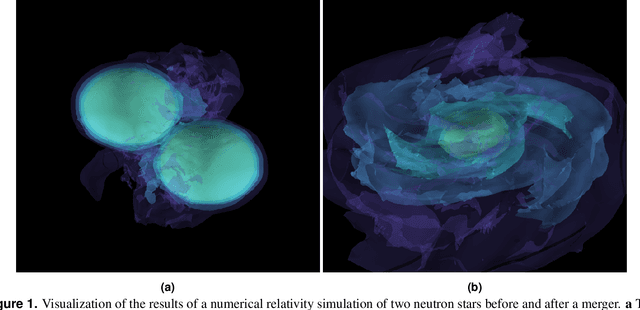
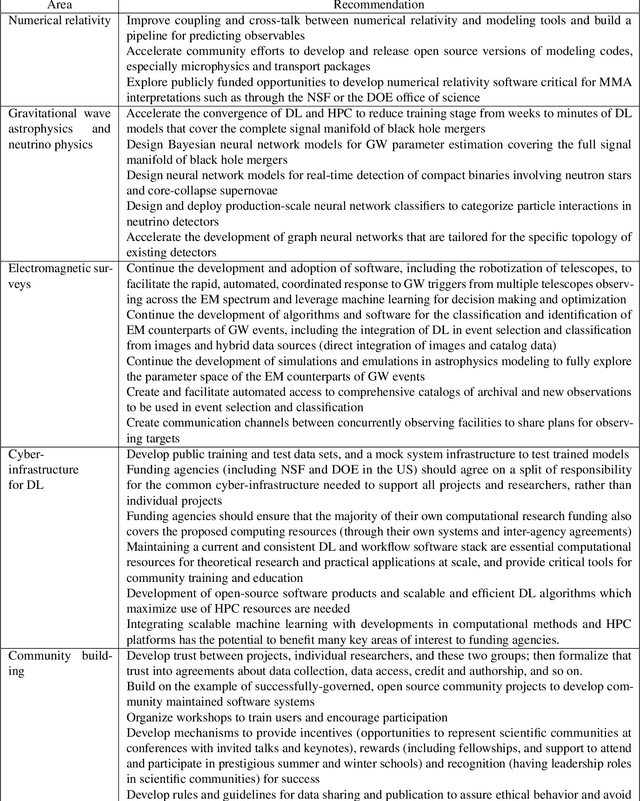
Multi-messenger astrophysics is a fast-growing, interdisciplinary field that combines data, which vary in volume and speed of data processing, from many different instruments that probe the Universe using different cosmic messengers: electromagnetic waves, cosmic rays, gravitational waves and neutrinos. In this Expert Recommendation, we review the key challenges of real-time observations of gravitational wave sources and their electromagnetic and astroparticle counterparts, and make a number of recommendations to maximize their potential for scientific discovery. These recommendations refer to the design of scalable and computationally efficient machine learning algorithms; the cyber-infrastructure to numerically simulate astrophysical sources, and to process and interpret multi-messenger astrophysics data; the management of gravitational wave detections to trigger real-time alerts for electromagnetic and astroparticle follow-ups; a vision to harness future developments of machine learning and cyber-infrastructure resources to cope with the big-data requirements; and the need to build a community of experts to realize the goals of multi-messenger astrophysics.
* Invited Expert Recommendation for Nature Reviews Physics. The art work produced by E. A. Huerta and Shawn Rosofsky for this article was used by Carl Conway to design the cover of the October 2019 issue of Nature Reviews Physics
Denoising Gravitational Waves with Enhanced Deep Recurrent Denoising Auto-Encoders
Mar 06, 2019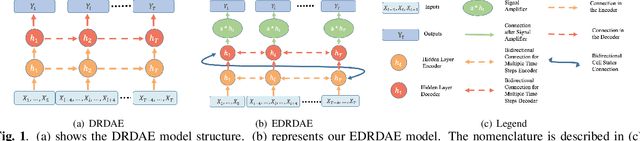
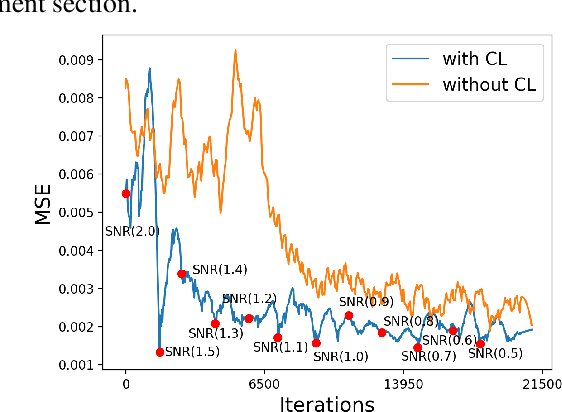

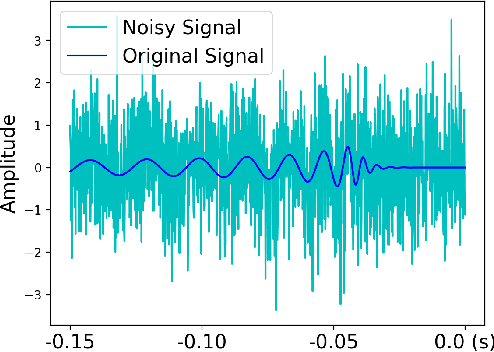
Denoising of time domain data is a crucial task for many applications such as communication, translation, virtual assistants etc. For this task, a combination of a recurrent neural net (RNNs) with a Denoising Auto-Encoder (DAEs) has shown promising results. However, this combined model is challenged when operating with low signal-to-noise ratio (SNR) data embedded in non-Gaussian and non-stationary noise. To address this issue, we design a novel model, referred to as 'Enhanced Deep Recurrent Denoising Auto-Encoder' (EDRDAE), that incorporates a signal amplifier layer, and applies curriculum learning by first denoising high SNR signals, before gradually decreasing the SNR until the signals become noise dominated. We showcase the performance of EDRDAE using time-series data that describes gravitational waves embedded in very noisy backgrounds. In addition, we show that EDRDAE can accurately denoise signals whose topology is significantly more complex than those used for training, demonstrating that our model generalizes to new classes of gravitational waves that are beyond the scope of established denoising algorithms.
Deep Learning for Multi-Messenger Astrophysics: A Gateway for Discovery in the Big Data Era
Feb 01, 2019This report provides an overview of recent work that harnesses the Big Data Revolution and Large Scale Computing to address grand computational challenges in Multi-Messenger Astrophysics, with a particular emphasis on real-time discovery campaigns. Acknowledging the transdisciplinary nature of Multi-Messenger Astrophysics, this document has been prepared by members of the physics, astronomy, computer science, data science, software and cyberinfrastructure communities who attended the NSF-, DOE- and NVIDIA-funded "Deep Learning for Multi-Messenger Astrophysics: Real-time Discovery at Scale" workshop, hosted at the National Center for Supercomputing Applications, October 17-19, 2018. Highlights of this report include unanimous agreement that it is critical to accelerate the development and deployment of novel, signal-processing algorithms that use the synergy between artificial intelligence (AI) and high performance computing to maximize the potential for scientific discovery with Multi-Messenger Astrophysics. We discuss key aspects to realize this endeavor, namely (i) the design and exploitation of scalable and computationally efficient AI algorithms for Multi-Messenger Astrophysics; (ii) cyberinfrastructure requirements to numerically simulate astrophysical sources, and to process and interpret Multi-Messenger Astrophysics data; (iii) management of gravitational wave detections and triggers to enable electromagnetic and astro-particle follow-ups; (iv) a vision to harness future developments of machine and deep learning and cyberinfrastructure resources to cope with the scale of discovery in the Big Data Era; (v) and the need to build a community that brings domain experts together with data scientists on equal footing to maximize and accelerate discovery in the nascent field of Multi-Messenger Astrophysics.
Real-time regression analysis with deep convolutional neural networks
May 07, 2018We discuss the development of novel deep learning algorithms to enable real-time regression analysis for time series data. We showcase the application of this new method with a timely case study, and then discuss the applicability of this approach to tackle similar challenges across science domains.
Deep Learning for Real-time Gravitational Wave Detection and Parameter Estimation with LIGO Data
Dec 11, 2017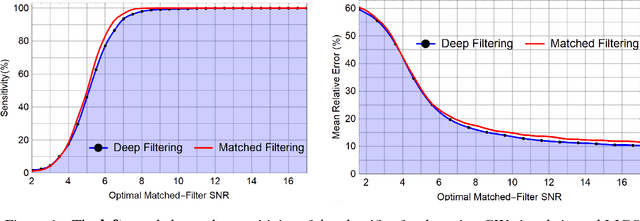
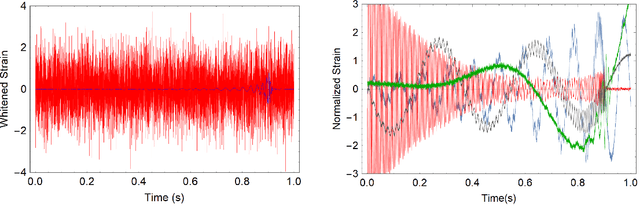
The recent Nobel-prize-winning detections of gravitational waves from merging black holes and the subsequent detection of the collision of two neutron stars in coincidence with electromagnetic observations have inaugurated a new era of multimessenger astrophysics. To enhance the scope of this emergent science, we proposed the use of deep convolutional neural networks for the detection and characterization of gravitational wave signals in real-time. This method, Deep Filtering, was initially demonstrated using simulated LIGO noise. In this article, we present the extension of Deep Filtering using real data from the first observing run of LIGO, for both detection and parameter estimation of gravitational waves from binary black hole mergers with continuous data streams from multiple LIGO detectors. We show for the first time that machine learning can detect and estimate the true parameters of a real GW event observed by LIGO. Our comparisons show that Deep Filtering is far more computationally efficient than matched-filtering, while retaining similar sensitivity and lower errors, allowing real-time processing of weak time-series signals in non-stationary non-Gaussian noise, with minimal resources, and also enables the detection of new classes of gravitational wave sources that may go unnoticed with existing detection algorithms. This approach is uniquely suited to enable coincident detection campaigns of gravitational waves and their multimessenger counterparts in real-time.
Glitch Classification and Clustering for LIGO with Deep Transfer Learning
Dec 11, 2017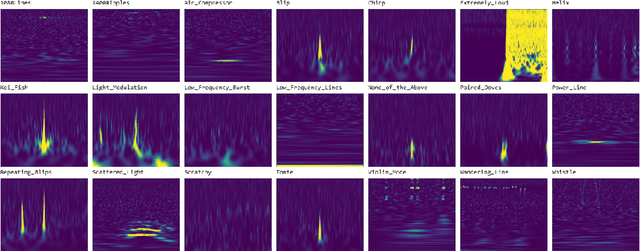
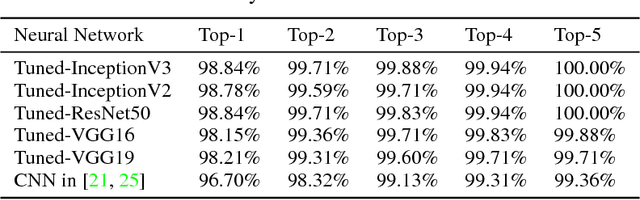
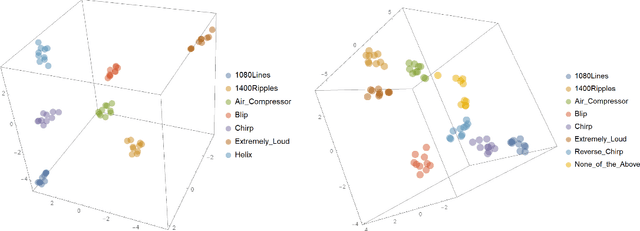
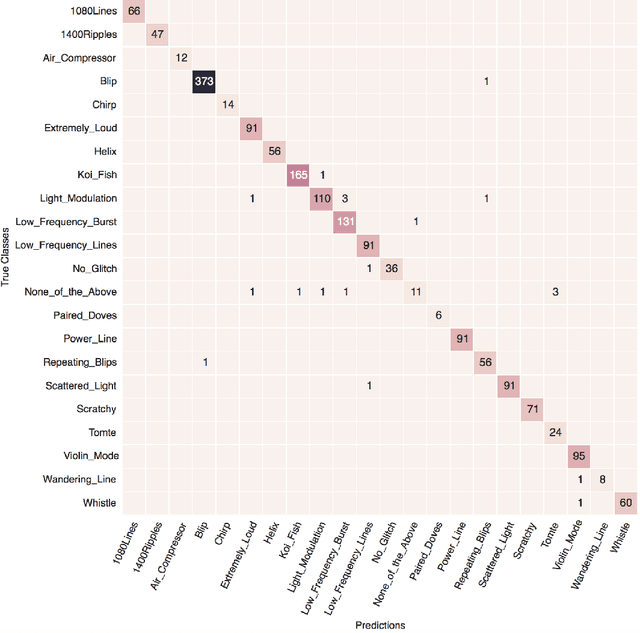
The detection of gravitational waves with LIGO and Virgo requires a detailed understanding of the response of these instruments in the presence of environmental and instrumental noise. Of particular interest is the study of anomalous non-Gaussian noise transients known as glitches, since their high occurrence rate in LIGO/Virgo data can obscure or even mimic true gravitational wave signals. Therefore, successfully identifying and excising glitches is of utmost importance to detect and characterize gravitational waves. In this article, we present the first application of Deep Learning combined with Transfer Learning for glitch classification, using real data from LIGO's first discovery campaign labeled by Gravity Spy, showing that knowledge from pre-trained models for real-world object recognition can be transferred for classifying spectrograms of glitches. We demonstrate that this method enables the optimal use of very deep convolutional neural networks for glitch classification given small unbalanced training datasets, significantly reduces the training time, and achieves state-of-the-art accuracy above 98.8%. Once trained via transfer learning, we show that the networks can be truncated and used as feature extractors for unsupervised clustering to automatically group together new classes of glitches and anomalies. This novel capability is of critical importance to identify and remove new types of glitches which will occur as the LIGO/Virgo detectors gradually attain design sensitivity.
* Camera-ready (final) paper accepted to NIPS 2017 conference workshop on Deep Learning for Physical Sciences. Extended article: arXiv:1706.07446