 Add to Chrome
 Add to Firefox
 Add to Edge
DPEPO: Diverse Parallel Exploration Policy Optimization for LLM-based Agents
Apr 27, 2026
Large language model (LLM) agents that follow the sequential "reason-then-act" paradigm have achieved superior performance in many complex tasks.However, these methods suffer from limited exploration and incomplete environmental understanding, as they interact with only a single environment per step. In this paper, we first introduce a novel paradigm that enables an agent to interact with multiple environments simultaneously and share cross-trajectory experiences. Building upon this paradigm, we further propose DPEPO, a reinforcement learning (RL) algorithm that encourages the agent to perform diverse parallel exploration. There are two stages in DPEPO: initial supervised fine-tuning (SFT) imparts basic parallel reasoning and action generation, followed by reinforcement learning stage with a hierarchical reward scheme. We design a parallel trajectory-level success reward and two step-level rewards: Diverse Action Reward and Diverse State Transition Reward, which actively penalize behavioral redundancy and promote broad exploration. Extensive experiments on ALFWorld and ScienceWorld show that DPEPO achieves state-of-the-art (SOTA) success rates, while maintaining comparable efficiency to strong sequential baselines. (Code is available at https://github.com/LePanda026/Code-for-DPEPO)

HTAA: Enhancing LLM Planning via Hybrid Toolset Agentization & Adaptation
Apr 13, 2026Enabling large language models to scale and reliably use hundreds of tools is critical for real-world applications, yet challenging due to the inefficiency and error accumulation inherent in flat tool-calling architectures. To address this, we propose Hybrid Toolset Agentization & Adaptation (HTAA), a hierarchical framework for scalable tool-use planning. We propose a novel toolset agentization paradigm, which encapsulates frequently co-used tools into specialized agent tools, thereby reducing the planner's action space and mitigating redundancy. To ensure effective coordination, we design Asymmetric Planner Adaptation, a trajectory-based training paradigm that aligns the high-level planner with agent tools via backward reconstruction and forward refinement. To validate the performance of HTAA, we conduct experiments on a real-world internal dataset, InfoVerify, based on the POI validation workflow of China's largest online large-scale ride-hailing platform, featuring long-horizon executable tool trajectories. Experiments on InfoVerify and widely-used benchmarks show that HTAA consistently achieves higher task success rates, requires short tool calling trajectories, and significantly reduces context overhead compared to strong baselines. Furthermore, in a production deployment, HTAA substantially reduces manual validation effort and operational cost, demonstrating its practical efficacy.
Beyond Superficial Forgetting: Thorough Unlearning through Knowledge Density Estimation and Block Re-insertion
Nov 11, 2025Machine unlearning, which selectively removes harmful knowledge from a pre-trained model without retraining from scratch, is crucial for addressing privacy, regulatory compliance, and ethical concerns in Large Language Models (LLMs). However, existing unlearning methods often struggle to thoroughly remove harmful knowledge, leaving residual harmful knowledge that can be easily recovered. To address these limitations, we propose Knowledge Density-Guided Unlearning via Blocks Reinsertion (KUnBR), a novel approach that first identifies layers with rich harmful knowledge and then thoroughly eliminates the harmful knowledge via re-insertion strategy. Our method introduces knowledge density estimation to quantify and locate layers containing the most harmful knowledge, enabling precise unlearning. Additionally, we design a layer re-insertion strategy that extracts and re-inserts harmful knowledge-rich layers into the original LLM, bypassing gradient obstruction caused by cover layers and ensuring effective gradient propagation during unlearning. Extensive experiments conducted on several unlearning and general capability benchmarks demonstrate that KUnBR achieves state-of-the-art forgetting performance while maintaining model utility.
LLMs are Also Effective Embedding Models: An In-depth Overview
Dec 17, 2024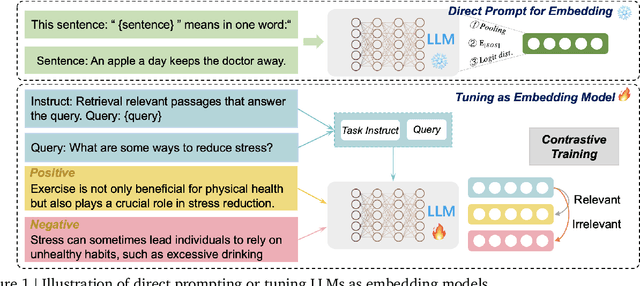
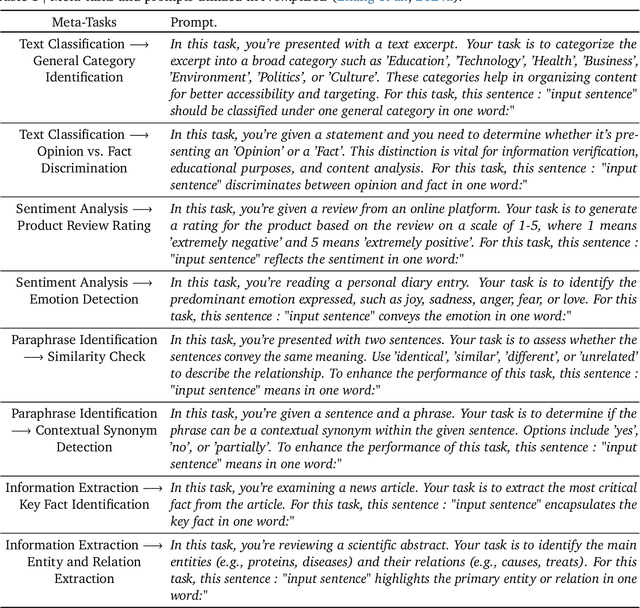
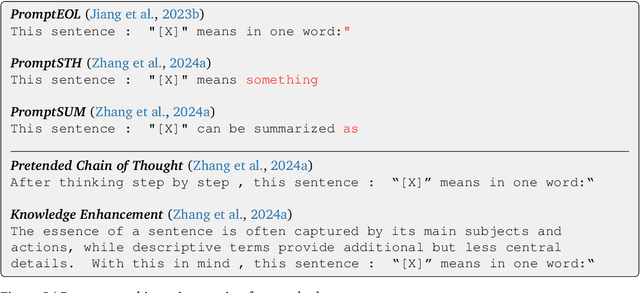
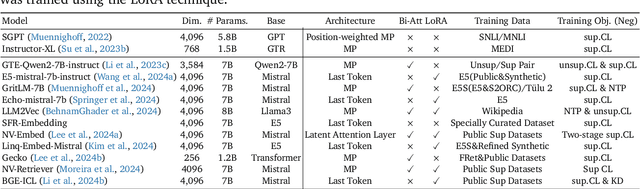
Large language models (LLMs) have revolutionized natural language processing by achieving state-of-the-art performance across various tasks. Recently, their effectiveness as embedding models has gained attention, marking a paradigm shift from traditional encoder-only models like ELMo and BERT to decoder-only, large-scale LLMs such as GPT, LLaMA, and Mistral. This survey provides an in-depth overview of this transition, beginning with foundational techniques before the LLM era, followed by LLM-based embedding models through two main strategies to derive embeddings from LLMs. 1) Direct prompting: We mainly discuss the prompt designs and the underlying rationale for deriving competitive embeddings. 2) Data-centric tuning: We cover extensive aspects that affect tuning an embedding model, including model architecture, training objectives, data constructions, etc. Upon the above, we also cover advanced methods, such as handling longer texts, and multilingual and cross-modal data. Furthermore, we discuss factors affecting choices of embedding models, such as performance/efficiency comparisons, dense vs sparse embeddings, pooling strategies, and scaling law. Lastly, the survey highlights the limitations and challenges in adapting LLMs for embeddings, including cross-task embedding quality, trade-offs between efficiency and accuracy, low-resource, long-context, data bias, robustness, etc. This survey serves as a valuable resource for researchers and practitioners by synthesizing current advancements, highlighting key challenges, and offering a comprehensive framework for future work aimed at enhancing the effectiveness and efficiency of LLMs as embedding models.