 Add to Chrome
 Add to Firefox
 Add to Edge
To Blend In, First Decouple: Rethinking Camouflage Image Generation via Context-Decoupled Representations
Jul 20, 2026
Camouflage image generation (CIG) focuses on generating visually concealed objects that seamlessly blend into their backgrounds. Existing methods typically follow either background-guided paradigms that adapt object appearance via style transfer, or foreground-guided strategies that outpaint surrounding regions conditioned on object features. However, they still suffer from appearance discrepancy and background artifacts. We attribute these limitations to cross-context representation leakage, where object and background cues are entangled in a coupled conditional space, resulting in ambiguous control and degraded camouflage fidelity. To tackle this, we propose a new context-decoupled generative paradigm, termed CamoDreamer, which aims to isolate contextual conditional guidance and explicitly decouple latent camouflage features into coordinated object and background control streams. First, a Contrast-aware Contextual Bridge is designed to model cross-context discrepancies and construct contrast-aware dual conditional guidance. Second, Context-Decoupled Assimilation Streams are employed to separate generative interactions conditioned on the dual guidance, while facilitating background rendering with target-aware cues in the latent space. Finally, a Frequency-Adaptive Contextual Blend module integrates complementary high-frequency textures and low-frequency structures from decoupled features to improve holistic coherence. Extensive experiments demonstrate that CamoDreamer consistently outperforms existing methods with a substantial margin, while maintaining a relatively lightweight design.

Pyramid Grafting Network for One-Stage High Resolution Saliency Detection
Apr 12, 2022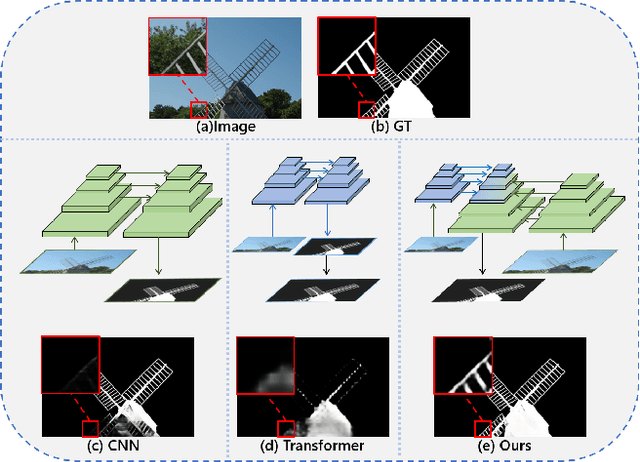
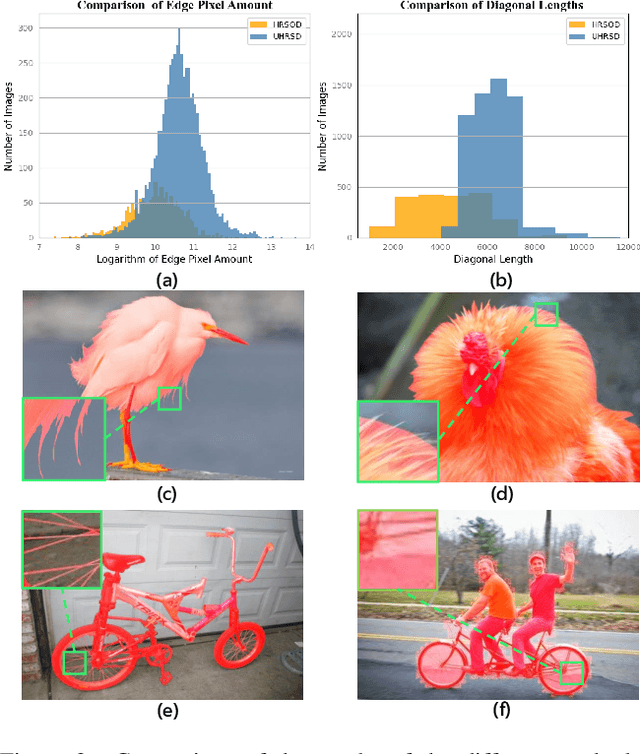
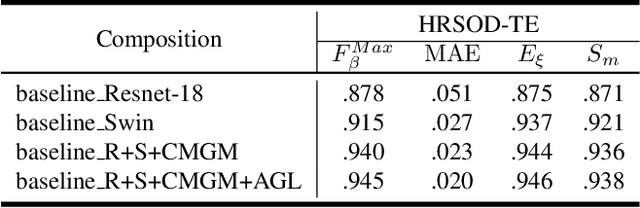
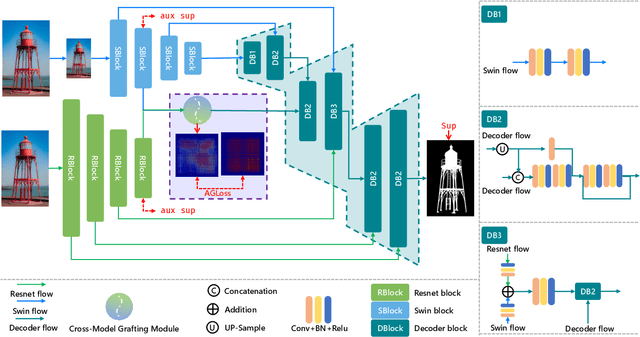
Recent salient object detection (SOD) methods based on deep neural network have achieved remarkable performance. However, most of existing SOD models designed for low-resolution input perform poorly on high-resolution images due to the contradiction between the sampling depth and the receptive field size. Aiming at resolving this contradiction, we propose a novel one-stage framework called Pyramid Grafting Network (PGNet), using transformer and CNN backbone to extract features from different resolution images independently and then graft the features from transformer branch to CNN branch. An attention-based Cross-Model Grafting Module (CMGM) is proposed to enable CNN branch to combine broken detailed information more holistically, guided by different source feature during decoding process. Moreover, we design an Attention Guided Loss (AGL) to explicitly supervise the attention matrix generated by CMGM to help the network better interact with the attention from different models. We contribute a new Ultra-High-Resolution Saliency Detection dataset UHRSD, containing 5,920 images at 4K-8K resolutions. To our knowledge, it is the largest dataset in both quantity and resolution for high-resolution SOD task, which can be used for training and testing in future research. Sufficient experiments on UHRSD and widely-used SOD datasets demonstrate that our method achieves superior performance compared to the state-of-the-art methods.
Receptive Field Broadening and Boosting for Salient Object Detection
Oct 15, 2021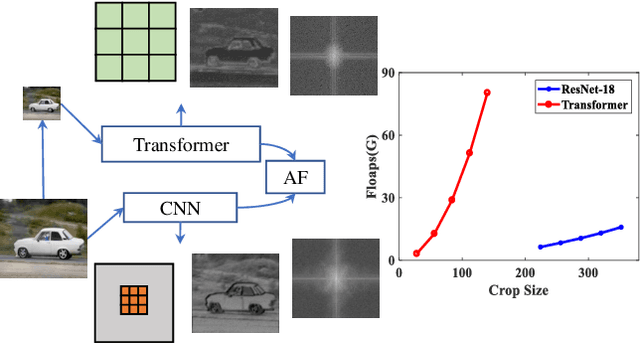
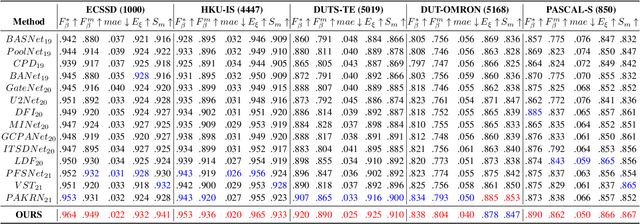
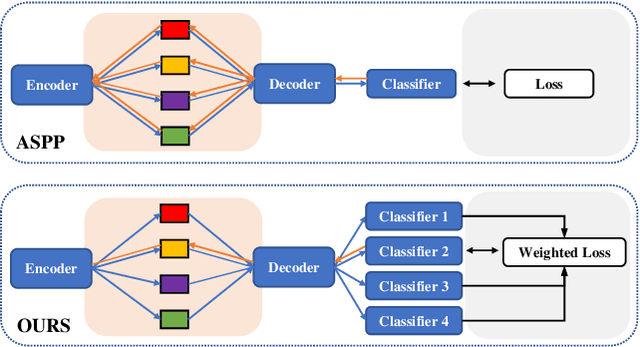
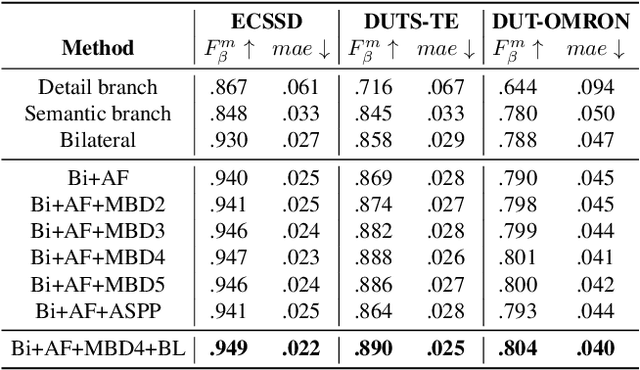
Salient object detection requires a comprehensive and scalable receptive field to locate the visually significant objects in the image. Recently, the emergence of visual transformers and multi-branch modules has significantly enhanced the ability of neural networks to perceive objects at different scales. However, compared to the traditional backbone, the calculation process of transformers is time-consuming. Moreover, different branches of the multi-branch modules could cause the same error back propagation in each training iteration, which is not conducive to extracting discriminative features. To solve these problems, we propose a bilateral network based on transformer and CNN to efficiently broaden local details and global semantic information simultaneously. Besides, a Multi-Head Boosting (MHB) strategy is proposed to enhance the specificity of different network branches. By calculating the errors of different prediction heads, each branch can separately pay more attention to the pixels that other branches predict incorrectly. Moreover, Unlike multi-path parallel training, MHB randomly selects one branch each time for gradient back propagation in a boosting way. Additionally, an Attention Feature Fusion Module (AF) is proposed to fuse two types of features according to respective characteristics. Comprehensive experiments on five benchmark datasets demonstrate that the proposed method can achieve a significant performance improvement compared with the state-of-the-art methods.