 Add to Chrome
 Add to Firefox
 Add to Edge
When to Personalize Household Object Search: A Rigidity-Gated Hybrid Policy
Jun 18, 2026
Service robots searching for household objects rely on spatial priors to reduce search cost, yet object locations can vary with resident traits. Collecting longitudinal, trait-specific in-home trajectories is invasive and hard to scale. We study when personalization helps and propose PerSim, a rigidity-gated hybrid policy that combines a trait-conditioned prior with a population-frequency baseline, personalizing only when placement behavior is variable. To scale resident-conditioned dynamics, we employ a human-calibrated simulation pipeline to generate and validate object-placement transitions in diverse home layouts, and train a predictor that injects continuous Big Five vectors to output room-level priors and within-room co-occurrence cues. In a unified human study (N=200), dual-layer validation shows that (i) synthetic transitions are judged behaviorally plausible (mean 3.85/5, p < 1e-6), and (ii) in a blinded A/B comparison, personalization is favored primarily for low-rigidity objects (p=0.005), while the population-frequency baseline remains strong for universally placed items, yielding a decision rule for when to personalize. In an offline objective test, we observe a small but significant improvement on unseen continuous trait vectors over nearest discrete configuration matching (p=0.035), supporting interpolation in five-dimensional trait space. Finally, in a home digital twin we show that PerSim reduces expected search cost by combining room visitation effort with within-room cue checking, demonstrating end-to-end gains beyond isolated prediction metrics.

PRISM: PRior-guided Imagination Sampling in world Models
Jun 06, 2026A learned world model provides a powerful physical intuition for evaluating future states. But its effectiveness in continuous control also depends critically on how candidate actions are generated for model-based planning. Rather than solely asking how accurately a model can simulate the future, we ask: which candidate actions are worth evaluating in the first place? Existing planners typically search arbitrarily or use expert demonstrations only to initialize a sampling mean, discarding the expert's state-conditioned confidence. Properly guiding this search requires a robust action prior, yet current approaches often rely on independent visual encoders or large-scale VLMs to obtain one. We argue that this architectural bloat is unnecessary: the exact same data - and the learned representations of the world model itself - inherently encode the agent's action intuition. We introduce PRISM, a task-agnostic framework that extracts both from a single dataset while maintaining strict architectural simplicity. Building on a standard JEPA-style latent world model, PRISM attaches a lightweight MLP directly to its frozen encoder to predict a state-conditioned Gaussian prior. At plan time, PRISM fuses this prior into the planner's sampling distribution via a precision-weighted Product-of-Gaussians update. This parameter-free, closed-form integration steers the sampling process, making the prior confident where it is and ceding control where it is not. PRISM improves success rates by 35 percentage points over vanilla world-model-based MPC on Cube and 32 percentage points on PushT, without introducing significant inference overhead.
Dynamic Token Selection for Aerial-Ground Person Re-Identification
Nov 30, 2024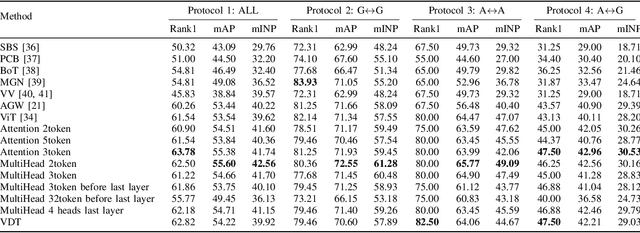
We propose a View-Decoupled Transformer (VDT) framework to address viewpoint discrepancies in person re-identification (ReID), particularly between aerial and ground views. VDT decouples view-specific and view-independent features by leveraging meta and view tokens, processed through self-attention and subtractive separation. Additionally, we introduce a Visual Token Selector (VTS) module that dynamically selects the most informative tokens, reducing redundancy and enhancing efficiency. Our approach significantly improves retrieval performance on the AGPReID dataset, while maintaining computational efficiency similar to baseline models.
Learning to Singulate Objects in Packed Environments using a Dexterous Hand
Sep 01, 2024
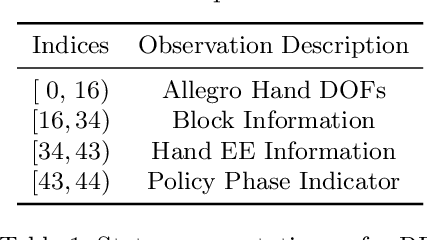


Robotic object singulation, where a robot must isolate, grasp, and retrieve a target object in a cluttered environment, is a fundamental challenge in robotic manipulation. This task is difficult due to occlusions and how other objects act as obstacles for manipulation. A robot must also reason about the effect of object-object interactions as it tries to singulate the target. Prior work has explored object singulation in scenarios where there is enough free space to perform relatively long pushes to separate objects, in contrast to when space is tight and objects have little separation from each other. In this paper, we propose the Singulating Objects in Packed Environments (SOPE) framework. We propose a novel method that involves a displacement-based state representation and a multi-phase reinforcement learning procedure that enables singulation using the 16-DOF Allegro Hand. We demonstrate extensive experiments in Isaac Gym simulation, showing the ability of our system to singulate a target object in clutter. We directly transfer the policy trained in simulation to the real world. Over 250 physical robot manipulation trials, our method obtains success rates of 79.2%, outperforming alternative learning and non-learning methods.
Blending Distributed NeRFs with Tri-stage Robust Pose Optimization
May 05, 2024


Due to the limited model capacity, leveraging distributed Neural Radiance Fields (NeRFs) for modeling extensive urban environments has become a necessity. However, current distributed NeRF registration approaches encounter aliasing artifacts, arising from discrepancies in rendering resolutions and suboptimal pose precision. These factors collectively deteriorate the fidelity of pose estimation within NeRF frameworks, resulting in occlusion artifacts during the NeRF blending stage. In this paper, we present a distributed NeRF system with tri-stage pose optimization. In the first stage, precise poses of images are achieved by bundle adjusting Mip-NeRF 360 with a coarse-to-fine strategy. In the second stage, we incorporate the inverting Mip-NeRF 360, coupled with the truncated dynamic low-pass filter, to enable the achievement of robust and precise poses, termed Frame2Model optimization. On top of this, we obtain a coarse transformation between NeRFs in different coordinate systems. In the third stage, we fine-tune the transformation between NeRFs by Model2Model pose optimization. After obtaining precise transformation parameters, we proceed to implement NeRF blending, showcasing superior performance metrics in both real-world and simulation scenarios. Codes and data will be publicly available at https://github.com/boilcy/Distributed-NeRF.