 Add to Chrome
 Add to Firefox
 Add to Edge
When to Personalize Household Object Search: A Rigidity-Gated Hybrid Policy
Jun 18, 2026
Service robots searching for household objects rely on spatial priors to reduce search cost, yet object locations can vary with resident traits. Collecting longitudinal, trait-specific in-home trajectories is invasive and hard to scale. We study when personalization helps and propose PerSim, a rigidity-gated hybrid policy that combines a trait-conditioned prior with a population-frequency baseline, personalizing only when placement behavior is variable. To scale resident-conditioned dynamics, we employ a human-calibrated simulation pipeline to generate and validate object-placement transitions in diverse home layouts, and train a predictor that injects continuous Big Five vectors to output room-level priors and within-room co-occurrence cues. In a unified human study (N=200), dual-layer validation shows that (i) synthetic transitions are judged behaviorally plausible (mean 3.85/5, p < 1e-6), and (ii) in a blinded A/B comparison, personalization is favored primarily for low-rigidity objects (p=0.005), while the population-frequency baseline remains strong for universally placed items, yielding a decision rule for when to personalize. In an offline objective test, we observe a small but significant improvement on unseen continuous trait vectors over nearest discrete configuration matching (p=0.035), supporting interpolation in five-dimensional trait space. Finally, in a home digital twin we show that PerSim reduces expected search cost by combining room visitation effort with within-room cue checking, demonstrating end-to-end gains beyond isolated prediction metrics.

Demonstrating CavePI: Autonomous Exploration of Underwater Caves by Semantic Guidance
Feb 07, 2025
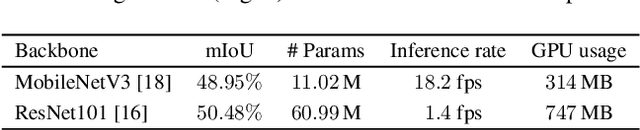
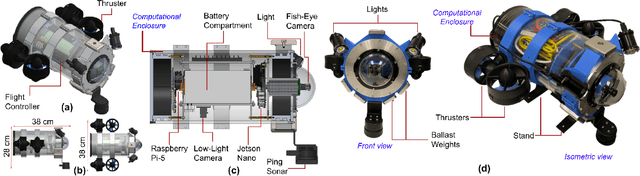
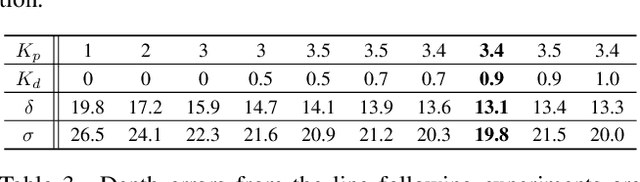
Enabling autonomous robots to safely and efficiently navigate, explore, and map underwater caves is of significant importance to water resource management, hydrogeology, archaeology, and marine robotics. In this work, we demonstrate the system design and algorithmic integration of a visual servoing framework for semantically guided autonomous underwater cave exploration. We present the hardware and edge-AI design considerations to deploy this framework on a novel AUV (Autonomous Underwater Vehicle) named CavePI. The guided navigation is driven by a computationally light yet robust deep visual perception module, delivering a rich semantic understanding of the environment. Subsequently, a robust control mechanism enables CavePI to track the semantic guides and navigate within complex cave structures. We evaluate the system through field experiments in natural underwater caves and spring-water sites and further validate its ROS (Robot Operating System)-based digital twin in a simulation environment. Our results highlight how these integrated design choices facilitate reliable navigation under feature-deprived, GPS-denied, and low-visibility conditions.