 Add to Chrome
 Add to Firefox
 Add to Edge
When to Personalize Household Object Search: A Rigidity-Gated Hybrid Policy
Jun 18, 2026
Service robots searching for household objects rely on spatial priors to reduce search cost, yet object locations can vary with resident traits. Collecting longitudinal, trait-specific in-home trajectories is invasive and hard to scale. We study when personalization helps and propose PerSim, a rigidity-gated hybrid policy that combines a trait-conditioned prior with a population-frequency baseline, personalizing only when placement behavior is variable. To scale resident-conditioned dynamics, we employ a human-calibrated simulation pipeline to generate and validate object-placement transitions in diverse home layouts, and train a predictor that injects continuous Big Five vectors to output room-level priors and within-room co-occurrence cues. In a unified human study (N=200), dual-layer validation shows that (i) synthetic transitions are judged behaviorally plausible (mean 3.85/5, p < 1e-6), and (ii) in a blinded A/B comparison, personalization is favored primarily for low-rigidity objects (p=0.005), while the population-frequency baseline remains strong for universally placed items, yielding a decision rule for when to personalize. In an offline objective test, we observe a small but significant improvement on unseen continuous trait vectors over nearest discrete configuration matching (p=0.035), supporting interpolation in five-dimensional trait space. Finally, in a home digital twin we show that PerSim reduces expected search cost by combining room visitation effort with within-room cue checking, demonstrating end-to-end gains beyond isolated prediction metrics.

Human-Machine Interfaces for Subsea Telerobotics: From Soda-straw to Natural Language Interactions
Dec 02, 2024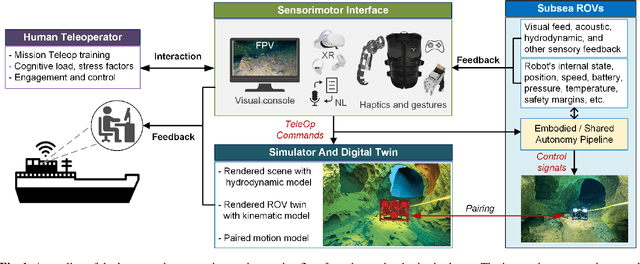
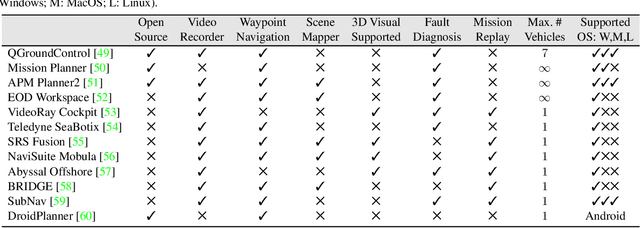
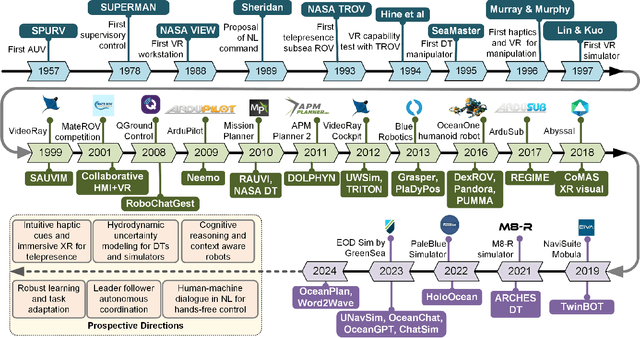
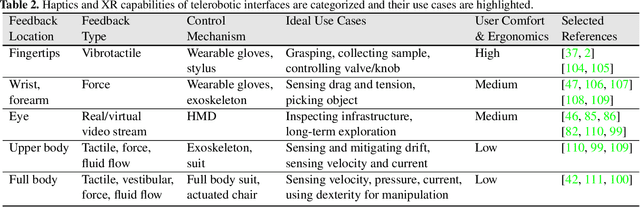
This review explores the evolution of human-machine interfaces (HMIs) for subsea telerobotics, tracing back the transition from traditional first-person "soda-straw" consoles (narrow field-of-view camera feed) to advanced interfaces powered by gesture recognition, virtual reality, and natural language models. First, we discuss various forms of subsea telerobotics applications, current state-of-the-art (SOTA) interface systems, and the challenges they face in robust underwater sensing, real-time estimation, and low-latency communication. Through this analysis, we highlight how advanced HMIs facilitate intuitive interactions between human operators and robots to overcome these challenges. A detailed review then categorizes and evaluates the cutting-edge HMI systems based on their offered features from both human perspectives (e.g., enhancing operator control and situational awareness) and machine perspectives (e.g., improving safety, mission accuracy, and task efficiency). Moreover, we examine the literature on bidirectional interaction and intelligent collaboration in terms of sensory feedback and intuitive control mechanisms for both physical and virtual interfaces. The paper concludes by identifying critical challenges, open research questions, and future directions, emphasizing the need for multidisciplinary collaboration in subsea telerobotics.