 Add to Chrome
 Add to Firefox
 Add to Edge
Dual-Pathway Geometry-Aware MLLM for Spatial Intelligence
May 25, 2026
Spatial understanding of the physical world from 2D visual inputs hinges on two complementary forms of geometric knowledge: holistic 3D structural perception and fine-grained metric scale estimation. Existing multimodal large language models (MLLMs) typically address only one facet, ingesting either depth maps or point clouds as additional model inputs, which incurs substantial computational overhead and inherits the generalization limitations of upstream prediction models. We propose GAMSI, a dual-pathway Geometry-Aware MLLM for Spatial Intelligence that takes only RGB images as input while internalizing both forms of geometric prior within a unified autoregressive backbone. Specifically, we introduce Metric-Structure Decoupled Queries (MSDQ) which employ two groups of learnable queries to respectively extract dense metric signals and sparse structural cues from the shared visual context, with a task-decoupled attention mask further preventing the two pathways from contaminating each other. Building on this, an Expert-Guided Visual Grounding (EVG) module projects the aggregated cues back to frame-level visual features and aligns them with vision foundation models, which serve purely as training-time supervision, rather than as model inputs. We further build a multi-task spatial instruction-tuning dataset (MTS) comprising 152{,}776 samples spanning 13 task types and three visual modalities, consolidated from six public datasets. Trained with a two-stage curriculum, GAMSI achieves state-of-the-art performance on seven spatial intelligence benchmarks.

Self-Consistent Latent Reasoning: Long Latent Sequence Reasoning for Vision-Language Model
May 13, 2026In language reasoning, longer chains of thought consistently yield better performance, which naturally suggests that visual latent reasoning may likewise benefit from longer latent sequences. However, we discover a counterintuitive phenomenon: the performance of existing latent visual reasoning methods systematically degrades as the latent sequence grows longer. We reveal the root cause: Information Gain Collapse -- autoregressive generation makes each step highly dependent on prior outputs, so subsequent tokens can barely introduce new information. We further identify that heavily pooled ($\geq 128\times$) image embeddings used as supervision targets provide no more signal than meaningless placeholders. Motivated by these insights, we propose SCOLAR (Self-COnsistent LAtent Reasoning), which introduces a lightweight detransformer that leverages the LLM's full-sequence hidden states to generate auxiliary visual tokens in a single shot, with each token independently anchored to the original visual space. Combined with three-stage SFT and ALPO reinforcement learning, SCOLAR extends acceptable latent CoT length by over $30\times$, achieves state-of-the-art among open-source models on real-world reasoning benchmarks (+14.12% over backbone), and demonstrates strong out-of-distribution generalization.
StreamingClaw Technical Report
Mar 23, 2026Applications such as embodied intelligence rely on a real-time perception-decision-action closed loop, posing stringent challenges for streaming video understanding. However, current agents suffer from fragmented capabilities, such as supporting only offline video understanding, lacking long-term multimodal memory mechanisms, or struggling to achieve real-time reasoning and proactive interaction under streaming inputs. These shortcomings have become a key bottleneck for preventing them from sustaining perception, making real-time decisions, and executing actions in real-world environments. To alleviate these issues, we propose StreamingClaw, a unified agent framework for streaming video understanding and embodied intelligence. It is also an OpenClaw-compatible framework that supports real-time, multimodal streaming interaction. StreamingClaw integrates five core capabilities: (1) It supports real-time streaming reasoning. (2) It supports reasoning about future events and proactive interaction under the online evolution of interaction objectives. (3) It supports multimodal long-term storage, hierarchical evolution, and efficient retrieval of shared memory across multiple agents. (4) It supports a closed-loop of perception-decision-action. In addition to conventional tools and skills, it also provides streaming tools and action-centric skills tailored for real-world physical environments. (5) It is compatible with the OpenClaw framework, allowing it to fully leverage the resources and support of the open-source community. With these designs, StreamingClaw integrates online real-time reasoning, multimodal long-term memory, and proactive interaction within a unified framework. Moreover, by translating decisions into executable actions, it enables direct control of the physical world, supporting practical deployment of embodied interaction.
ANPrompt: Anti-noise Prompt Tuning for Vision-Language Models
Aug 06, 2025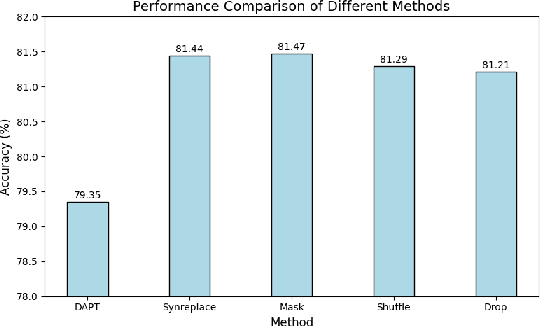
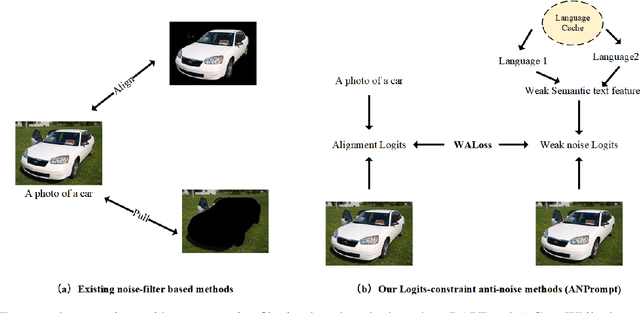


Prompt tuning has emerged as an efficient and effective technique for adapting vision-language models (VLMs) with low computational overhead. However, existing methods often overlook the vulnerability of prompt-tuned VLMs to weak semantic perturbations-such as subtle image or text noise-that degrade their generalization to unseen classes. To address this limitation, we propose ANPrompt, a novel prompt tuning framework designed to enhance robustness under such perturbations. ANPrompt first constructs weak noise text features by fusing original and noise-perturbed text embeddings, which are then clustered to form noise prompts. These noise prompts are integrated with learnable prompt tokens to generate anti-noise prompts, which are injected into the deeper layers of both image and text encoders. To further capture the noise-aware visual semantics, ANPrompt computes the Noise-Resistant Visual Prompt Prototype (NRVPP) by averaging the output prompt tokens from the vision encoder. Finally, ANPrompt introduces alignment, robustness, and anti-noise objectives by computing a Weak semantic noise Alignment Loss (WALoss) alongside the standard cross-entropy and sim loss. Experiments across 11 benchmarks demonstrate that ANPrompt consistently outperforms existing prompt tuning approaches, achieving superior robustness to semantic noise and improved generalization to novel categories.