 Add to Chrome
 Add to Firefox
 Add to Edge
MPC-Patch-Bench: Security-Aware LLM Code Patch for Multi-Party Computation
Jun 09, 2026
Repository-level benchmarks for evaluating Large Language Model (LLM) code repair on Secure Multi-Party Computation (MPC) software do not yet exist, and directly transplanting general-purpose benchmarks such as SWE-bench fails on three structural fronts: (i) MPC repositories are dominated by generic Python infrastructure rather than cryptographic logic; (ii) high-value MPC fixes lack the standardized tests rigid extraction pipelines require; and (iii) standard fail-to-pass evaluation is insufficient for code that must also be cryptographically safe. MPC is increasingly deployed for privacy-preserving machine learning, biomedical collaboration, and secure analytics. Existing MPC-specific code-synthesis efforts cover only operator-level or single-framework tasks; evaluating LLM agents on real repository-level MPC repair instead demands MPC-aware data curation and a verifier matched to the security and numerical-fidelity guarantees MPC programs must obey neither of which existing benchmarks provide. We introduce MPC-Patch-Bench, a repository-level benchmark organised around two frameworks. (1)The Data Curation Framework combines a domain-specific curation agent that filters raw pull requests through three cryptographic layers with a human-AI completion engine that synthesizes missing problem statements and Fail-to-Pass/Pass-to-Pass tests, yielding 205 fully verified instances. (2)The MPC Verifier provides dedicated security and numerical-fidelity checks via dynamic differential testing against plaintext oracles and MPC-specific static analysis rules that flag unsafe reveals, insecure arithmetic, and illegal public/private casts. The strongest evaluated LLM functionally resolves only 22.9% of MPC-Patch-Bench tasks; the MPC Verifier further reduces verified resolution to 17.1%, with up to 40% of functionally-passing patches rejected for cryptographic or numerical-fidelity violations.

SpikeHash: Learning Binary Codes with Spiking Neural Networks for Cross-Modal Hashing Retrieval
May 30, 2026Cross-modal hashing retrieval encodes heterogeneous data into compact binary codes for efficient Hamming-space search. Existing methods usually learn cross-modal semantics in continuous feature spaces and generate binary codes through a final sign operation, which weakly couples training optimization with discrete hash retrieval. We propose SpikeHash, a unified spiking framework that formulates cross-modal hashing as spike-state evolution, directional spike interaction, and competitive spike readout. Specifically, SpikeHash converts image and text features into multi-timestep spike sequences. In a shared Hamming space, the two spike sequences jointly drive the temporal evolution of a shared hash state. Cross-modal interaction is further performed through directional spike modulation, enabling each modality to influence the firing dynamics of the other. Crucially, SpikeHash replaces the conventional continuous hash head with a positive-negative spiking hash readout, where each hash bit is produced by temporal competition between paired spike channels. Experimental results show that SpikeHash achieves competitive retrieval accuracy on three benchmark datasets while reducing the parameter size, operation count, and estimated energy of the hash learning stage, suggesting a compact spiking alternative to conventional continuous hash mapping. The project page is available at https://shuqiao-111.github.io/.
Phase-Conditioned Imitation Learning with Autonomous Failure Recovery for Robust Deformable Object Manipulation
May 28, 2026This paper presents a phase-conditioned, force-aware framework for robust deformable object manipulation. Standard imitation learning policies such as Action Chunking with Transformers (ACT) rely on a Markovian assumption at inference, causing state aliasing when visually similar observations require contradictory actions and preventing autonomous recovery from execution failures. We address this with a closed-loop hierarchical architecture. A FiLM-conditioned ACT encoder modulates feature extraction based on the current task phase, enabling a single unified policy to produce phase-specific behaviors while sharing action dynamics across phases. A multi-modal phase predictor fusing visual, force, and pose feedback estimates the phase in real time, detecting contact failures that are invisible to vision alone and autonomously triggering recovery trajectories. The system is completed by a hybrid impedance controller for compliant execution and a haptic teleoperation interface for force-aware data collection. Ablation studies show that FiLM-based modulation significantly outperforms both unconditioned and token-level conditioned baselines, and t-SNE analysis confirms that FiLM induces well-separated, phase-specific feature representations. Validated on hanging and removing a T-shirt with dual arms, the closed-loop system improves the hanging success rate from 56\% to 87\% through autonomous error recovery. Code and videos: https://leledeyuan00.github.io/phaser/
ANPrompt: Anti-noise Prompt Tuning for Vision-Language Models
Aug 06, 2025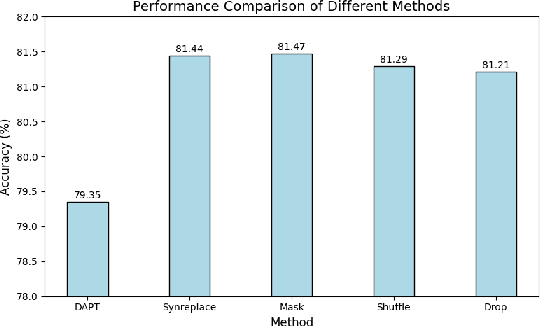
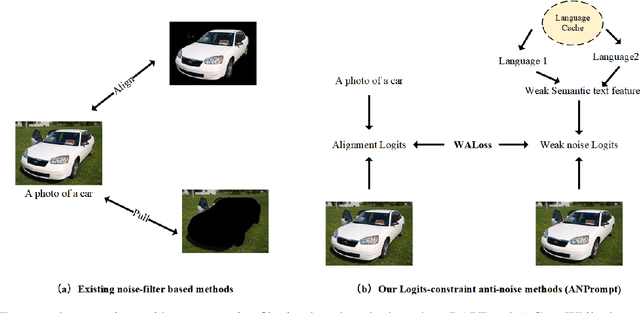


Prompt tuning has emerged as an efficient and effective technique for adapting vision-language models (VLMs) with low computational overhead. However, existing methods often overlook the vulnerability of prompt-tuned VLMs to weak semantic perturbations-such as subtle image or text noise-that degrade their generalization to unseen classes. To address this limitation, we propose ANPrompt, a novel prompt tuning framework designed to enhance robustness under such perturbations. ANPrompt first constructs weak noise text features by fusing original and noise-perturbed text embeddings, which are then clustered to form noise prompts. These noise prompts are integrated with learnable prompt tokens to generate anti-noise prompts, which are injected into the deeper layers of both image and text encoders. To further capture the noise-aware visual semantics, ANPrompt computes the Noise-Resistant Visual Prompt Prototype (NRVPP) by averaging the output prompt tokens from the vision encoder. Finally, ANPrompt introduces alignment, robustness, and anti-noise objectives by computing a Weak semantic noise Alignment Loss (WALoss) alongside the standard cross-entropy and sim loss. Experiments across 11 benchmarks demonstrate that ANPrompt consistently outperforms existing prompt tuning approaches, achieving superior robustness to semantic noise and improved generalization to novel categories.
Rt-Track: Robust Tricks for Multi-Pedestrian Tracking
Mar 16, 2023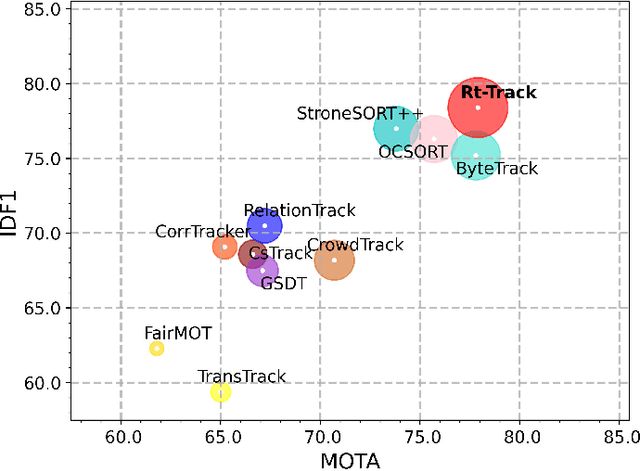
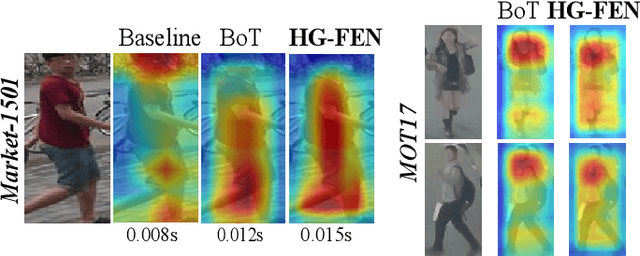
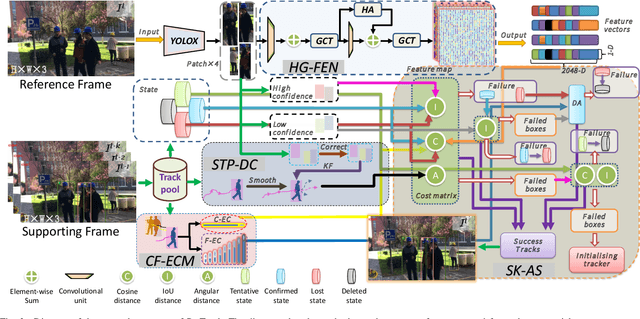
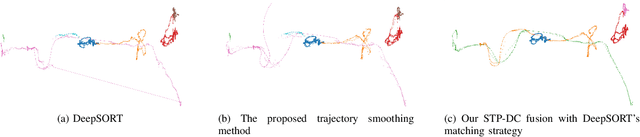
Object tracking is divided into single-object tracking (SOT) and multi-object tracking (MOT). MOT aims to maintain the identities of multiple objects across a series of continuous video sequences. In recent years, MOT has made rapid progress. However, modeling the motion and appearance models of objects in complex scenes still faces various challenging issues. In this paper, we design a novel direction consistency method for smooth trajectory prediction (STP-DC) to increase the modeling of motion information and overcome the lack of robustness in previous methods in complex scenes. Existing methods use pedestrian re-identification (Re-ID) to model appearance, however, they extract more background information which lacks discriminability in occlusion and crowded scenes. We propose a hyper-grain feature embedding network (HG-FEN) to enhance the modeling of appearance models, thus generating robust appearance descriptors. We also proposed other robustness techniques, including CF-ECM for storing robust appearance information and SK-AS for improving association accuracy. To achieve state-of-the-art performance in MOT, we propose a robust tracker named Rt-track, incorporating various tricks and techniques. It achieves 79.5 MOTA, 76.0 IDF1 and 62.1 HOTA on the test set of MOT17.Rt-track also achieves 77.9 MOTA, 78.4 IDF1 and 63.3 HOTA on MOT20, surpassing all published methods.
SA-DNet: A on-demand semantic object registration network adapting to non-rigid deformation
Oct 18, 2022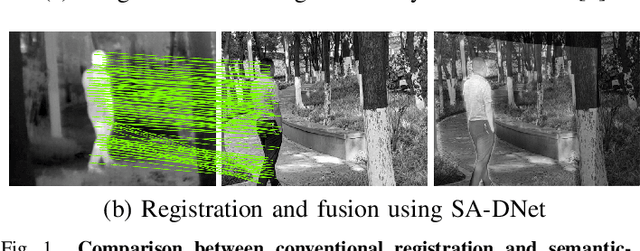
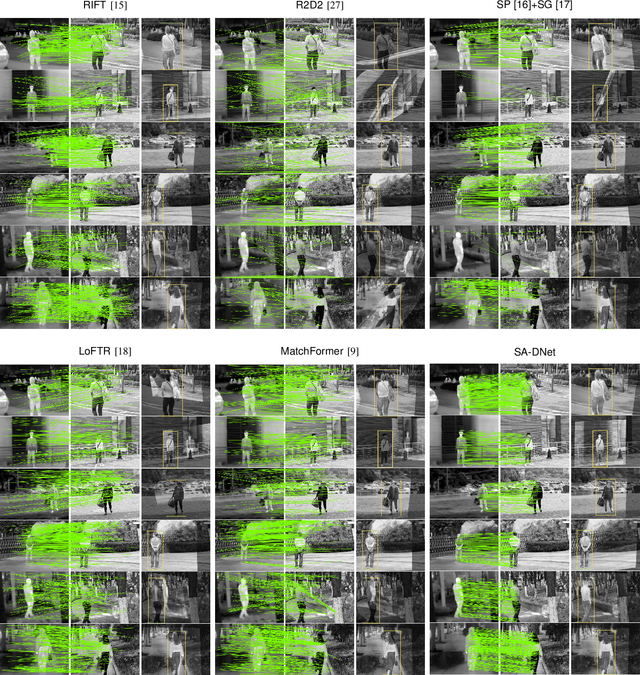
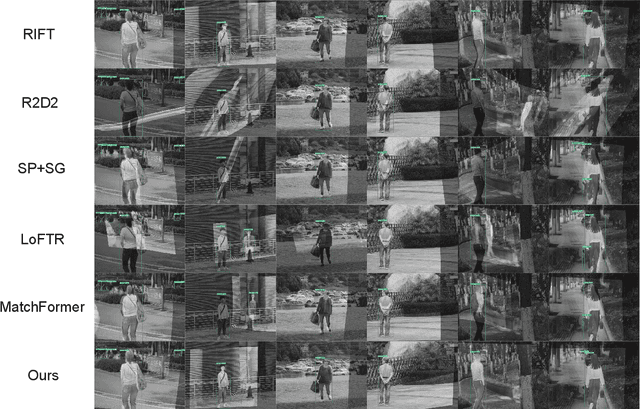
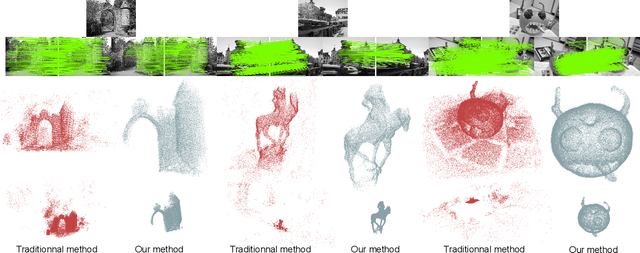
As an essential processing step before the fusing of infrared and visible images, the performance of image registration determines whether the two images can be fused at correct spatial position. In the actual scenario, the varied imaging devices may lead to a change in perspective or time gap between shots, making significant non-rigid spatial relationship in infrared and visible images. Even if a large number of feature points are matched, the registration accuracy may still be inadequate, affecting the result of image fusion and other vision tasks. To alleviate this problem, we propose a Semantic-Aware on-Demand registration network (SA-DNet), which mainly purpose is to confine the feature matching process to the semantic region of interest (sROI) by designing semantic-aware module (SAM) and HOL-Deep hybrid matching module (HDM). After utilizing TPS to transform infrared and visible images based on the corresponding feature points in sROI, the registered images are fused using image fusion module (IFM) to achieve a fully functional registration and fusion network. Moreover, we point out that for different demands, this type of approach allows us to select semantic objects for feature matching as needed and accomplishes task-specific registration based on specific requirements. To demonstrate the robustness of SA-DNet for non-rigid distortions, we conduct extensive experiments by comparing SA-DNet with five state-of-the-art infrared and visible image feature matching methods, and the experimental results show that our method adapts better to the presence of non-rigid distortions in the images and provides semantically well-registered images.