 Add to Chrome
 Add to Firefox
 Add to Edge
Sparse Task Vector Mixup with Hypernetworks for Efficient Knowledge Transfer in Whole-Slide Image Prognosis
Mar 11, 2026
Whole-Slide Images (WSIs) are widely used for estimating the prognosis of cancer patients. Current studies generally follow a cancer-specific learning paradigm. However, the available training samples for one cancer type are usually scarce in pathology. Consequently, the model often struggles to learn generalizable knowledge, thus performing worse on the tumor samples with inherent high heterogeneity. Although multi-cancer joint learning and knowledge transfer approaches have been explored recently to address it, they either rely on large-scale joint training or extensive inference across multiple models, posing new challenges in computational efficiency. To this end, this paper proposes a new scheme, Sparse Task Vector Mixup with Hypernetworks (STEPH). Unlike previous ones, it efficiently absorbs generalizable knowledge from other cancers for the target via model merging: i) applying task vector mixup to each source-target pair and then ii) sparsely aggregating task vector mixtures to obtain an improved target model, driven by hypernetworks. Extensive experiments on 13 cancer datasets show that STEPH improves over cancer-specific learning and an existing knowledge transfer baseline by 5.14% and 2.01%, respectively. Moreover, it is a more efficient solution for learning prognostic knowledge from other cancers, without requiring large-scale joint training or extensive multi-model inference. Code is publicly available at https://github.com/liupei101/STEPH.

Spectral-Structured Diffusion for Single-Image Rain Removal
Mar 10, 2026Rain streaks manifest as directional and frequency-concentrated structures that overlap across multiple scales, making single-image rain removal particularly challenging. While diffusion-based restoration models provide a powerful framework for progressive denoising, standard spatial-domain diffusion does not explicitly account for such structured spectral characteristics. We introduce SpectralDiff, a spectral-structured diffusion-based framework tailored for single-image rain removal. Rather than redefining the diffusion formulation, our method incorporates structured spectral perturbations to guide the progressive suppression of multi-directional rain components. To support this design, we further propose a full-product U-Net architecture that leverages the convolution theorem to replace convolution operations with element-wise product layers, improving computational efficiency while preserving modeling capacity. Extensive experiments on synthetic and real-world benchmarks demonstrate that SpectralDiff achieves competitive rain removal performance with improved model compactness and favorable inference efficiency compared to existing diffusion-based approaches.
Structured Prototype-Guided Adaptation for EEG Foundation Models
Feb 19, 2026Electroencephalography (EEG) foundation models (EFMs) have achieved strong performance under full fine-tuning but exhibit poor generalization when subject-level supervision is limited, a common constraint in real-world clinical settings. We show that this failure stems not merely from limited supervision, but from a structural mismatch between noisy, limited supervision and the highly plastic parameter space of EFMs. To address this challenge, we propose SCOPE, a Structured COnfidence-aware Prototype-guided adaptation framework for EFM fine-tuning. SCOPE follows a two-stage pipeline. In the first stage, we construct reliable external supervision by learning geometry-regularized task priors, constructing balanced class-level prototypes over the resulting embeddings, and producing confidence-aware pseudo-labels from their agreement to filter unreliable signals on unlabeled data. In the second stage, we introduce ProAdapter, which adapts frozen EEG foundation models via a lightweight adapter conditioned on the structured prototypes. Experiments across three EEG tasks and five foundation model backbones demonstrate that SCOPE consistently achieves strong performance and efficiency under label-limited cross-subject settings.
DANCER: Dance ANimation via Condition Enhancement and Rendering with diffusion model
Oct 31, 2025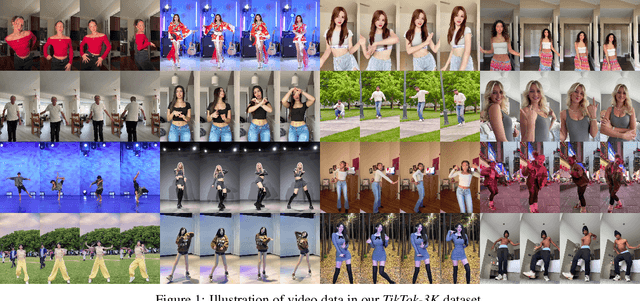
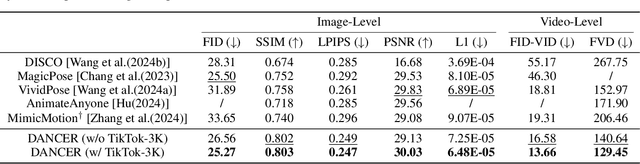
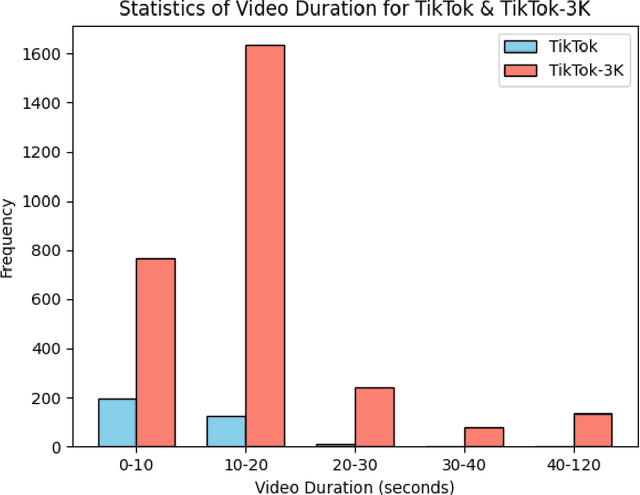

Recently, diffusion models have shown their impressive ability in visual generation tasks. Besides static images, more and more research attentions have been drawn to the generation of realistic videos. The video generation not only has a higher requirement for the quality, but also brings a challenge in ensuring the video continuity. Among all the video generation tasks, human-involved contents, such as human dancing, are even more difficult to generate due to the high degrees of freedom associated with human motions. In this paper, we propose a novel framework, named as DANCER (Dance ANimation via Condition Enhancement and Rendering with Diffusion Model), for realistic single-person dance synthesis based on the most recent stable video diffusion model. As the video generation is generally guided by a reference image and a video sequence, we introduce two important modules into our framework to fully benefit from the two inputs. More specifically, we design an Appearance Enhancement Module (AEM) to focus more on the details of the reference image during the generation, and extend the motion guidance through a Pose Rendering Module (PRM) to capture pose conditions from extra domains. To further improve the generation capability of our model, we also collect a large amount of video data from Internet, and generate a novel datasetTikTok-3K to enhance the model training. The effectiveness of the proposed model has been evaluated through extensive experiments on real-world datasets, where the performance of our model is superior to that of the state-of-the-art methods. All the data and codes will be released upon acceptance.
CodeBrain: Bridging Decoupled Tokenizer and Multi-Scale Architecture for EEG Foundation Model
Jun 10, 2025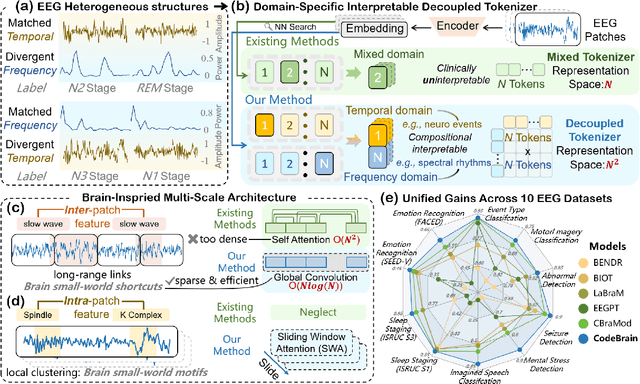
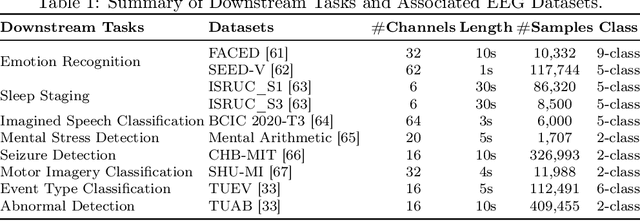
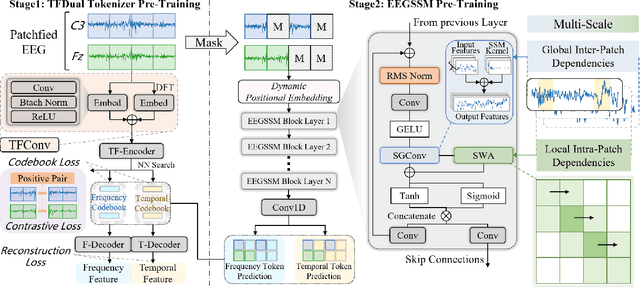
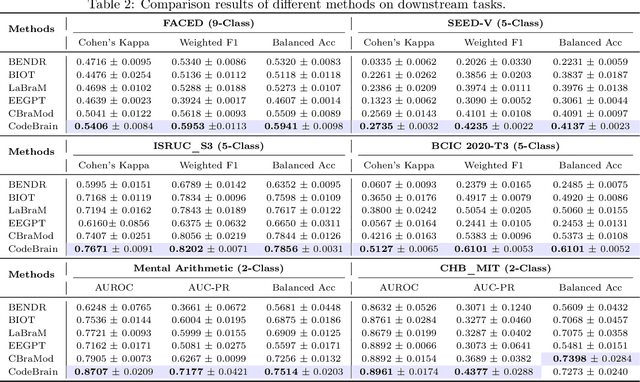
Electroencephalography (EEG) provides real-time insights into brain activity and is widely used in neuroscience. However, variations in channel configurations, sequence lengths, and task objectives limit the transferability of traditional task-specific models. Although recent EEG foundation models (EFMs) aim to learn generalizable representations, they struggle with limited heterogeneous representation capacity and inefficiency in capturing multi-scale brain dependencies. To address these challenges, we propose CodeBrain, an efficient EFM structurally aligned with brain organization, trained in two stages. (1) We introduce a TFDual-Tokenizer that independently tokenizes heterogeneous temporal and frequency components, enabling a quadratic expansion of the discrete representation space. This also offers a degree of interpretability through cross-domain token analysis. (2) We propose the EEGSSM, which combines a structured global convolution architecture and a sliding window attention mechanism to jointly model sparse long-range and local dependencies. Unlike fully connected Transformer models, EEGSSM better reflects the brain's small-world topology and efficiently captures EEG's inherent multi-scale structure. EEGSSM is trained with a masked self-supervised learning objective to predict token indices obtained in TFDual-Tokenizer. Comprehensive experiments on 10 public EEG datasets demonstrate the generalizability of CodeBrain with linear probing. By offering biologically informed and interpretable EEG modeling, CodeBrain lays the foundation for future neuroscience research. Both code and pretraining weights will be released in the future version.
EsurvFusion: An evidential multimodal survival fusion model based on Gaussian random fuzzy numbers
Dec 02, 2024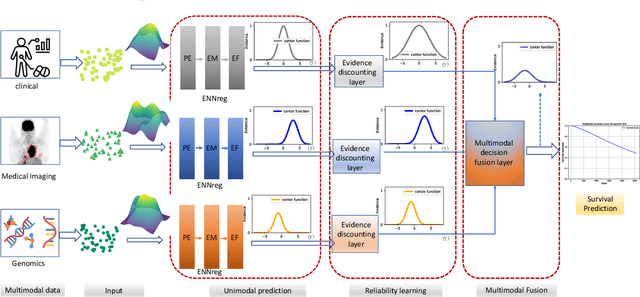
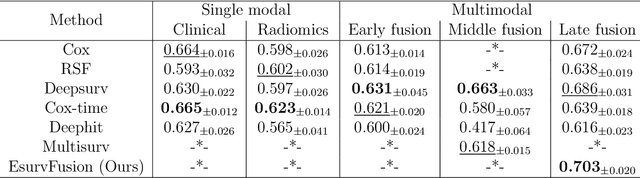
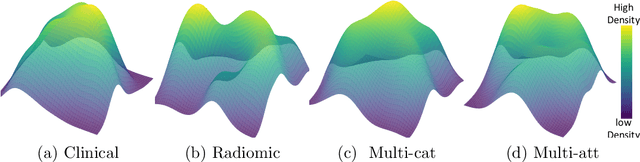
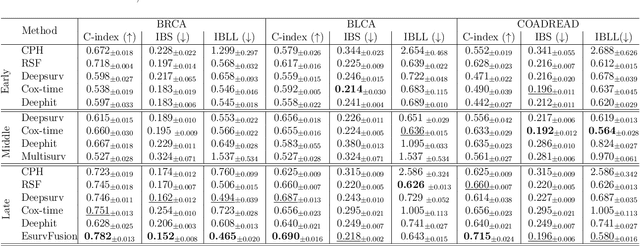
Multimodal survival analysis aims to combine heterogeneous data sources (e.g., clinical, imaging, text, genomics) to improve the prediction quality of survival outcomes. However, this task is particularly challenging due to high heterogeneity and noise across data sources, which vary in structure, distribution, and context. Additionally, the ground truth is often censored (uncertain) due to incomplete follow-up data. In this paper, we propose a novel evidential multimodal survival fusion model, EsurvFusion, designed to combine multimodal data at the decision level through an evidence-based decision fusion layer that jointly addresses both data and model uncertainty while incorporating modality-level reliability. Specifically, EsurvFusion first models unimodal data with newly introduced Gaussian random fuzzy numbers, producing unimodal survival predictions along with corresponding aleatoric and epistemic uncertainties. It then estimates modality-level reliability through a reliability discounting layer to correct the misleading impact of noisy data modalities. Finally, a multimodal evidence-based fusion layer is introduced to combine the discounted predictions to form a unified, interpretable multimodal survival analysis model, revealing each modality's influence based on the learned reliability coefficients. This is the first work that studies multimodal survival analysis with both uncertainty and reliability. Extensive experiments on four multimodal survival datasets demonstrate the effectiveness of our model in handling high heterogeneity data, establishing new state-of-the-art on several benchmarks.
Adaptively Controllable Diffusion Model for Efficient Conditional Image Generation
Nov 19, 2024With the development of artificial intelligence, more and more attention has been put onto generative models, which represent the creativity, a very important aspect of intelligence. In recent years, diffusion models have been studied and proven to be more reasonable and effective than previous methods. However, common diffusion frameworks suffer from controllability problems. Although extra conditions have been considered by some work to guide the diffusion process for a specific target generation, it only controls the generation result but not its process. In this work, we propose a new adaptive framework, $\textit{Adaptively Controllable Diffusion (AC-Diff) Model}$, to automatically and fully control the generation process, including not only the type of generation result but also the length and parameters of the generation process. Both inputs and conditions will be first fed into a $\textit{Conditional Time-Step (CTS) Module}$ to determine the number of steps needed for a generation. Then according to the length of the process, the diffusion rate parameters will be estimated through our $\textit{Adaptive Hybrid Noise Schedule (AHNS) Module}$. We further train the network with the corresponding adaptive sampling mechanism to learn how to adjust itself according to the conditions for the overall performance improvement. To enable its practical applications, AC-Diff is expected to largely reduce the average number of generation steps and execution time while maintaining the same performance as done in the literature diffusion models.
Puppet-CNN: Input-Adaptive Convolutional Neural Networks with Model Compression using Ordinary Differential Equation
Nov 19, 2024Convolutional Neural Network (CNN) has been applied to more and more scenarios due to its excellent performance in many machine learning tasks, especially with deep and complex structures. However, as the network goes deeper, more parameters need to be stored and optimized. Besides, almost all common CNN models adopt "train-and-use" strategy where the structure is pre-defined and the kernel parameters are fixed after the training with the same structure and set of parameters used for all data without considering the content complexity. In this paper, we propose a new CNN framework, named as $\textit{Puppet-CNN}$, which contains two modules: a $\textit{puppet module}$ and a $\textit{puppeteer module}$. The puppet module is a CNN model used to actually process the input data just like other works, but its depth and kernels are generated by the puppeteer module (realized with Ordinary Differential Equation (ODE)) based on the input complexity each time. By recurrently generating kernel parameters in the puppet module, we can take advantage of the dependence among kernels of different convolutional layers to significantly reduce the size of CNN model by only storing and training the parameters of the much smaller puppeteer ODE module. Through experiments on several datasets, our method has proven to be superior than the traditional CNNs on both performance and efficiency. The model size can be reduced more than 10 times.
Map-Free Trajectory Prediction with Map Distillation and Hierarchical Encoding
Nov 17, 2024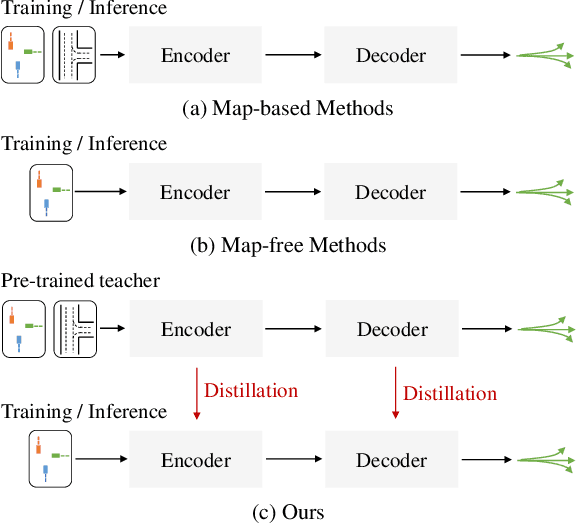
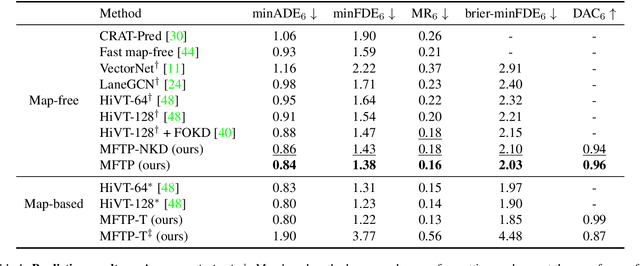
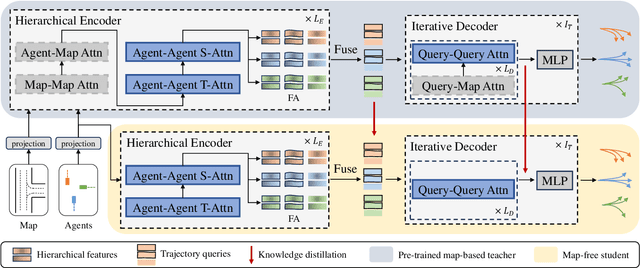
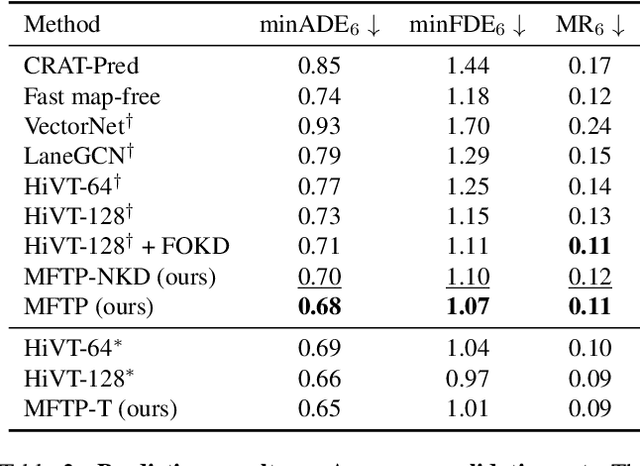
Reliable motion forecasting of surrounding agents is essential for ensuring the safe operation of autonomous vehicles. Many existing trajectory prediction methods rely heavily on high-definition (HD) maps as strong driving priors. However, the availability and accuracy of these priors are not guaranteed due to substantial costs to build, localization errors of vehicles, or ongoing road constructions. In this paper, we introduce MFTP, a Map-Free Trajectory Prediction method that offers several advantages. First, it eliminates the need for HD maps during inference while still benefiting from map priors during training via knowledge distillation. Second, we present a novel hierarchical encoder that effectively extracts spatial-temporal agent features and aggregates them into multiple trajectory queries. Additionally, we introduce an iterative decoder that sequentially decodes trajectory queries to generate the final predictions. Extensive experiments show that our approach achieves state-of-the-art performance on the Argoverse dataset under the map-free setting.
Evidential time-to-event prediction model with well-calibrated uncertainty estimation
Nov 12, 2024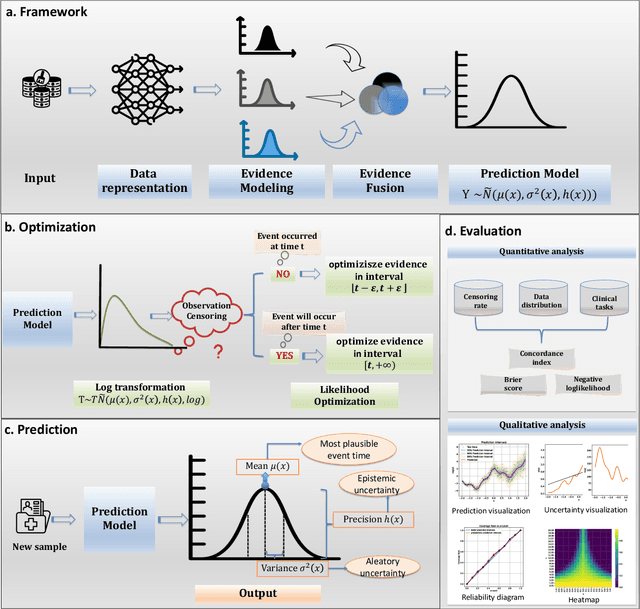

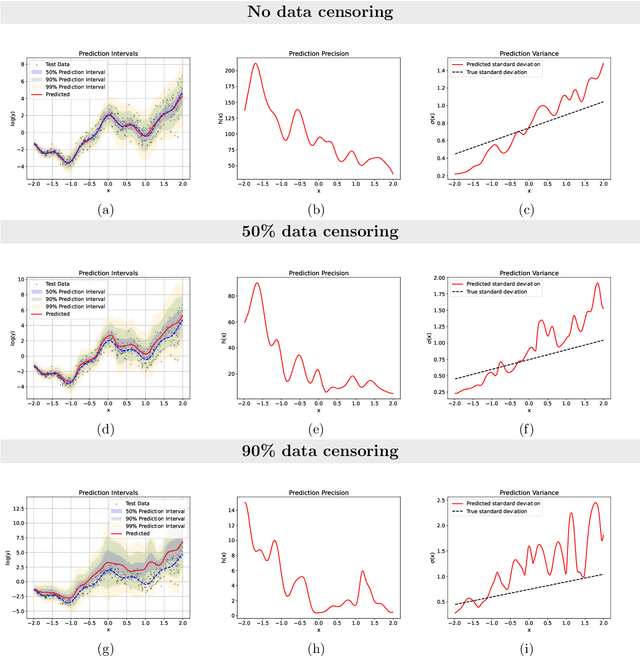
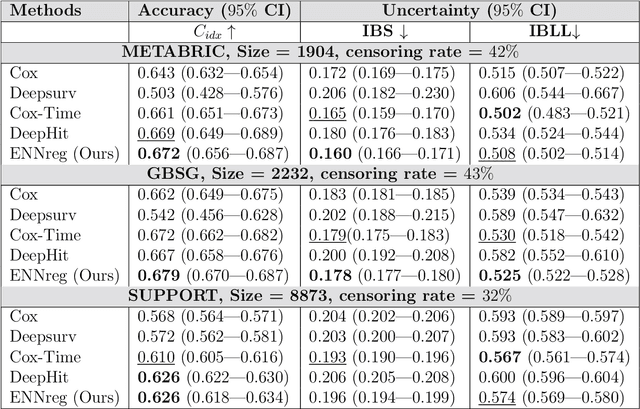
Time-to-event analysis, or Survival analysis, provides valuable insights into clinical prognosis and treatment recommendations. However, this task is typically more challenging than other regression tasks due to the censored observations. Moreover, concerns regarding the reliability of predictions persist among clinicians, mainly attributed to the absence of confidence assessment, robustness, and calibration of prediction. To address those challenges, we introduce an evidential regression model designed especially for time-to-event prediction tasks, with which the most plausible event time, is directly quantified by aggregated Gaussian random fuzzy numbers (GRFNs). The GRFNs are a newly introduced family of random fuzzy subsets of the real line that generalizes both Gaussian random variables and Gaussian possibility distributions. Different from conventional methods that construct models based on strict data distribution, e.g., proportional hazard function, our model only assumes the event time is encoded in a real line GFRN without any strict distribution assumption, therefore offering more flexibility in complex data scenarios. Furthermore, the epistemic and aleatory uncertainty regarding the event time is quantified within the aggregated GRFN as well. Our model can, therefore, provide more detailed clinical decision-making guidance with two more degrees of information. The model is fit by minimizing a generalized negative log-likelihood function that accounts for data censoring based on uncertainty evidence reasoning. Experimental results on simulated datasets with varying data distributions and censoring scenarios, as well as on real-world datasets across diverse clinical settings and tasks, demonstrate that our model achieves both accurate and reliable performance, outperforming state-of-the-art methods.