 Add to Chrome
 Add to Firefox
 Add to Edge
Sparse Task Vector Mixup with Hypernetworks for Efficient Knowledge Transfer in Whole-Slide Image Prognosis
Mar 11, 2026
Whole-Slide Images (WSIs) are widely used for estimating the prognosis of cancer patients. Current studies generally follow a cancer-specific learning paradigm. However, the available training samples for one cancer type are usually scarce in pathology. Consequently, the model often struggles to learn generalizable knowledge, thus performing worse on the tumor samples with inherent high heterogeneity. Although multi-cancer joint learning and knowledge transfer approaches have been explored recently to address it, they either rely on large-scale joint training or extensive inference across multiple models, posing new challenges in computational efficiency. To this end, this paper proposes a new scheme, Sparse Task Vector Mixup with Hypernetworks (STEPH). Unlike previous ones, it efficiently absorbs generalizable knowledge from other cancers for the target via model merging: i) applying task vector mixup to each source-target pair and then ii) sparsely aggregating task vector mixtures to obtain an improved target model, driven by hypernetworks. Extensive experiments on 13 cancer datasets show that STEPH improves over cancer-specific learning and an existing knowledge transfer baseline by 5.14% and 2.01%, respectively. Moreover, it is a more efficient solution for learning prognostic knowledge from other cancers, without requiring large-scale joint training or extensive multi-model inference. Code is publicly available at https://github.com/liupei101/STEPH.

AdaptMol: Adaptive Fusion from Sequence String to Topological Structure for Few-shot Drug Discovery
May 17, 2025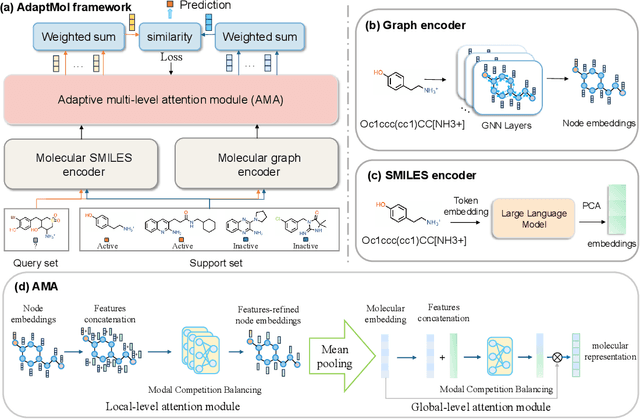
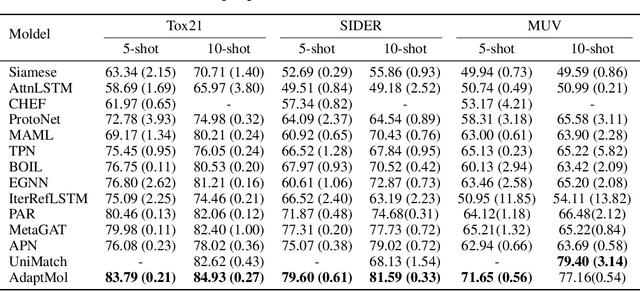
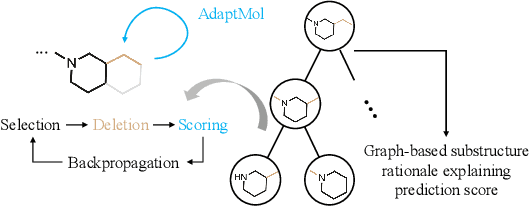
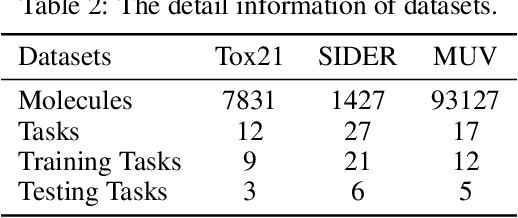
Accurate molecular property prediction (MPP) is a critical step in modern drug development. However, the scarcity of experimental validation data poses a significant challenge to AI-driven research paradigms. Under few-shot learning scenarios, the quality of molecular representations directly dictates the theoretical upper limit of model performance. We present AdaptMol, a prototypical network integrating Adaptive multimodal fusion for Molecular representation. This framework employs a dual-level attention mechanism to dynamically integrate global and local molecular features derived from two modalities: SMILES sequences and molecular graphs. (1) At the local level, structural features such as atomic interactions and substructures are extracted from molecular graphs, emphasizing fine-grained topological information; (2) At the global level, the SMILES sequence provides a holistic representation of the molecule. To validate the necessity of multimodal adaptive fusion, we propose an interpretable approach based on identifying molecular active substructures to demonstrate that multimodal adaptive fusion can efficiently represent molecules. Extensive experiments on three commonly used benchmarks under 5-shot and 10-shot settings demonstrate that AdaptMol achieves state-of-the-art performance in most cases. The rationale-extracted method guides the fusion of two modalities and highlights the importance of both modalities.