 Add to Chrome
 Add to Firefox
 Add to Edge
Imaging-101: Benchmarking LLM Coding Agents on Scientific Computational Imaging
Jul 12, 2026
Computational imaging, which recovers hidden signals from indirect, noisy measurements, underpins quantitative discovery across scientific disciplines, yet building a correct reconstruction pipeline demands deep domain expertise and remains laborious even for domain scientists. We introduce Imaging-101, a benchmark of 57 expert-verified computational imaging tasks spanning six scientific domains, each grounded in a peer-reviewed paper and canonicalized into a standardized four-stage pipeline (preprocessing, forward physics modeling, inverse solver, and visualization) Three evaluation tracks (planning, function-level unit tests, and end-to-end reconstruction) probe distinct agent capabilities across the full pipeline. Evaluating seven frontier LLMs uncovers systematic challenges in applying coding agents to computational imaging that go beyond those exposed by general coding benchmarks, spanning algorithm selection, physical convention handling, and pipeline integration. These findings highlight concrete capability gaps and point toward skill-augmented, domain-specialized agents as a practical path to reliable computational imaging assistance.

Hybrid Full Waveform Inversion Assisted by Rytov Approximation for Musculoskeletal Ultrasound Computed Tomography
May 24, 2026Ultrasound computed tomography is emerging as a promising safe and accessible modality for soft-tissue medical imaging, with full waveform inversion playing a key role in unlocking its full potential for high-resolution, quantitative reconstructions. Frequency domain full waveform inversion (FDFWI) for reconstructing spatial maps of acoustic properties in the musculoskeletal system is highly sensitive to the quality of low-frequency signals, making the final imaging outcome vulnerable to issues such as inappropriate initial models and strong scatterings related to bones. To address these challenges, we propose a hybrid full waveform inversion (HFWI) algorithm that incorporates a traveltime inversion algorithm based on the generalized Rytov approximation into the FDFWI framework. This hybrid strategy enhances early-stage inversion quality and substantially reduces sensitivity to the initial model, all while maintaining computational efficiency. Importantly, HFWI achieves results comparable to those obtained using well-constructed initial models, without incurring extra computational cost, thus enabling accurate imaging under realistic, bandwidth-limited conditions. In addition, we introduce a near real-time strategy to update first-arrival traveltimes based on forward-scattered phase variations without requiring extra wavefield simulations. Numerical simulations, as well as \textit{in vitro} and \textit{in vivo} experiments confirm the robustness and efficiency of the proposed approach. HFWI also shows promise to extend to more complex scenarios of musculoskeletal parametric reconstruction.
In vivo 3D ultrasound computed tomography of musculoskeletal tissues with generative neural physics
Aug 17, 2025Ultrasound computed tomography (USCT) is a radiation-free, high-resolution modality but remains limited for musculoskeletal imaging due to conventional ray-based reconstructions that neglect strong scattering. We propose a generative neural physics framework that couples generative networks with physics-informed neural simulation for fast, high-fidelity 3D USCT. By learning a compact surrogate of ultrasonic wave propagation from only dozens of cross-modality images, our method merges the accuracy of wave modeling with the efficiency and stability of deep learning. This enables accurate quantitative imaging of in vivo musculoskeletal tissues, producing spatial maps of acoustic properties beyond reflection-mode images. On synthetic and in vivo data (breast, arm, leg), we reconstruct 3D maps of tissue parameters in under ten minutes, with sensitivity to biomechanical properties in muscle and bone and resolution comparable to MRI. By overcoming computational bottlenecks in strongly scattering regimes, this approach advances USCT toward routine clinical assessment of musculoskeletal disease.
Neural Born Series Operator for Biomedical Ultrasound Computed Tomography
Dec 25, 2023Ultrasound Computed Tomography (USCT) provides a radiation-free option for high-resolution clinical imaging. Despite its potential, the computationally intensive Full Waveform Inversion (FWI) required for tissue property reconstruction limits its clinical utility. This paper introduces the Neural Born Series Operator (NBSO), a novel technique designed to speed up wave simulations, thereby facilitating a more efficient USCT image reconstruction process through an NBSO-based FWI pipeline. Thoroughly validated on comprehensive brain and breast datasets, simulated under experimental USCT conditions, the NBSO proves to be accurate and efficient in both forward simulation and image reconstruction. This advancement demonstrates the potential of neural operators in facilitating near real-time USCT reconstruction, making the clinical application of USCT increasingly viable and promising.
Deep Self-Paced Learning for Person Re-Identification
Oct 07, 2017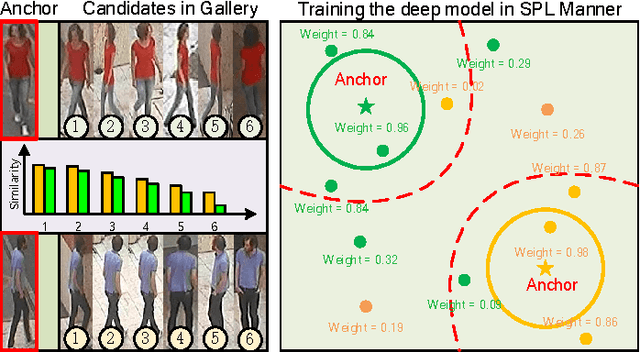
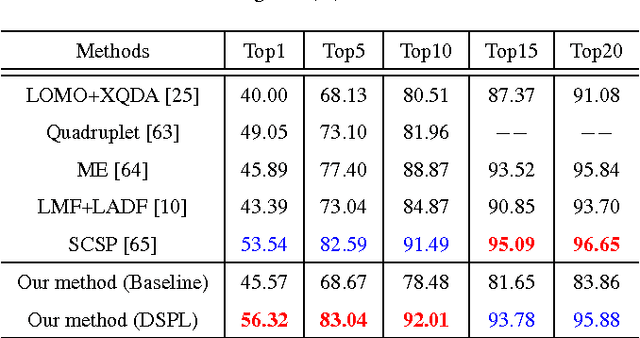
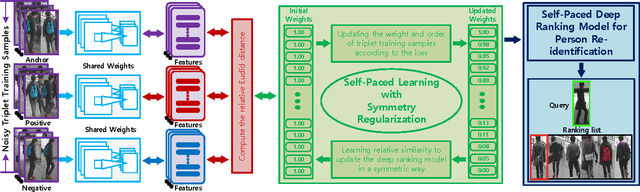
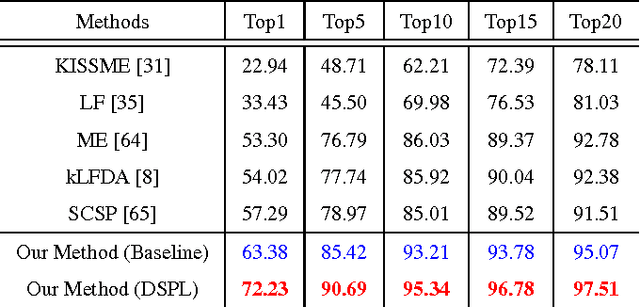
Person re-identification (Re-ID) usually suffers from noisy samples with background clutter and mutual occlusion, which makes it extremely difficult to distinguish different individuals across the disjoint camera views. In this paper, we propose a novel deep self-paced learning (DSPL) algorithm to alleviate this problem, in which we apply a self-paced constraint and symmetric regularization to help the relative distance metric training the deep neural network, so as to learn the stable and discriminative features for person Re-ID. Firstly, we propose a soft polynomial regularizer term which can derive the adaptive weights to samples based on both the training loss and model age. As a result, the high-confidence fidelity samples will be emphasized and the low-confidence noisy samples will be suppressed at early stage of the whole training process. Such a learning regime is naturally implemented under a self-paced learning (SPL) framework, in which samples weights are adaptively updated based on both model age and sample loss using an alternative optimization method. Secondly, we introduce a symmetric regularizer term to revise the asymmetric gradient back-propagation derived by the relative distance metric, so as to simultaneously minimize the intra-class distance and maximize the inter-class distance in each triplet unit. Finally, we build a part-based deep neural network, in which the features of different body parts are first discriminately learned in the lower convolutional layers and then fused in the higher fully connected layers. Experiments on several benchmark datasets have demonstrated the superior performance of our method as compared with the state-of-the-art approaches.