 Add to Chrome
 Add to Firefox
 Add to Edge
Safety, or Just Capability? A Validity Audit of Agent-Safety Benchmarks
Jul 30, 2026
Agent-safety benchmarks measure different behaviors, and their scores get quoted interchangeably as an agent's safety. We treat four of them (R-Judge, InjecAgent, AgentHarm, AgentDojo) as measurements to be validated, running each under its official implementation and author-provided scorer on up to 22 models, with MMLU and GPQA measured by us under one protocol as a capability composite. The metric is the first problem. On any binary trace-judgment benchmark scored by $F_1$, an ``always positive'' policy attains $F_1 = 2π/(1+π)$; on R-Judge that is $0.690$, above five of the 21 models that actually discriminate. The three broad-coverage benchmarks then rank the same 18 models differently, and the trade-off behind that disagreement is a small-panel artifact: R-Judge specificity against AgentHarm safety correlates $-0.64$ at $n{=}7$ and $+0.02$ at $n{=}18$, and a quarter of random size-7 subsets reach $|ρ| \geq 0.5$ around that near-zero value. Held-out validity turns on which outcome you pick. Capability predicts task success ($ρ{=}{+}0.60$) but correlates negatively with misalignment safety ($ρ{=}{-}0.44$, $n{=}21$). On their paired $n{=}20$ panel, the corresponding contrast is $Δ{=}{-}1.00$ (95% CI $[-1.48, -0.49]$, $p<0.001$), and it survives leave-one-organization-out and organization-clustered bootstrap analyses. On an expanded 41-model panel, the misalignment correlation weakens to $-0.16$ (95% CI $[-0.54, +0.22]$) and jailbreak strengthens to $+0.34$, though neither change is significant. \mbox{AgentHarm} shows the strongest held-out association, $ρ{=}{+}0.72$ with three-template jailbreak safety after controlling capability. But both instruments score harmful compliance, so this is evidence of convergent validity rather than general safety. Naming the benchmark, metric, target behavior, and model panel is the minimum a safety claim needs.

When LLM Reward Design Fails: Diagnostic-Driven Refinement for Sparse Structured RL
May 27, 2026For sparse, structured reinforcement-learning tasks with semantic reward-function interfaces, LLM-generated reward shaping is better framed as debugging than one-shot generation. We study PPO-trained agents using MiniGrid as core evaluation and MuJoCo as boundary stress test. Our audit finds two dominant one-shot failure modes -- reward flooding and semantic/API misunderstanding -- plus a rarer weak-shaping case. We propose diagnostic-driven iterative refinement, where training diagnostics and a failure-mode taxonomy guide targeted reward-function revision. Refinement improves DoorKey-8x8 from 2.3% to 97.6% and KeyCorridor from 31.2% to 86.7% with high seed-to-seed variance. Controls show these gains are not from retrying or extra training: metrics-only re-prompting yields large drops, while a static-vocabulary control recovers much of the gap (87.6%; 70.7%), showing the taxonomy prompt is a major mechanism and dynamic labels provide only partially isolated incremental evidence. Budget-matched and Best-of-3 comparisons separate refinement from selection and training-time effects. Component-removal tests, sensitivity analyses, and an audit against author labels provide converging evidence for the debugging interpretation while revealing calibration limits. Continuous-control results show the boundary: success-based diagnostics can misfire in dense-reward locomotion, and return-trend feedback removes one false-positive mechanism without robust gains. The low-call protocol is a cost contrast with population-based reward search, not a benchmark comparison. In four crossed-variance-design environments, point estimates suggest larger gains when LLM reward-function variance dominates but bootstrap intervals are wide. The method is bounded to sparse structured tasks with reliable interfaces under PPO; fields like event_text may help, hurt, or be neutral.
VisualLeakBench: Auditing the Fragility of Large Vision-Language Models against PII Leakage and Social Engineering
Mar 11, 2026As Large Vision-Language Models (LVLMs) are increasingly deployed in agent-integrated workflows and other deployment-relevant settings, their robustness against semantic visual attacks remains under-evaluated -- alignment is typically tested on explicit harmful content rather than privacy-critical multimodal scenarios. We introduce VisualLeakBench, an evaluation suite to audit LVLMs against OCR Injection and Contextual PII Leakage using 1,000 synthetically generated adversarial images with 8 PII types, validated on 50 in-the-wild (IRL) real-world screenshots spanning diverse visual contexts. We evaluate four frontier systems (GPT-5.2, Claude~4, Gemini-3 Flash, Grok-4) with Wilson 95% confidence intervals. Claude~4 achieves the lowest OCR ASR (14.2%) but the highest PII ASR (74.4%), exhibiting a comply-then-warn pattern -- where verbatim data disclosure precedes any safety-oriented language. Grok-4 achieves the lowest PII ASR (20.4%). A defensive system prompt eliminates PII leakage for two models, reduces Claude~4's leakage from 74.4% to 2.2%, but has no effect on Gemini-3 Flash on synthetic data. Strikingly, IRL validation reveals Gemini-3 Flash does respond to mitigation on real-world images (50% to 0%), indicating that mitigation robustness is template-sensitive rather than uniformly absent. We release our dataset and code for reproducible robustness and safety evaluation of deployment-relevant vision-language systems.
Automated Robotic Needle Puncture for Percutaneous Dilatational Tracheostomy
Feb 26, 2026Percutaneous dilatational tracheostomy (PDT) is frequently performed on patients in intensive care units for prolonged mechanical ventilation. The needle puncture, as the most critical step of PDT, could lead to adverse consequences such as major bleeding and posterior tracheal wall perforation if performed inaccurately. Current practices of PDT puncture are all performed manually with no navigation assistance, which leads to large position and angular errors (5 mm and 30 degree). To improve the accuracy and reduce the difficulty of the PDT procedure, we propose a system that automates the needle insertion using a velocity-controlled robotic manipulator. Guided using pose data from two electromagnetic sensors, one at the needle tip and the other inside the trachea, the robotic system uses an adaptive constrained controller to adapt the uncertain kinematic parameters online and avoid collisions with the patient's body and tissues near the target. Simulations were performed to validate the controller's implementation, and then four hundred PDT punctures were performed on a mannequin to evaluate the position and angular accuracy. The absolute median puncture position error was 1.7 mm (IQR: 1.9 mm) and midline deviation was 4.13 degree (IQR: 4.55 degree), measured by the sensor inside the trachea. The small deviations from the nominal puncture in a simulated experimental setup and formal guarantees of collision-free insertions suggest the feasibility of the robotic PDT puncture.
SASep: Saliency-Aware Structured Separation of Geometry and Feature for Open Set Learning on Point Clouds
Jun 16, 2025Recent advancements in deep learning have greatly enhanced 3D object recognition, but most models are limited to closed-set scenarios, unable to handle unknown samples in real-world applications. Open-set recognition (OSR) addresses this limitation by enabling models to both classify known classes and identify novel classes. However, current OSR methods rely on global features to differentiate known and unknown classes, treating the entire object uniformly and overlooking the varying semantic importance of its different parts. To address this gap, we propose Salience-Aware Structured Separation (SASep), which includes (i) a tunable semantic decomposition (TSD) module to semantically decompose objects into important and unimportant parts, (ii) a geometric synthesis strategy (GSS) to generate pseudo-unknown objects by combining these unimportant parts, and (iii) a synth-aided margin separation (SMS) module to enhance feature-level separation by expanding the feature distributions between classes. Together, these components improve both geometric and feature representations, enhancing the model's ability to effectively distinguish known and unknown classes. Experimental results show that SASep achieves superior performance in 3D OSR, outperforming existing state-of-the-art methods.
A No-Reference Medical Image Quality Assessment Method Based on Automated Distortion Recognition Technology: Application to Preprocessing in MRI-guided Radiotherapy
Dec 10, 2024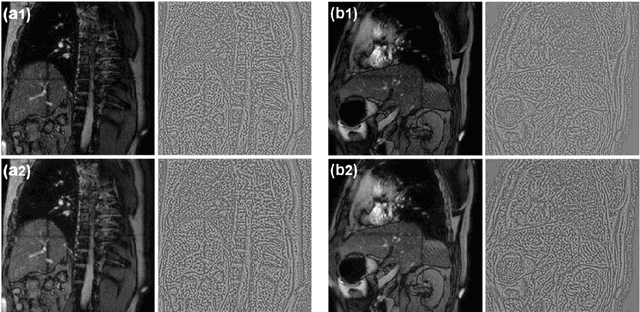


Objective:To develop a no-reference image quality assessment method using automated distortion recognition to boost MRI-guided radiotherapy precision.Methods:We analyzed 106,000 MR images from 10 patients with liver metastasis,captured with the Elekta Unity MR-LINAC.Our No-Reference Quality Assessment Model includes:1)image preprocessing to enhance visibility of key diagnostic features;2)feature extraction and directional analysis using MSCN coefficients across four directions to capture textural attributes and gradients,vital for identifying image features and potential distortions;3)integrative Quality Index(QI)calculation,which integrates features via AGGD parameter estimation and K-means clustering.The QI,based on a weighted MAD computation of directional scores,provides a comprehensive image quality measure,robust against outliers.LOO-CV assessed model generalizability and performance.Tumor tracking algorithm performance was compared with and without preprocessing to verify tracking accuracy enhancements.Results:Preprocessing significantly improved image quality,with the QI showing substantial positive changes and surpassing other metrics.After normalization,the QI's average value was 79.6 times higher than CNR,indicating improved image definition and contrast.It also showed higher sensitivity in detail recognition with average values 6.5 times and 1.7 times higher than Tenengrad gradient and entropy.The tumor tracking algorithm confirmed significant tracking accuracy improvements with preprocessed images,validating preprocessing effectiveness.Conclusions:This study introduces a novel no-reference image quality evaluation method based on automated distortion recognition,offering a new quality control tool for MRIgRT tumor tracking.It enhances clinical application accuracy and facilitates medical image quality assessment standardization, with significant clinical and research value.
Fancy123: One Image to High-Quality 3D Mesh Generation via Plug-and-Play Deformation
Nov 25, 2024


Generating 3D meshes from a single image is an important but ill-posed task. Existing methods mainly adopt 2D multiview diffusion models to generate intermediate multiview images, and use the Large Reconstruction Model (LRM) to create the final meshes. However, the multiview images exhibit local inconsistencies, and the meshes often lack fidelity to the input image or look blurry. We propose Fancy123, featuring two enhancement modules and an unprojection operation to address the above three issues, respectively. The appearance enhancement module deforms the 2D multiview images to realign misaligned pixels for better multiview consistency. The fidelity enhancement module deforms the 3D mesh to match the input image. The unprojection of the input image and deformed multiview images onto LRM's generated mesh ensures high clarity, discarding LRM's predicted blurry-looking mesh colors. Extensive qualitative and quantitative experiments verify Fancy123's SoTA performance with significant improvement. Also, the two enhancement modules are plug-and-play and work at inference time, allowing seamless integration into various existing single-image-to-3D methods.
A Novel Automatic Real-time Motion Tracking Method for Magnetic Resonance Imaging-guided Radiotherapy: Leveraging the Enhanced Tracking-Learning-Detection Framework with Automatic Segmentation
Nov 12, 2024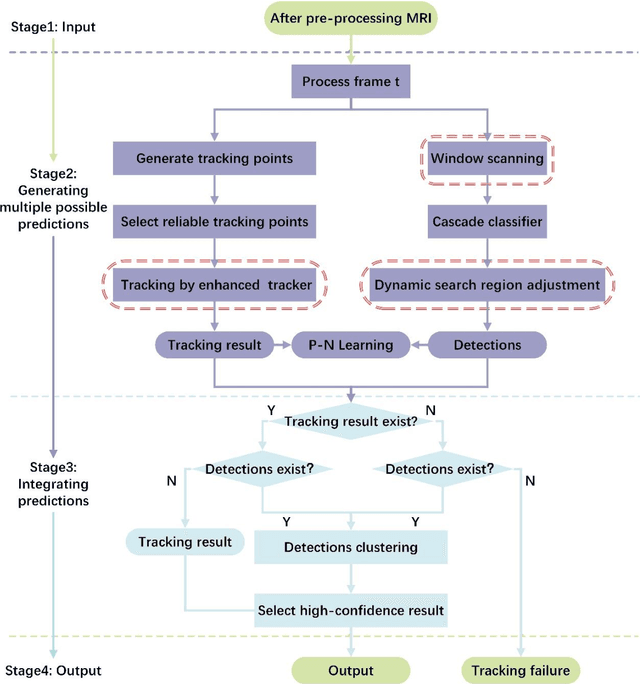
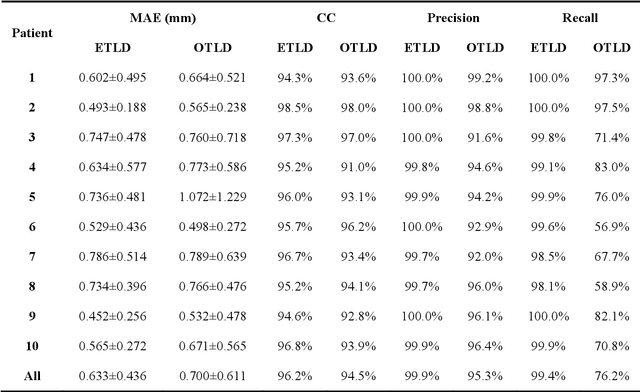
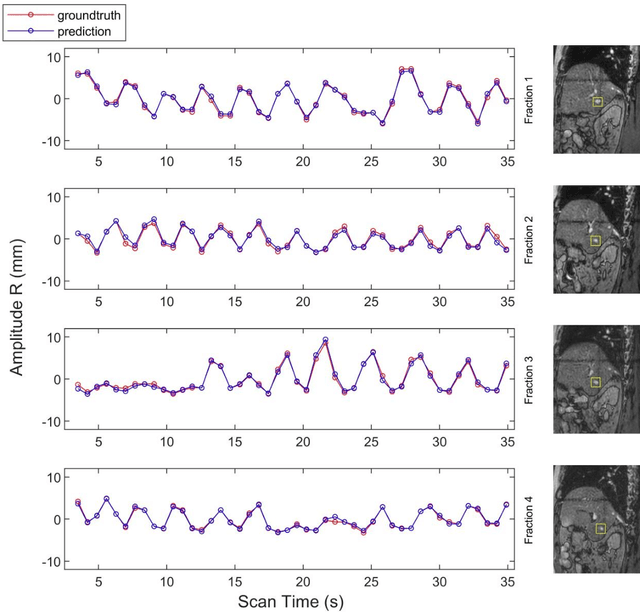
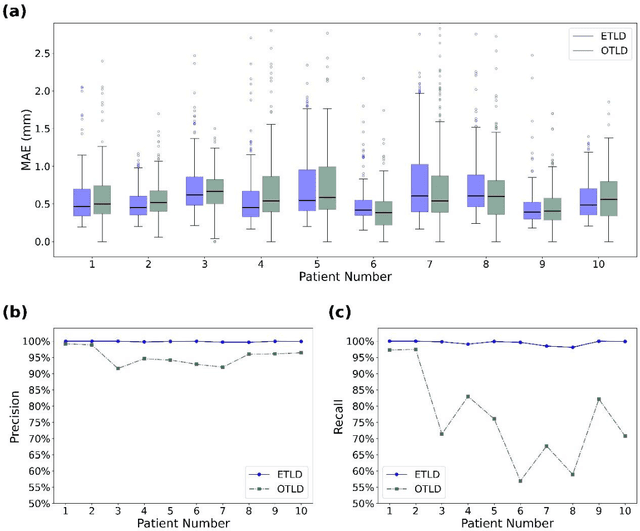
Objective: Ensuring the precision in motion tracking for MRI-guided Radiotherapy (MRIgRT) is crucial for the delivery of effective treatments. This study refined the motion tracking accuracy in MRIgRT through the innovation of an automatic real-time tracking method, leveraging an enhanced Tracking-Learning-Detection (ETLD) framework coupled with automatic segmentation. Methods: We developed a novel MRIgRT motion tracking method by integrating two primary methods: the ETLD framework and an improved Chan-Vese model (ICV), named ETLD+ICV. The TLD framework was upgraded to suit real-time cine MRI, including advanced image preprocessing, no-reference image quality assessment, an enhanced median-flow tracker, and a refined detector with dynamic search region adjustments. Additionally, ICV was combined for precise coverage of the target volume, which refined the segmented region frame by frame using tracking results, with key parameters optimized. Tested on 3.5D MRI scans from 10 patients with liver metastases, our method ensures precise tracking and accurate segmentation vital for MRIgRT. Results: An evaluation of 106,000 frames across 77 treatment fractions revealed sub-millimeter tracking errors of less than 0.8mm, with over 99% precision and 98% recall for all subjects, underscoring the robustness and efficacy of the ETLD. Moreover, the ETLD+ICV yielded a dice global score of more than 82% for all subjects, demonstrating the proposed method's extensibility and precise target volume coverage. Conclusions: This study successfully developed an automatic real-time motion tracking method for MRIgRT that markedly surpasses current methods. The novel method not only delivers exceptional precision in tracking and segmentation but also demonstrates enhanced adaptability to clinical demands, positioning it as an indispensable asset in the quest to augment the efficacy of radiotherapy treatments.
More Text, Less Point: Towards 3D Data-Efficient Point-Language Understanding
Aug 28, 2024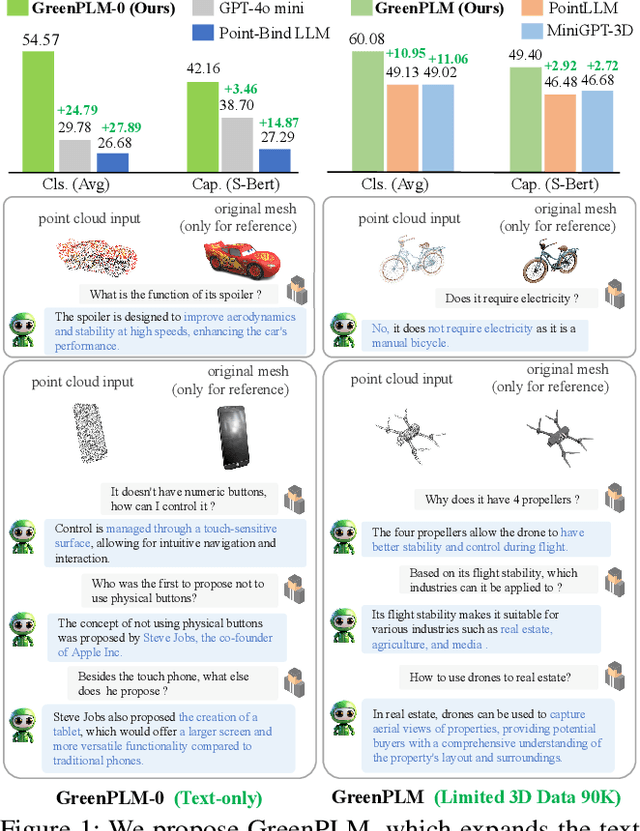
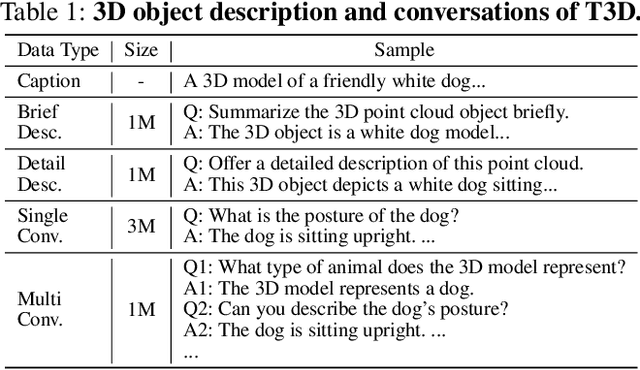
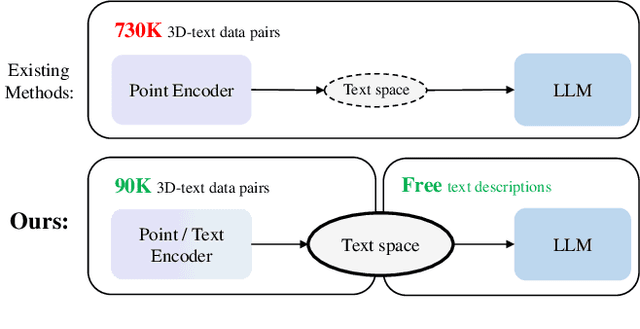

Enabling Large Language Models (LLMs) to comprehend the 3D physical world remains a significant challenge. Due to the lack of large-scale 3D-text pair datasets, the success of LLMs has yet to be replicated in 3D understanding. In this paper, we rethink this issue and propose a new task: 3D Data-Efficient Point-Language Understanding. The goal is to enable LLMs to achieve robust 3D object understanding with minimal 3D point cloud and text data pairs. To address this task, we introduce GreenPLM, which leverages more text data to compensate for the lack of 3D data. First, inspired by using CLIP to align images and text, we utilize a pre-trained point cloud-text encoder to map the 3D point cloud space to the text space. This mapping leaves us to seamlessly connect the text space with LLMs. Once the point-text-LLM connection is established, we further enhance text-LLM alignment by expanding the intermediate text space, thereby reducing the reliance on 3D point cloud data. Specifically, we generate 6M free-text descriptions of 3D objects, and design a three-stage training strategy to help LLMs better explore the intrinsic connections between different modalities. To achieve efficient modality alignment, we design a zero-parameter cross-attention module for token pooling. Extensive experimental results show that GreenPLM requires only 12% of the 3D training data used by existing state-of-the-art models to achieve superior 3D understanding. Remarkably, GreenPLM also achieves competitive performance using text-only data. The code and weights are available at: https://github.com/TangYuan96/GreenPLM.
PointDreamer: Zero-shot 3D Textured Mesh Reconstruction from Colored Point Cloud by 2D Inpainting
Jun 22, 2024Reconstructing textured meshes from colored point clouds is an important but challenging task in 3D graphics and vision. Most existing methods predict colors as implicit functions in 3D or UV space, suffering from blurry textures or the lack of generalization capability. Addressing this, we propose PointDreamer, a novel framework for textured mesh reconstruction from colored point cloud. It produces meshes with enhanced fidelity and clarity by 2D image inpainting, taking advantage of the mature techniques and massive data of 2D vision. Specifically, we first project the input point cloud into 2D space to generate sparse multi-view images, and then inpaint empty pixels utilizing a pre-trained 2D diffusion model. Next, we design a novel Non-Border-First strategy to unproject the colors of the inpainted dense images back to 3D space, thus obtaining the final textured mesh. In this way, our PointDreamer works in a zero-shot manner, requiring no extra training. Extensive qualitative and quantitative experiments on various synthetic and real-scanned datasets show the SoTA performance of PointDreamer, by significantly outperforming baseline methods with 30\% improvement in LPIPS score (from 0.118 to 0.068). Code at: https://github.com/YuQiao0303/PointDreamer.