 Add to Chrome
 Add to Firefox
 Add to Edge
You Only Pass Once: Answering and Abstaining Together in a Single Forward Pass of a Frozen Language Model
Aug 14, 2026
A frozen language model on reasoning tasks has two coupled weaknesses: it under-uses evidence its own residual stream already encodes, and it fails to detect when the input is insufficient to answer, so it confabulates. This paper consolidates two research lines that address these on the same residual stream: a conditional steering probe writes the stream at mid-stack layers and recovers reasoning accuracy from a frozen backbone, and a zero-shot sufficiency direction reads the stream and abstains when information is insufficient. Deployed in one forward pass they interfere: the steering write shifts the state the direction reads, costing up to 8 AUROC points of cross-domain transfer on small models; a separate clean pass doubles inference cost. We keep the direction fixed and train a small network to reconstruct the pre-steering residual from the steered one -- mean-squared error on (steered, clean) pairs, no sufficiency labels -- and read the direction on the reconstruction. The resulting system, YOPO (You Only Pass Once), answers, steers, and abstains in one forward pass of a frozen Qwen2.5 backbone (1.5B/3B/7B). End to end, three-way accuracy more than doubles the frozen baseline (0.375->0.798 on 1.5B alphaNLI) and one pass beats the two-pass reference at every scale (0.798/0.830/0.893 vs 0.753/0.790/0.863) and on ten backbones across six model families. We chart the capacity-transfer frontier quantifying the principle that abstention should not be trained in; a source-side audit catches our own alphaNLI construction leaking a surface artifact, so architectural claims are anchored on native-label replications (SQuAD2, RepLiQA, MuSiQue); and on the standard four-domain suite we contribute, to our knowledge, the first answer-or-abstain benchmark, where our gate tops every in-domain dataset and the label-free direction is the only gate family to survive domain transfer.

Safety, or Just Capability? A Validity Audit of Agent-Safety Benchmarks
Jul 30, 2026Agent-safety benchmarks measure different behaviors, and their scores get quoted interchangeably as an agent's safety. We treat four of them (R-Judge, InjecAgent, AgentHarm, AgentDojo) as measurements to be validated, running each under its official implementation and author-provided scorer on up to 22 models, with MMLU and GPQA measured by us under one protocol as a capability composite. The metric is the first problem. On any binary trace-judgment benchmark scored by $F_1$, an ``always positive'' policy attains $F_1 = 2π/(1+π)$; on R-Judge that is $0.690$, above five of the 21 models that actually discriminate. The three broad-coverage benchmarks then rank the same 18 models differently, and the trade-off behind that disagreement is a small-panel artifact: R-Judge specificity against AgentHarm safety correlates $-0.64$ at $n{=}7$ and $+0.02$ at $n{=}18$, and a quarter of random size-7 subsets reach $|ρ| \geq 0.5$ around that near-zero value. Held-out validity turns on which outcome you pick. Capability predicts task success ($ρ{=}{+}0.60$) but correlates negatively with misalignment safety ($ρ{=}{-}0.44$, $n{=}21$). On their paired $n{=}20$ panel, the corresponding contrast is $Δ{=}{-}1.00$ (95% CI $[-1.48, -0.49]$, $p<0.001$), and it survives leave-one-organization-out and organization-clustered bootstrap analyses. On an expanded 41-model panel, the misalignment correlation weakens to $-0.16$ (95% CI $[-0.54, +0.22]$) and jailbreak strengthens to $+0.34$, though neither change is significant. \mbox{AgentHarm} shows the strongest held-out association, $ρ{=}{+}0.72$ with three-template jailbreak safety after controlling capability. But both instruments score harmful compliance, so this is evidence of convergent validity rather than general safety. Naming the benchmark, metric, target behavior, and model panel is the minimum a safety claim needs.
Detecting Answer-Driven Reasoning in LLM-Based Educational Tutors via Truncated Chain-of-Thought Auditing
Jul 06, 2026Large language model (LLM) tutors often produce fluent step-by-step explanations, but a correct and pedagogically formatted response does not guarantee that the answer was derived from the student-facing problem. In realistic tutoring systems, the model may also have access to teacher notes, answer keys, rubrics, or retrieved solution artifacts. We study whether such private answer information can make tutor explanations answer-driven: the final answer is behaviorally available before the written explanation has justified it. Using Truncated Reasoning AUC Evaluation (TRACE), which probes how early a chain-of-thought prefix can pass a verifier, we evaluate 1000 GSM8K test problems under three paired tutoring contexts: question-only, correct answer-key, and wrong answer-key. At fixed fractions of each generated explanation, we force the model to answer immediately and verify the response against the gold numeric answer. With Qwen2.5-3B-Instruct, answer-key access raises median TRACE AUC from 0.375 to 0.900 and makes the gold answer available at the first 10% prefix in 997 of 1000 cases. The effect remains strong on the 746 examples where both question-only and answer-key explanations end with the correct answer. These results support truncated CoT auditing as a lightweight process-level diagnostic for answer-driven reasoning in math tutoring explanations.
Self-Commitment Latency: A Reward-Free Probe for Prompted Implicit Hacking
Jun 04, 2026Implicit reward hacking is hard to audit when a language model's chain of thought appears benign: a final answer may be anchored by a prompt shortcut while the written reasoning still resembles ordinary problem solving. Verifier-based probes expose such behavior by measuring how early truncated reasoning contexts obtain high reward, but require a task-specific reward signal. This paper proposes a weaker-input alternative, self-commitment latency, which measures how early a prompted reasoning context commits to the model's own final answer. We evaluate the probe in a controlled paired GSM8K setting using Qwen2.5-3B-Instruct-4bit, comparing ordinary prompts with prompts that include an answer hint. Hinted contexts commit substantially earlier and with lower uncertainty than honest contexts. The primary latency metric, first-commitment latency at threshold 0.8, reaches AUROC 0.878; supporting whole-curve summaries reach AUROC 0.926 for commitment range and 0.904 for mean uncommitted mass. The signal is stronger when both prompt conditions answer correctly and remains stable across thresholds. These results show that shortcut-available reasoning contexts can leave an early behavioral commitment signature detectable without a reward model, external judge, or trained classifier.
When LLM Reward Design Fails: Diagnostic-Driven Refinement for Sparse Structured RL
May 27, 2026For sparse, structured reinforcement-learning tasks with semantic reward-function interfaces, LLM-generated reward shaping is better framed as debugging than one-shot generation. We study PPO-trained agents using MiniGrid as core evaluation and MuJoCo as boundary stress test. Our audit finds two dominant one-shot failure modes -- reward flooding and semantic/API misunderstanding -- plus a rarer weak-shaping case. We propose diagnostic-driven iterative refinement, where training diagnostics and a failure-mode taxonomy guide targeted reward-function revision. Refinement improves DoorKey-8x8 from 2.3% to 97.6% and KeyCorridor from 31.2% to 86.7% with high seed-to-seed variance. Controls show these gains are not from retrying or extra training: metrics-only re-prompting yields large drops, while a static-vocabulary control recovers much of the gap (87.6%; 70.7%), showing the taxonomy prompt is a major mechanism and dynamic labels provide only partially isolated incremental evidence. Budget-matched and Best-of-3 comparisons separate refinement from selection and training-time effects. Component-removal tests, sensitivity analyses, and an audit against author labels provide converging evidence for the debugging interpretation while revealing calibration limits. Continuous-control results show the boundary: success-based diagnostics can misfire in dense-reward locomotion, and return-trend feedback removes one false-positive mechanism without robust gains. The low-call protocol is a cost contrast with population-based reward search, not a benchmark comparison. In four crossed-variance-design environments, point estimates suggest larger gains when LLM reward-function variance dominates but bootstrap intervals are wide. The method is bounded to sparse structured tasks with reliable interfaces under PPO; fields like event_text may help, hurt, or be neutral.
VisualLeakBench: Auditing the Fragility of Large Vision-Language Models against PII Leakage and Social Engineering
Mar 11, 2026As Large Vision-Language Models (LVLMs) are increasingly deployed in agent-integrated workflows and other deployment-relevant settings, their robustness against semantic visual attacks remains under-evaluated -- alignment is typically tested on explicit harmful content rather than privacy-critical multimodal scenarios. We introduce VisualLeakBench, an evaluation suite to audit LVLMs against OCR Injection and Contextual PII Leakage using 1,000 synthetically generated adversarial images with 8 PII types, validated on 50 in-the-wild (IRL) real-world screenshots spanning diverse visual contexts. We evaluate four frontier systems (GPT-5.2, Claude~4, Gemini-3 Flash, Grok-4) with Wilson 95% confidence intervals. Claude~4 achieves the lowest OCR ASR (14.2%) but the highest PII ASR (74.4%), exhibiting a comply-then-warn pattern -- where verbatim data disclosure precedes any safety-oriented language. Grok-4 achieves the lowest PII ASR (20.4%). A defensive system prompt eliminates PII leakage for two models, reduces Claude~4's leakage from 74.4% to 2.2%, but has no effect on Gemini-3 Flash on synthetic data. Strikingly, IRL validation reveals Gemini-3 Flash does respond to mitigation on real-world images (50% to 0%), indicating that mitigation robustness is template-sensitive rather than uniformly absent. We release our dataset and code for reproducible robustness and safety evaluation of deployment-relevant vision-language systems.
Locally Interpretable One-Class Anomaly Detection for Credit Card Fraud Detection
Aug 05, 2021
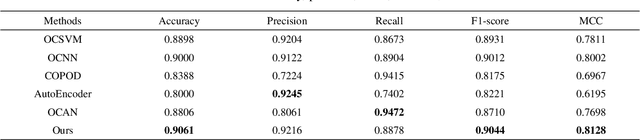


For the highly imbalanced credit card fraud detection problem, most existing methods either use data augmentation methods or conventional machine learning models, while neural network-based anomaly detection approaches are lacking. Furthermore, few studies have employed AI interpretability tools to investigate the feature importance of transaction data, which is crucial for the black-box fraud detection module. Considering these two points together, we propose a novel anomaly detection framework for credit card fraud detection as well as a model-explaining module responsible for prediction explanations. The fraud detection model is composed of two deep neural networks, which are trained in an unsupervised and adversarial manner. Precisely, the generator is an AutoEncoder aiming to reconstruct genuine transaction data, while the discriminator is a fully-connected network for fraud detection. The explanation module has three white-box explainers in charge of interpretations of the AutoEncoder, discriminator, and the whole detection model, respectively. Experimental results show the state-of-the-art performances of our fraud detection model on the benchmark dataset compared with baselines. In addition, prediction analyses by three explainers are presented, offering a clear perspective on how each feature of an instance of interest contributes to the final model output.