 Add to Chrome
 Add to Firefox
 Add to Edge
VisualLeakBench: Auditing the Fragility of Large Vision-Language Models against PII Leakage and Social Engineering
Mar 11, 2026
As Large Vision-Language Models (LVLMs) are increasingly deployed in agent-integrated workflows and other deployment-relevant settings, their robustness against semantic visual attacks remains under-evaluated -- alignment is typically tested on explicit harmful content rather than privacy-critical multimodal scenarios. We introduce VisualLeakBench, an evaluation suite to audit LVLMs against OCR Injection and Contextual PII Leakage using 1,000 synthetically generated adversarial images with 8 PII types, validated on 50 in-the-wild (IRL) real-world screenshots spanning diverse visual contexts. We evaluate four frontier systems (GPT-5.2, Claude~4, Gemini-3 Flash, Grok-4) with Wilson 95% confidence intervals. Claude~4 achieves the lowest OCR ASR (14.2%) but the highest PII ASR (74.4%), exhibiting a comply-then-warn pattern -- where verbatim data disclosure precedes any safety-oriented language. Grok-4 achieves the lowest PII ASR (20.4%). A defensive system prompt eliminates PII leakage for two models, reduces Claude~4's leakage from 74.4% to 2.2%, but has no effect on Gemini-3 Flash on synthetic data. Strikingly, IRL validation reveals Gemini-3 Flash does respond to mitigation on real-world images (50% to 0%), indicating that mitigation robustness is template-sensitive rather than uniformly absent. We release our dataset and code for reproducible robustness and safety evaluation of deployment-relevant vision-language systems.

A majorized PAM method with subspace correction for low-rank composite factorization model
Jun 07, 2024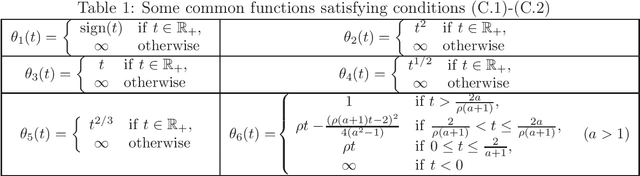
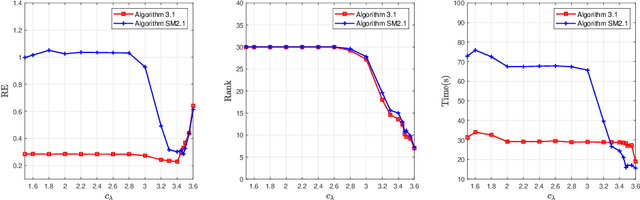
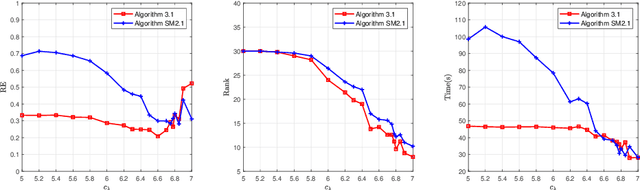
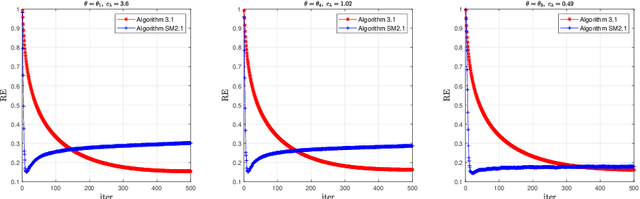
This paper concerns a class of low-rank composite factorization models arising from matrix completion. For this nonconvex and nonsmooth optimization problem, we propose a proximal alternating minimization algorithm (PAMA) with subspace correction, in which a subspace correction step is imposed on every proximal subproblem so as to guarantee that the corrected proximal subproblem has a closed-form solution. For this subspace correction PAMA, we prove the subsequence convergence of the iterate sequence, and establish the convergence of the whole iterate sequence and the column subspace sequences of factor pairs under the KL property of objective function and a restrictive condition that holds automatically for the column $\ell_{2,0}$-norm function. Numerical comparison with the proximal alternating linearized minimization method on one-bit matrix completion problems indicates that PAMA has an advantage in seeking lower relative error within less time.
Column $\ell_{2,0}$-norm regularized factorization model of low-rank matrix recovery and its computation
Aug 24, 2020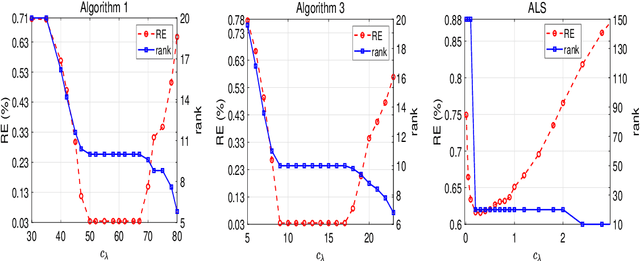
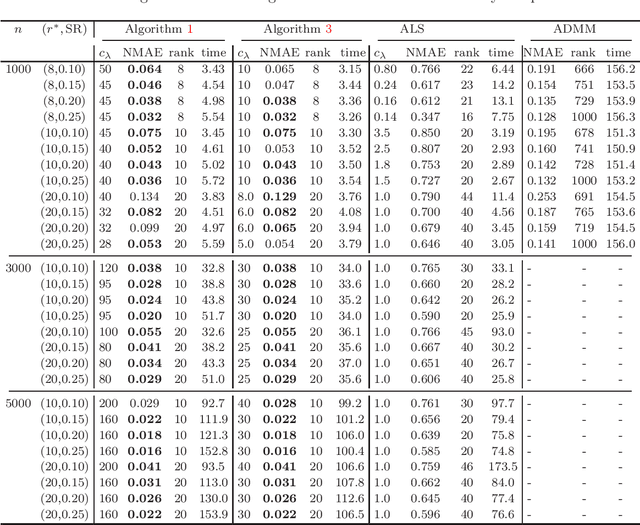
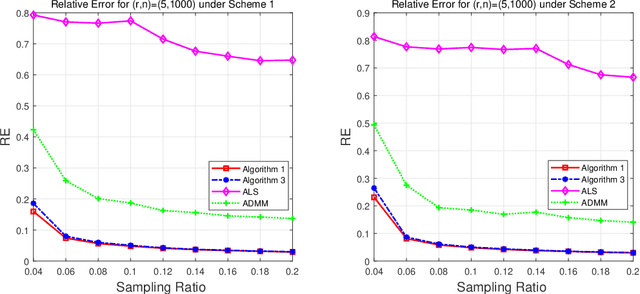
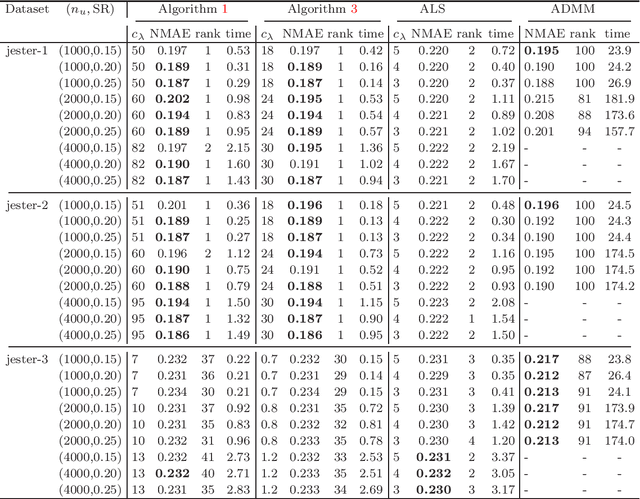
This paper is concerned with the column $\ell_{2,0}$-regularized factorization model of low-rank matrix recovery problems and its computation. The column $\ell_{2,0}$-norm of factor matrices is introduced to promote column sparsity of factors and lower rank solutions. For this nonconvex nonsmooth and non-Lipschitz problem, we develop an alternating majorization-minimization (AMM) method with extrapolation, and a hybrid AMM in which a majorized alternating proximal method is first proposed to seek an initial factor pair with less nonzero columns and then the AMM with extrapolation is applied to the minimization of smooth nonconvex loss. We provide the global convergence analysis for the proposed AMM methods and apply them to the matrix completion problem with non-uniform sampling schemes. Numerical experiments are conducted with synthetic and real data examples, and comparison results with the nuclear-norm regularized factorization model and the max-norm regularized convex model demonstrate that the column $\ell_{2,0}$-regularized factorization model has an advantage in offering solutions of lower error and rank within less time.