 Add to Chrome
 Add to Firefox
 Add to Edge
Recursive Think-Answer Process for LLMs and VLMs
Mar 03, 2026
Think-Answer reasoners such as DeepSeek-R1 have made notable progress by leveraging interpretable internal reasoning. However, despite the frequent presence of self-reflective cues like "Oops!", they remain vulnerable to output errors during single-pass inference. To address this limitation, we propose an efficient Recursive Think-Answer Process (R-TAP) that enables models to engage in iterative reasoning cycles and generate more accurate answers, going beyond conventional single-pass approaches. Central to this approach is a confidence generator that evaluates the certainty of model responses and guides subsequent improvements. By incorporating two complementary rewards-Recursively Confidence Increase Reward and Final Answer Confidence Reward-we show that R-TAP-enhanced models consistently outperform conventional single-pass methods for both large language models (LLMs) and vision-language models (VLMs). Moreover, by analyzing the frequency of "Oops"-like expressions in model responses, we find that R-TAP-applied models exhibit significantly fewer self-reflective patterns, resulting in more stable and faster inference-time reasoning. We hope R-TAP pave the way evolving into efficient and elaborated methods to refine the reasoning processes of future AI.

MAD: Modality-Adaptive Decoding for Mitigating Cross-Modal Hallucinations in Multimodal Large Language Models
Jan 29, 2026Multimodal Large Language Models (MLLMs) suffer from cross-modal hallucinations, where one modality inappropriately influences generation about another, leading to fabricated output. This exposes a more fundamental deficiency in modality-interaction control. To address this, we propose Modality-Adaptive Decoding (MAD), a training-free method that adaptively weights modality-specific decoding branches based on task requirements. MAD leverages the model's inherent ability to self-assess modality relevance by querying which modalities are needed for each task. The extracted modality probabilities are then used to adaptively weight contrastive decoding branches, enabling the model to focus on relevant information while suppressing cross-modal interference. Extensive experiments on CMM and AVHBench demonstrate that MAD significantly reduces cross-modal hallucinations across multiple audio-visual language models (7.8\% and 2.0\% improvements for VideoLLaMA2-AV, 8.7\% and 4.7\% improvements for Qwen2.5-Omni). Our approach demonstrates that explicit modality awareness through self-assessment is crucial for robust multimodal reasoning, offering a principled extension to existing contrastive decoding methods. Our code is available at \href{https://github.com/top-yun/MAD}{https://github.com/top-yun/MAD}
Are Vision-Language Models Truly Understanding Multi-vision Sensor?
Dec 30, 2024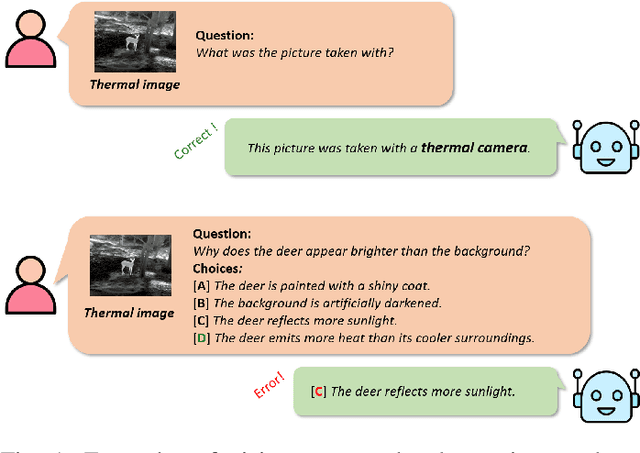
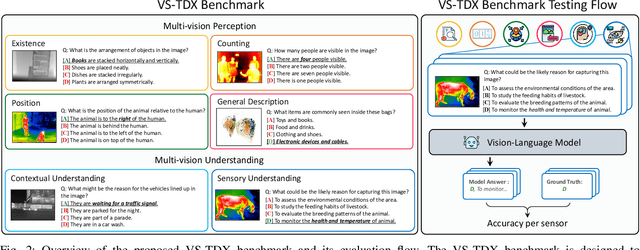
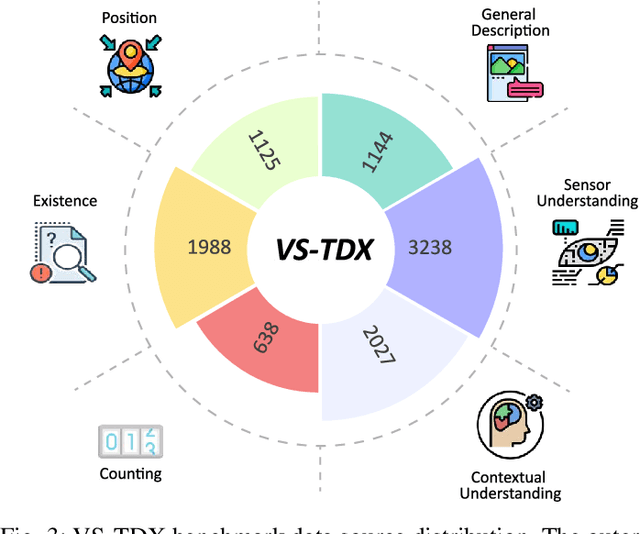
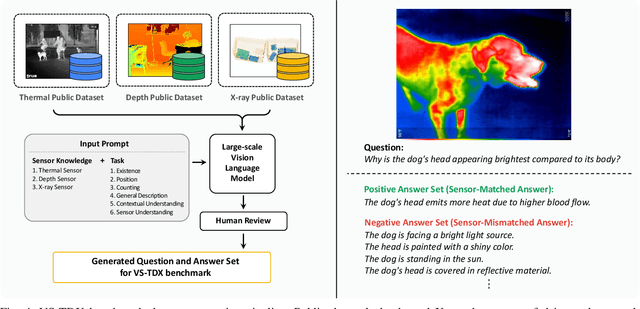
Large-scale Vision-Language Models (VLMs) have advanced by aligning vision inputs with text, significantly improving performance in computer vision tasks. Moreover, for VLMs to be effectively utilized in real-world applications, an understanding of diverse multi-vision sensor data, such as thermal, depth, and X-ray information, is essential. However, we find that current VLMs process multi-vision sensor images without deep understanding of sensor information, disregarding each sensor's unique physical properties. This limitation restricts their capacity to interpret and respond to complex questions requiring multi-vision sensor reasoning. To address this, we propose a novel Multi-vision Sensor Perception and Reasoning (MS-PR) benchmark, assessing VLMs on their capacity for sensor-specific reasoning. Moreover, we introduce Diverse Negative Attributes (DNA) optimization to enable VLMs to perform deep reasoning on multi-vision sensor tasks, helping to bridge the core information gap between images and sensor data. Extensive experimental results validate that the proposed DNA method can significantly improve the multi-vision sensor reasoning for VLMs.