 Add to Chrome
 Add to Firefox
 Add to Edge
STRIDE: When to Speak Meets Sequence Denoising for Streaming Video Understanding
Mar 29, 2026
Recent progress in video large language models (Video-LLMs) has enabled strong offline reasoning over long and complex videos. However, real-world deployments increasingly require streaming perception and proactive interaction, where video frames arrive online and the system must decide not only what to respond, but also when to respond. In this work, we revisit proactive activation in streaming video as a structured sequence modeling problem, motivated by the observation that temporal transitions in streaming video naturally form span-structured activation patterns. To capture this span-level structure, we model activation signals jointly over a sliding temporal window and update them iteratively as new frames arrive. We propose STRIDE (Structured Temporal Refinement with Iterative DEnoising), which employs a lightweight masked diffusion module at the activation interface to jointly predict and progressively refine activation signals across the window. Extensive experiments on diverse streaming benchmarks and downstream models demonstrate that STRIDE shows more reliable and temporally coherent proactive responses, significantly improving when-to-speak decision quality in online streaming scenarios.

Look Every Frame All at Once: Video-Ma$^2$mba for Efficient Long-form Video Understanding with Multi-Axis Gradient Checkpointing
Nov 29, 2024With the growing scale and complexity of video data, efficiently processing long video sequences poses significant challenges due to the quadratic increase in memory and computational demands associated with existing transformer-based Large Multi-modal Models (LMMs). To address these issues, we introduce Video-Ma$^2$mba, a novel architecture that incorporates State Space Models (SSMs) within the Mamba-2 framework, replacing the attention mechanisms. This allows the LMMs to scale linearly in terms of time and memory requirements, making it feasible to handle long-duration video content. Furthermore, we enhance the memory efficiency introducing the Multi-Axis Gradient Checkpointing (MA-GC) method, which strategically manages memory by retaining only essential activations across multiple computational axes. Our approach significantly reduces the memory footprint compared to standard gradient checkpointing. Empirical analyses show that Video-Ma$^2$mba can process extensive video sequences-equivalent to millions of tokens or over two hours of continuous sequences at 1 FPS-on a single GPU. By maintaining a detailed capture of temporal dynamics, our model improves the accuracy and relevance of responses in long video understanding tasks, demonstrating substantial advantages over existing frameworks.
SALOVA: Segment-Augmented Long Video Assistant for Targeted Retrieval and Routing in Long-Form Video Analysis
Nov 25, 2024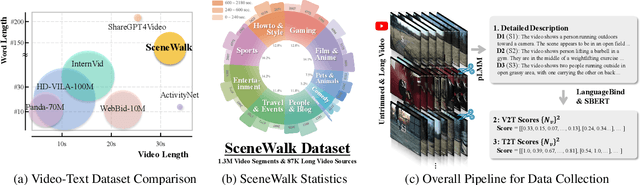
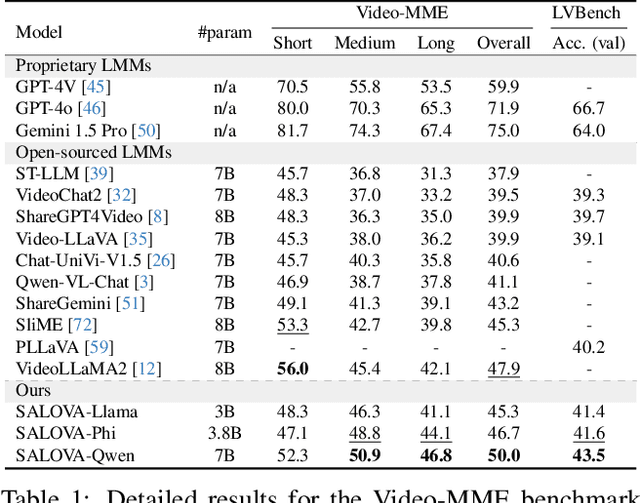
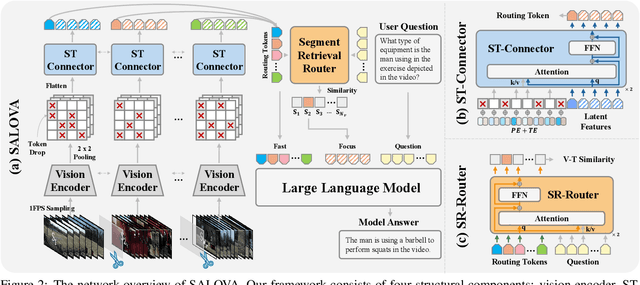

Despite advances in Large Multi-modal Models, applying them to long and untrimmed video content remains challenging due to limitations in context length and substantial memory overhead. These constraints often lead to significant information loss and reduced relevance in the model responses. With the exponential growth of video data across web platforms, understanding long-form video is crucial for advancing generalized intelligence. In this paper, we introduce SALOVA: Segment-Augmented LOng Video Assistant, a novel video-LLM framework designed to enhance the comprehension of lengthy video content through targeted retrieval process. We address two main challenges to achieve it: (i) We present the SceneWalk dataset, a high-quality collection of 87.8K long videos, each densely captioned at the segment level to enable models to capture scene continuity and maintain rich descriptive context. (ii) We develop robust architectural designs integrating dynamic routing mechanism and spatio-temporal projector to efficiently retrieve and process relevant video segments based on user queries. Our framework mitigates the limitations of current video-LMMs by allowing for precise identification and retrieval of relevant video segments in response to queries, thereby improving the contextual relevance of the generated responses. Through extensive experiments, SALOVA demonstrates enhanced capability in processing complex long-form videos, showing significant capability to maintain contextual integrity across extended sequences.