 Add to Chrome
 Add to Firefox
 Add to Edge
One Refiner to Unlock Them All: Inference-Time Reasoning Elicitation via Reinforcement Query Refinement
Apr 28, 2026
Large Language Models (LLMs) often fail to utilize their latent reasoning capabilities due to a distributional mismatch between ambiguous human inquiries and the structured logic required for machine activation. Existing alignment methods either incur prohibitive $O(N)$ costs by fine-tuning each model individually or rely on static prompts that fail to resolve query-level structural complexity. In this paper, we propose ReQueR (\textbf{Re}inforcement \textbf{Que}ry \textbf{R}efinement), a modular framework that treats reasoning elicitation as an inference-time alignment task. We train a specialized Refiner policy via Reinforcement Learning to rewrite raw queries into explicit logical decompositions, treating frozen LLMs as the environment. Rooted in the classical Zone of Proximal Development from educational psychology, we introduce the Adaptive Solver Hierarchy, a curriculum mechanism that stabilizes training by dynamically aligning environmental difficulty with the Refiner's evolving competence. ReQueR yields consistent absolute gains of 1.7\%--7.2\% across diverse architectures and benchmarks, outperforming strong baselines by 2.1\% on average. Crucially, it provides a promising paradigm for one-to-many inference-time reasoning elicitation, enabling a single Refiner trained on a small set of models to effectively unlock reasoning in diverse unseen models. Code is available at https://github.com/newera-xiao/ReQueR.

Look Inward to Explore Outward: Learning Temperature Policy from LLM Internal States via Hierarchical RL
Feb 13, 2026Reinforcement Learning from Verifiable Rewards (RLVR) trains large language models (LLMs) from sampled trajectories, making decoding strategy a core component of learning rather than a purely inference-time choice. Sampling temperature directly controls the exploration--exploitation trade-off by modulating policy entropy, yet existing methods rely on static values or heuristic adaptations that are decoupled from task-level rewards. We propose Introspective LLM, a hierarchical reinforcement learning framework that learns to control sampling temperature during generation. At each decoding step, the model selects a temperature based on its hidden state and samples the next token from the resulting distribution. Temperature and token policies are jointly optimized from downstream rewards using a coordinate ascent scheme. Experiments on mathematical reasoning benchmarks show that learned temperature policies outperform fixed and heuristic baselines, while exhibiting interpretable exploration behaviors aligned with reasoning uncertainty.
Each Rank Could be an Expert: Single-Ranked Mixture of Experts LoRA for Multi-Task Learning
Jan 25, 2025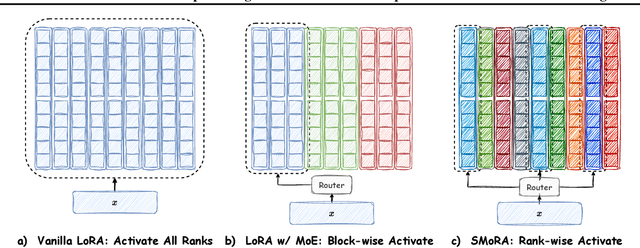
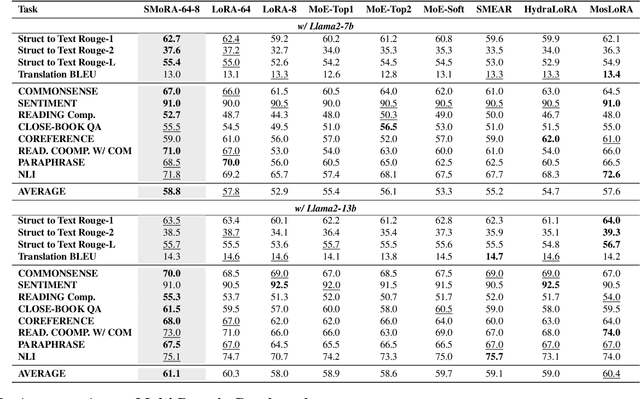
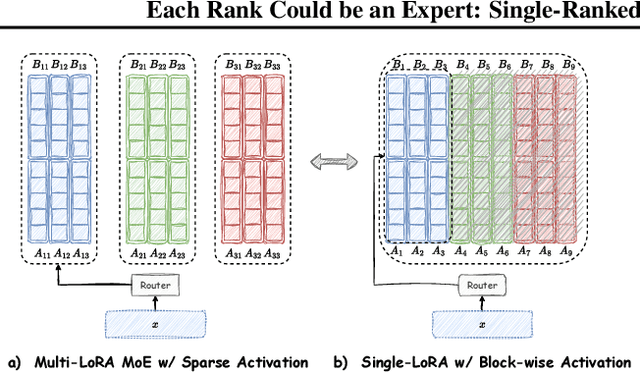
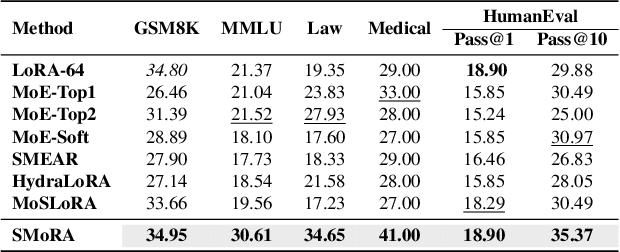
Low-Rank Adaptation (LoRA) is widely used for adapting large language models (LLMs) to specific domains due to its efficiency and modularity. Meanwhile, vanilla LoRA struggles with task conflicts in multi-task scenarios. Recent works adopt Mixture of Experts (MoE) by treating each LoRA module as an expert, thereby mitigating task interference through multiple specialized LoRA modules. While effective, these methods often isolate knowledge within individual tasks, failing to fully exploit the shared knowledge across related tasks. In this paper, we establish a connection between single LoRA and multi-LoRA MoE, integrating them into a unified framework. We demonstrate that the dynamic routing of multiple LoRAs is functionally equivalent to rank partitioning and block-level activation within a single LoRA. We further empirically demonstrate that finer-grained LoRA partitioning, within the same total and activated parameter constraints, leads to better performance gains across heterogeneous tasks. Building on these findings, we propose Single-ranked Mixture of Experts LoRA (\textbf{SMoRA}), which embeds MoE into LoRA by \textit{treating each rank as an independent expert}. With a \textit{dynamic rank-wise activation} mechanism, SMoRA promotes finer-grained knowledge sharing while mitigating task conflicts. Experiments demonstrate that SMoRA activates fewer parameters yet achieves better performance in multi-task scenarios.