 Add to Chrome
 Add to Firefox
 Add to Edge
CONFER: Conflict-Aware Evidence Negotiation for Regime-Calibrated Weak Supervision in Multimodal Emotion Recognition
Aug 08, 2026
Multimodal emotion recognition often treats self-reported labels as reliable supervision while overlooking self-report unreliability and cross-modal conflict. We propose \textbf{CONFER}, a graph-based conflict-aware evidence negotiation framework for weakly supervised multimodal emotion recognition. CONFER represents each modality expert as a node with a predictive belief, boundary-based uncertainty, and runtime reliability estimated from historical out-of-fold performance and current-sample uncertainty. Uncertainty-aware compatibility and reliability-directed asymmetric edge weights govern iterative message-passing negotiation, followed by peer-supported prediction readout. Conflict reduction, residual disagreement, and mean modality uncertainty further characterize three regimes---Consensus, Dissent, and Ambiguity---for sample-specific weak-label calibration. We evaluate CONFER on AMIGOS, MAHNOB-HCI, and DEAP under subject-dependent 10-fold and strict leave-one-subject-out (LOSO) protocols. CONFER achieves competitive performance, reaching \textbf{0.873} accuracy on AMIGOS-V and \textbf{0.854} accuracy on MAHNOB-V under strict LOSO evaluation. Further analyses show larger negotiation gains on high-conflict samples and improved robustness to weak-label corruption, indicating that cross-modal conflict provides useful information for both directional modality coordination and supervision-reliability estimation.

BioKD: Selective Physiology-to-Video Knowledge Distillation via Reliability Gate for Emotion Recognition
Aug 06, 2026To address the limitations of video-based emotion recognition under ambiguous or socially masked behavioral cues, as well as the poor deployability of physiological signals, this paper proposes a reliability-aware physiology-to-video knowledge distillation framework, termed BioKD. The proposed framework leverages physiological signals as privileged information during training to guide a video-based student model in learning deep affective representations, while relying solely on non-intrusive video inputs at inference time. To cope with the high noise and instability of physiological teacher supervision caused by inter-subject variability, signal artifacts, and temporal inconsistency, BioKD incorporates a sample-wise reliability-aware gating mechanism together with a progressive distillation strategy. By adaptively regulating the strength of knowledge transfer, the framework suppresses negative transfer induced by unreliable physiological supervision and enables more stable cross-modal distillation. Experiments on DEAP and AMIGOS show that BioKD consistently outperforms representative baselines under both trial-wise and subject-wise evaluation protocols for valence and arousal recognition. For example, BioKD achieves 68.01\% on DEAP (trial-wise arousal) and 65.29\% under the more challenging subject-wise setting, demonstrating improved performance under a subject-independent evaluation setting. Further analyses show that BioKD effectively mitigates overconfident teacher errors and outperforms an entropy-only weighting strategy, confirming the importance of explicitly modeling supervision reliability. In addition, BioKD introduces no additional inference-time overhead relative to the same video student architecture and removes the need for physiological sensing and multimodal synchronization.
QA-MoE: Towards a Continuous Reliability Spectrum with Quality-Aware Mixture of Experts for Robust Multimodal Sentiment Analysis
Apr 07, 2026Multimodal Sentiment Analysis (MSA) aims to infer human sentiment from textual, acoustic, and visual signals. In real-world scenarios, however, multimodal inputs are often compromised by dynamic noise or modality missingness. Existing methods typically treat these imperfections as discrete cases or assume fixed corruption ratios, which limits their adaptability to continuously varying reliability conditions. To address this, we first introduce a Continuous Reliability Spectrum to unify missingness and quality degradation into a single framework. Building on this, we propose QA-MoE, a Quality-Aware Mixture-of-Experts framework that quantifies modality reliability via self-supervised aleatoric uncertainty. This mechanism explicitly guides expert routing, enabling the model to suppress error propagation from unreliable signals while preserving task-relevant information. Extensive experiments indicate that QA-MoE achieves competitive or state-of-the-art performance across diverse degradation scenarios and exhibits a promising One-Checkpoint-for-All property in practice.
R3-REC: Reasoning-Driven Recommendation via Retrieval-Augmented LLMs over Multi-Granular Interest Signals
Mar 14, 2026This paper addresses two persistent challenges in sequential recommendation: (i) evidence insufficiency-cold-start sparsity together with noisy, length-varying item texts; and (ii) opaque modeling of dynamic, multi-faceted intents across long/short horizons. We propose R3-REC (Reasoning-Retrieval-Recommendation), a prompt-centric, retrieval-augmented framework that unifies Multi-level User Intent Reasoning, Item Semantic Extraction, Long-Short Interest Polarity Mining, Similar User Collaborative Enhancement, and Reasoning-based Interest Matching and Scoring. Across ML-1M, Games, and Bundle, R3-REC consistently surpasses strong neural and LLM baselines, yielding improvements up to +10.2% (HR@1) and +6.4% (HR@5) with manageable end-to-end latency. Ablations corroborate complementary gains of all modules.
GLM-5: from Vibe Coding to Agentic Engineering
Feb 17, 2026We present GLM-5, a next-generation foundation model designed to transition the paradigm of vibe coding to agentic engineering. Building upon the agentic, reasoning, and coding (ARC) capabilities of its predecessor, GLM-5 adopts DSA to significantly reduce training and inference costs while maintaining long-context fidelity. To advance model alignment and autonomy, we implement a new asynchronous reinforcement learning infrastructure that drastically improves post-training efficiency by decoupling generation from training. Furthermore, we propose novel asynchronous agent RL algorithms that further improve RL quality, enabling the model to learn from complex, long-horizon interactions more effectively. Through these innovations, GLM-5 achieves state-of-the-art performance on major open benchmarks. Most critically, GLM-5 demonstrates unprecedented capability in real-world coding tasks, surpassing previous baselines in handling end-to-end software engineering challenges. Code, models, and more information are available at https://github.com/zai-org/GLM-5.
GLM-4.5: Agentic, Reasoning, and Coding (ARC) Foundation Models
Aug 08, 2025We present GLM-4.5, an open-source Mixture-of-Experts (MoE) large language model with 355B total parameters and 32B activated parameters, featuring a hybrid reasoning method that supports both thinking and direct response modes. Through multi-stage training on 23T tokens and comprehensive post-training with expert model iteration and reinforcement learning, GLM-4.5 achieves strong performance across agentic, reasoning, and coding (ARC) tasks, scoring 70.1% on TAU-Bench, 91.0% on AIME 24, and 64.2% on SWE-bench Verified. With much fewer parameters than several competitors, GLM-4.5 ranks 3rd overall among all evaluated models and 2nd on agentic benchmarks. We release both GLM-4.5 (355B parameters) and a compact version, GLM-4.5-Air (106B parameters), to advance research in reasoning and agentic AI systems. Code, models, and more information are available at https://github.com/zai-org/GLM-4.5.
Real-time Cross-modal Cybersickness Prediction in Virtual Reality
Jan 02, 2025Cybersickness remains a significant barrier to the widespread adoption of immersive virtual reality (VR) experiences, as it can greatly disrupt user engagement and comfort. Research has shown that cybersickness can significantly be reflected in head and eye tracking data, along with other physiological data (e.g., TMP, EDA, and BMP). Despite the application of deep learning techniques such as CNNs and LSTMs, these models often struggle to capture the complex interactions between multiple data modalities and lack the capacity for real-time inference, limiting their practical application. Addressing this gap, we propose a lightweight model that leverages a transformer-based encoder with sparse self-attention to process bio-signal features and a PP-TSN network for video feature extraction. These features are then integrated via a cross-modal fusion module, creating a video-aware bio-signal representation that supports cybersickness prediction based on both visual and bio-signal inputs. Our model, trained with a lightweight framework, was validated on a public dataset containing eye and head tracking data, physiological data, and VR video, and demonstrated state-of-the-art performance in cybersickness prediction, achieving a high accuracy of 93.13\% using only VR video inputs. These findings suggest that our approach not only enables effective, real-time cybersickness prediction but also addresses the longstanding issue of modality interaction in VR environments. This advancement provides a foundation for future research on multimodal data integration in VR, potentially leading to more personalized, comfortable and widely accessible VR experiences.
DiffusionTalker: Personalization and Acceleration for Speech-Driven 3D Face Diffuser
Dec 02, 2023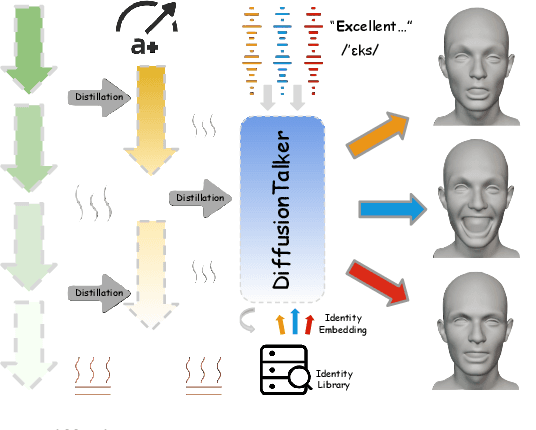


Speech-driven 3D facial animation has been an attractive task in both academia and industry. Traditional methods mostly focus on learning a deterministic mapping from speech to animation. Recent approaches start to consider the non-deterministic fact of speech-driven 3D face animation and employ the diffusion model for the task. However, personalizing facial animation and accelerating animation generation are still two major limitations of existing diffusion-based methods. To address the above limitations, we propose DiffusionTalker, a diffusion-based method that utilizes contrastive learning to personalize 3D facial animation and knowledge distillation to accelerate 3D animation generation. Specifically, to enable personalization, we introduce a learnable talking identity to aggregate knowledge in audio sequences. The proposed identity embeddings extract customized facial cues across different people in a contrastive learning manner. During inference, users can obtain personalized facial animation based on input audio, reflecting a specific talking style. With a trained diffusion model with hundreds of steps, we distill it into a lightweight model with 8 steps for acceleration. Extensive experiments are conducted to demonstrate that our method outperforms state-of-the-art methods. The code will be released.