 Add to Chrome
 Add to Firefox
 Add to Edge
QA-MoE: Towards a Continuous Reliability Spectrum with Quality-Aware Mixture of Experts for Robust Multimodal Sentiment Analysis
Apr 07, 2026
Multimodal Sentiment Analysis (MSA) aims to infer human sentiment from textual, acoustic, and visual signals. In real-world scenarios, however, multimodal inputs are often compromised by dynamic noise or modality missingness. Existing methods typically treat these imperfections as discrete cases or assume fixed corruption ratios, which limits their adaptability to continuously varying reliability conditions. To address this, we first introduce a Continuous Reliability Spectrum to unify missingness and quality degradation into a single framework. Building on this, we propose QA-MoE, a Quality-Aware Mixture-of-Experts framework that quantifies modality reliability via self-supervised aleatoric uncertainty. This mechanism explicitly guides expert routing, enabling the model to suppress error propagation from unreliable signals while preserving task-relevant information. Extensive experiments indicate that QA-MoE achieves competitive or state-of-the-art performance across diverse degradation scenarios and exhibits a promising One-Checkpoint-for-All property in practice.

Experimental Exploration: Investigating Cooperative Interaction Behavior Between Humans and Large Language Model Agents
Mar 10, 2025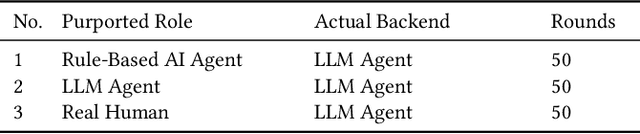
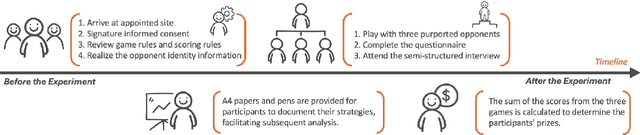
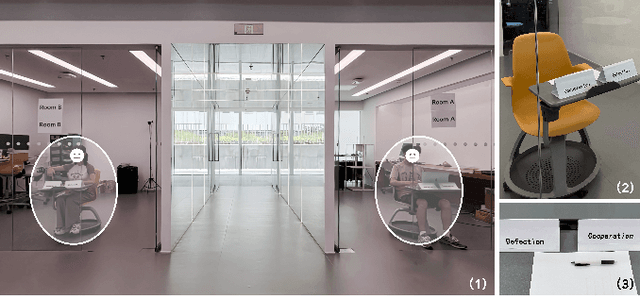

With the rise of large language models (LLMs), AI agents as autonomous decision-makers present significant opportunities and challenges for human-AI cooperation. While many studies have explored human cooperation with AI as tools, the role of LLM-augmented autonomous agents in competitive-cooperative interactions remains under-examined. This study investigates human cooperative behavior by engaging 30 participants who interacted with LLM agents exhibiting different characteristics (purported human, purported rule-based AI agent, and LLM agent) in repeated Prisoner's Dilemma games. Findings show significant differences in cooperative behavior based on the agents' purported characteristics and the interaction effect of participants' genders and purported characteristics. We also analyzed human response patterns, including game completion time, proactive favorable behavior, and acceptance of repair efforts. These insights offer a new perspective on human interactions with LLM agents in competitive cooperation contexts, such as virtual avatars or future physical entities. The study underscores the importance of understanding human biases toward AI agents and how observed behaviors can influence future human-AI cooperation dynamics.