 Add to Chrome
 Add to Firefox
 Add to Edge
APVI-SLAM: Real-Time Acoustic-Pressure-Visual-Inertial Localization and Photorealistic Mapping System in Complex Underwater Environment
Jul 07, 2026
Extreme subsea environments often cause severe feature de-gradation and estimator divergence in underwater visual-inertial SLAM. Although sensors like Doppler Velocity Logs (DVL) and pressure gauges provide auxiliary constraints, robust multi-sensor fusion during intermittent visual failure remains challenging. To address this, we present APVI-SLAM, a real-time multi-sensor fusion SLAM system that achieves both accurate underwater localization and photorealistic mapping. Our approach introduces a reliability-aware localization framework that dynamically reweights sensor estimators and employs a sliding-window freezing strategy to recover from tracking failures, substantially enhancing system robustness. Furthermore, for high-fidelity scenes reconstruction, we propose an efficient quadtree-guided mapping module that facilitates incremental water-medium modeling and 3D Gaussian optimization. Recognizing the lack of benchmark for underwater mapping evaluation, we also contribute a coral reef surveying dataset with synchronized multi-modality data. Extensive experiments on public and our proposed benchmarks demonstrate that APVI-SLAM achieves state-of-the-art localization and reconstruction quality at real-time speeds.

UniTriSplat: A Unified 3D Gaussian Splatting Framework with Uniform Spherical Rasterization for Universal Cameras
Jun 29, 2026Existing 3D Gaussian Splatting (3DGS) frameworks rely on camera-specific rasterization, suffering from inconsistent solid-angle sampling and degraded performance across heterogeneous camera models (e.g., perspective, fisheye, omnidirectional). To address this limitation, we propose UniTriSplat, a unified 3DGS framework for universal cameras that reformulates Gaussian splatting on the unit sphere via HEALPix discretization. Leveraging the equal-area property of HEALPix, we construct a spherical sampling grid aligned with the angular resolution of input images. We derive the forward rendering and gradient propagation of Gaussians directly in the spherical radian domain, yielding uniform optimization behavior from narrow-FoV images to full 360-degree panoramas. To enhance perceptual reconstruction quality, we additionally introduce a HEALPix-aware SSIM loss that respects spherical neighborhood structure. Extensive experiments across diverse camera models demonstrate that UniTriSplat consistently improves cross-camera generalization while preserving geometric fidelity and rendering quality.
ClawBench: Can AI Agents Complete Everyday Online Tasks?
Apr 09, 2026AI agents may be able to automate your inbox, but can they automate other routine aspects of your life? Everyday online tasks offer a realistic yet unsolved testbed for evaluating the next generation of AI agents. To this end, we introduce ClawBench, an evaluation framework of 153 simple tasks that people need to accomplish regularly in their lives and work, spanning 144 live platforms across 15 categories, from completing purchases and booking appointments to submitting job applications. These tasks require demanding capabilities beyond existing benchmarks, such as obtaining relevant information from user-provided documents, navigating multi-step workflows across diverse platforms, and write-heavy operations like filling in many detailed forms correctly. Unlike existing benchmarks that evaluate agents in offline sandboxes with static pages, ClawBench operates on production websites, preserving the full complexity, dynamic nature, and challenges of real-world web interaction. A lightweight interception layer captures and blocks only the final submission request, ensuring safe evaluation without real-world side effects. Our evaluations of 7 frontier models show that both proprietary and open-source models can complete only a small portion of these tasks. For example, Claude Sonnet 4.6 achieves only 33.3%. Progress on ClawBench brings us closer to AI agents that can function as reliable general-purpose assistants.
360Loc: A Dataset and Benchmark for Omnidirectional Visual Localization with Cross-device Queries
Nov 29, 2023Portable 360$^\circ$ cameras are becoming a cheap and efficient tool to establish large visual databases. By capturing omnidirectional views of a scene, these cameras could expedite building environment models that are essential for visual localization. However, such an advantage is often overlooked due to the lack of valuable datasets. This paper introduces a new benchmark dataset, 360Loc, composed of 360$^\circ$ images with ground truth poses for visual localization. We present a practical implementation of 360$^\circ$ mapping combining 360$^\circ$ images with lidar data to generate the ground truth 6DoF poses. 360Loc is the first dataset and benchmark that explores the challenge of cross-device visual positioning, involving 360$^\circ$ reference frames, and query frames from pinhole, ultra-wide FoV fisheye, and 360$^\circ$ cameras. We propose a virtual camera approach to generate lower-FoV query frames from 360$^\circ$ images, which ensures a fair comparison of performance among different query types in visual localization tasks. We also extend this virtual camera approach to feature matching-based and pose regression-based methods to alleviate the performance loss caused by the cross-device domain gap, and evaluate its effectiveness against state-of-the-art baselines. We demonstrate that omnidirectional visual localization is more robust in challenging large-scale scenes with symmetries and repetitive structures. These results provide new insights into 360-camera mapping and omnidirectional visual localization with cross-device queries.
UWA360CAM: A 360$^{\circ}$ 24/7 Real-Time Streaming Camera System for Underwater Applications
Sep 30, 2023
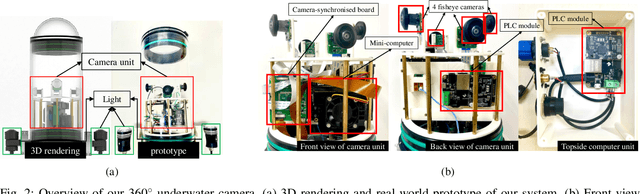
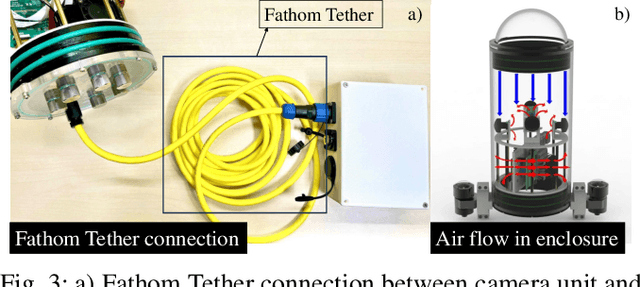
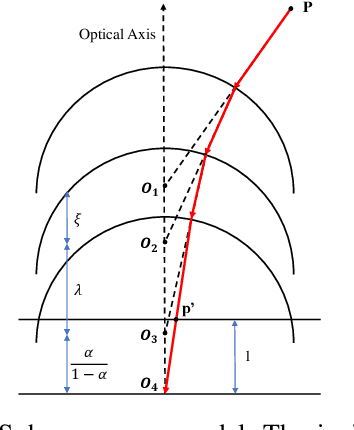
Omnidirectional camera is a cost-effective and information-rich sensor highly suitable for many marine applications and the ocean scientific community, encompassing several domains such as augmented reality, mapping, motion estimation, visual surveillance, and simultaneous localization and mapping. However, designing and constructing such a high-quality 360$^{\circ}$ real-time streaming camera system for underwater applications is a challenging problem due to the technical complexity in several aspects including sensor resolution, wide field of view, power supply, optical design, system calibration, and overheating management. This paper presents a novel and comprehensive system that addresses the complexities associated with the design, construction, and implementation of a fully functional 360$^{\circ}$ real-time streaming camera system specifically tailored for underwater environments. Our proposed system, UWA360CAM, can stream video in real time, operate in 24/7, and capture 360$^{\circ}$ underwater panorama images. Notably, our work is the pioneering effort in providing a detailed and replicable account of this system. The experiments provide a comprehensive analysis of our proposed system.
AsdKB: A Chinese Knowledge Base for the Early Screening and Diagnosis of Autism Spectrum Disorder
Aug 02, 2023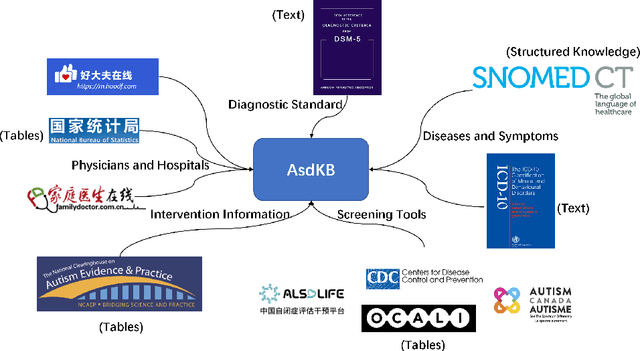
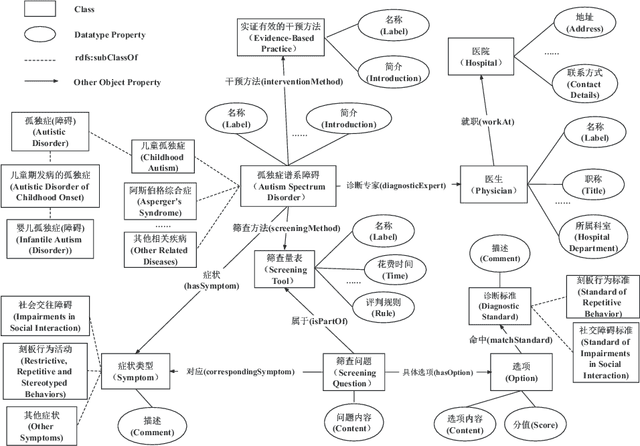
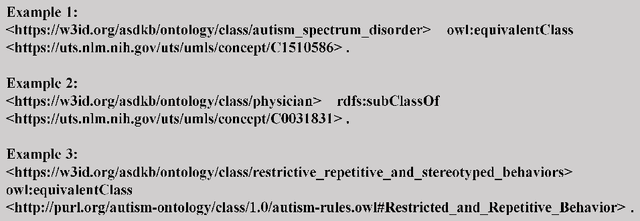
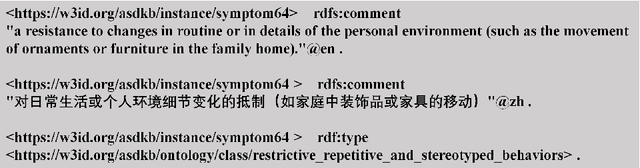
To easily obtain the knowledge about autism spectrum disorder and help its early screening and diagnosis, we create AsdKB, a Chinese knowledge base on autism spectrum disorder. The knowledge base is built on top of various sources, including 1) the disease knowledge from SNOMED CT and ICD-10 clinical descriptions on mental and behavioural disorders, 2) the diagnostic knowledge from DSM-5 and different screening tools recommended by social organizations and medical institutes, and 3) the expert knowledge on professional physicians and hospitals from the Web. AsdKB contains both ontological and factual knowledge, and is accessible as Linked Data at https://w3id.org/asdkb/. The potential applications of AsdKB are question answering, auxiliary diagnosis, and expert recommendation, and we illustrate them with a prototype which can be accessed at http://asdkb.org.cn/.