 Add to Chrome
 Add to Firefox
 Add to Edge
$τ_0$-VLA: a Hierarchical Robot Foundation Model with World-Model-Guided Test-Time Computation
Aug 17, 2026
Long-horizon robot manipulation requires a robot to both execute individual skills reliably and sequence them coherently over extended tasks. Most hierarchical vision-language-action (VLA) models make each such decision with a single forward pass, leaving no mechanism to allocate additional computation to difficult or consequential choices. We introduce $τ_0$-VLA, a hierarchical robot foundation model that formulates high-level subtask generation as a compute-scalable inference problem through world-model-guided test-time computation. At each inference step, the high-level policy uses execution memory to generate a subtask and, when needed, searches over alternatives before committing to its output. A low-level policy then executes the generated subtask across multiple robot embodiments. The policy is trained on 40,115 hours of heterogeneous real-world data with multimodal co-training. Across in-domain and distribution-shifted settings, allocating additional test-time computation substantially improves next-subtask prediction accuracy, and these gains translate into higher closed-loop success on long-horizon robot manipulation tasks.

ClawBench: Can AI Agents Complete Everyday Online Tasks?
Apr 09, 2026AI agents may be able to automate your inbox, but can they automate other routine aspects of your life? Everyday online tasks offer a realistic yet unsolved testbed for evaluating the next generation of AI agents. To this end, we introduce ClawBench, an evaluation framework of 153 simple tasks that people need to accomplish regularly in their lives and work, spanning 144 live platforms across 15 categories, from completing purchases and booking appointments to submitting job applications. These tasks require demanding capabilities beyond existing benchmarks, such as obtaining relevant information from user-provided documents, navigating multi-step workflows across diverse platforms, and write-heavy operations like filling in many detailed forms correctly. Unlike existing benchmarks that evaluate agents in offline sandboxes with static pages, ClawBench operates on production websites, preserving the full complexity, dynamic nature, and challenges of real-world web interaction. A lightweight interception layer captures and blocks only the final submission request, ensuring safe evaluation without real-world side effects. Our evaluations of 7 frontier models show that both proprietary and open-source models can complete only a small portion of these tasks. For example, Claude Sonnet 4.6 achieves only 33.3%. Progress on ClawBench brings us closer to AI agents that can function as reliable general-purpose assistants.
AgentIAD: Tool-Augmented Single-Agent for Industrial Anomaly Detection
Dec 15, 2025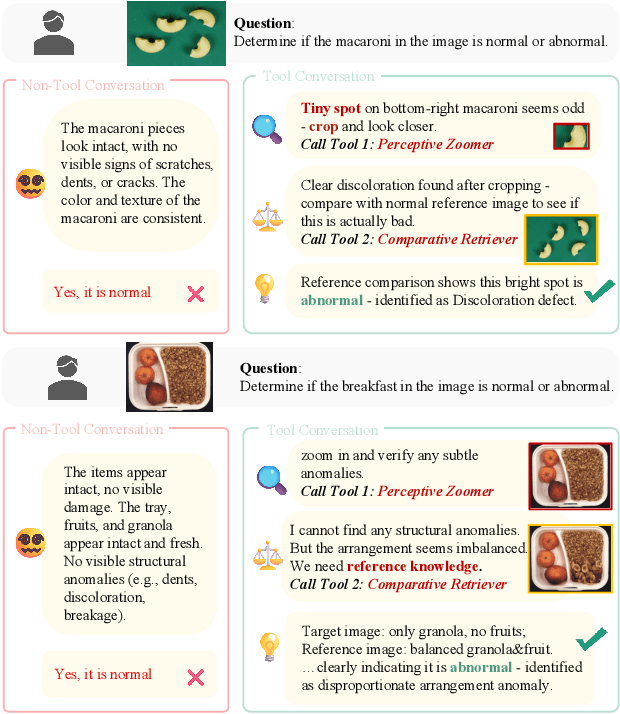
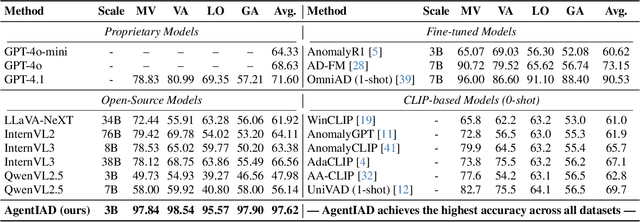
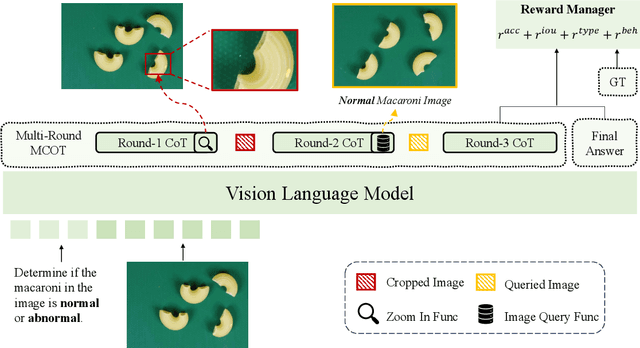
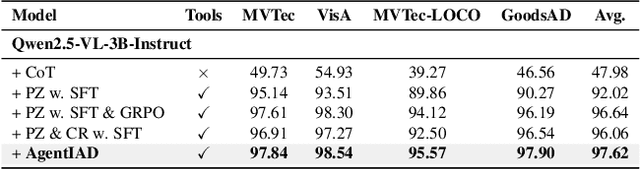
Industrial anomaly detection (IAD) is difficult due to the scarcity of normal reference samples and the subtle, localized nature of many defects. Single-pass vision-language models (VLMs) often overlook small abnormalities and lack explicit mechanisms to compare against canonical normal patterns. We propose AgentIAD, a tool-driven agentic framework that enables multi-stage visual inspection. The agent is equipped with a Perceptive Zoomer (PZ) for localized fine-grained analysis and a Comparative Retriever (CR) for querying normal exemplars when evidence is ambiguous. To teach these inspection behaviors, we construct structured perceptive and comparative trajectories from the MMAD dataset and train the model in two stages: supervised fine-tuning followed by reinforcement learning. A two-part reward design drives this process: a perception reward that supervises classification accuracy, spatial alignment, and type correctness, and a behavior reward that encourages efficient tool use. Together, these components enable the model to refine its judgment through step-wise observation, zooming, and verification. AgentIAD achieves a new state-of-the-art 97.62% classification accuracy on MMAD, surpassing prior MLLM-based approaches while producing transparent and interpretable inspection traces.
SportR: A Benchmark for Multimodal Large Language Model Reasoning in Sports
Nov 17, 2025Deeply understanding sports requires an intricate blend of fine-grained visual perception and rule-based reasoning - a challenge that pushes the limits of current multimodal models. To succeed, models must master three critical capabilities: perceiving nuanced visual details, applying abstract sport rule knowledge, and grounding that knowledge in specific visual evidence. Current sports benchmarks either cover single sports or lack the detailed reasoning chains and precise visual grounding needed to robustly evaluate these core capabilities in a multi-sport context. To address this gap, we introduce SportR, the first multi-sports large-scale benchmark designed to train and evaluate MLLMs on the fundamental reasoning required for sports intelligence. Our benchmark provides a dataset of 5,017 images and 2,101 videos. To enable granular evaluation, we structure our benchmark around a progressive hierarchy of question-answer (QA) pairs designed to probe reasoning at increasing depths - from simple infraction identification to complex penalty prediction. For the most advanced tasks requiring multi-step reasoning, such as determining penalties or explaining tactics, we provide 7,118 high-quality, human-authored Chain of Thought (CoT) annotations. In addition, our benchmark incorporates both image and video modalities and provides manual bounding box annotations to test visual grounding in the image part directly. Extensive experiments demonstrate the profound difficulty of our benchmark. State-of-the-art baseline models perform poorly on our most challenging tasks. While training on our data via Supervised Fine-Tuning and Reinforcement Learning improves these scores, they remain relatively low, highlighting a significant gap in current model capabilities. SportR presents a new challenge for the community, providing a critical resource to drive future research in multimodal sports reasoning.