 Add to Chrome
 Add to Firefox
 Add to Edge
OpenBelief-Nav: Evidence-Preserving Object Memory for Open-Vocabulary Language-Guided Navigation
Aug 14, 2026
Open-vocabulary 3D scene graphs provide compact semantic memory for language-guided navigation, but mapped objects are often exposed through a single fused feature or committed semantic label. Such commitment can remove minority yet task-relevant hypotheses from the task-time interface. We present OpenBelief-Nav, an evidence-preserving object memory that retains observation-level phrases, reliability cues, and frame-mask provenance while maintaining separate aggregate geometric and visual representations. Semantically related phrases are consolidated into a vocabulary-independent object belief from which task-specific readouts perform fixed-vocabulary projection or free-form retrieval. On five ScanNet200 and eight Replica scenes, full-belief projection achieves mIoU scores of 0.2742 and 0.2912, compared with 0.2393 and 0.2701 for a matched early-commit readout. Across 78 HM3D-YCB navigation trials, consensus and early-commit retrieval each achieve 60/78 successes, compared with 58/78 for belief-weighted retrieval and 55/78 for DualMap. Across 20 Unitree G1 runs organized as 10 matched evaluation cases, a correction policy permitting at most two verified candidate attempts improves target-confirmation success from 6/10 to 8/10 relative to top-1-only execution. Code will be released upon acceptance at https://openbelief-nav.github.io/.

HumanoidVLN: A Physics-Grounded Simulator and Benchmark for Vision-Language Navigation Across Diverse Humanoid Embodiments
Aug 13, 2026Vision-Language Navigation (VLN) for humanoid robots poses challenges existing benchmarks fail to address: bipedal locomotion imposes physical constraints absent from wheeled agents, humanoid morphologies vary across platforms, and egocentric observations are distorted by locomotion-induced camera dynamics. We present HumanoidVLN, a physics-grounded simulator and benchmark for VLN across diverse humanoid embodiments. Built on NVIDIA Isaac Sim, our platform supports an extensible set of humanoid configurations, demonstrated on four robots (Unitree G1, Unitree H1, Internal-A, Internal-B) spanning 10-12 lower-body DoF and heights from 1.17m to 1.80m, via a hierarchical control stack combining a reinforcement learning locomotion policy with interchangeable PD or MPC path trackers. New robots and VLN models integrate with minimal effort; we demonstrate compatibility with NaVILA, DualVLN, StreamVLN, and JanusVLN. Environments are drawn from artist-designed scenes and 3D Gaussian Splatting reconstructions, filtered for navigable areas exceeding 100 square meters. Instructions are generated by a dual generator-reviewer plus paraphraser multi-agent pipeline with human-in-the-loop verification, yielding 933 collision-aware reference episodes, each paired with one fine-grained instruction and three coarse-grained stylistic variants (formal, natural, casual). Across four models and four embodiments, JanusVLN achieves the highest mean success rate of 43.55% and nDTW of 48.38. In a 20-episode sim-to-real pilot with DualVLN and the Unitree G1, navigation errors correlate strongly (r=0.935), with a mean absolute difference of 0.68m and mean trajectory similarity of 0.782 (+/-0.188) nDTW. These results highlight the interaction between VLN models, controllers, and humanoid embodiments under physical execution. Code, benchmark, and data will be released upon acceptance at https://humanoid-vln.github.io/.
The 2nd Workshop on Maritime Computer Vision 2024
Nov 23, 2023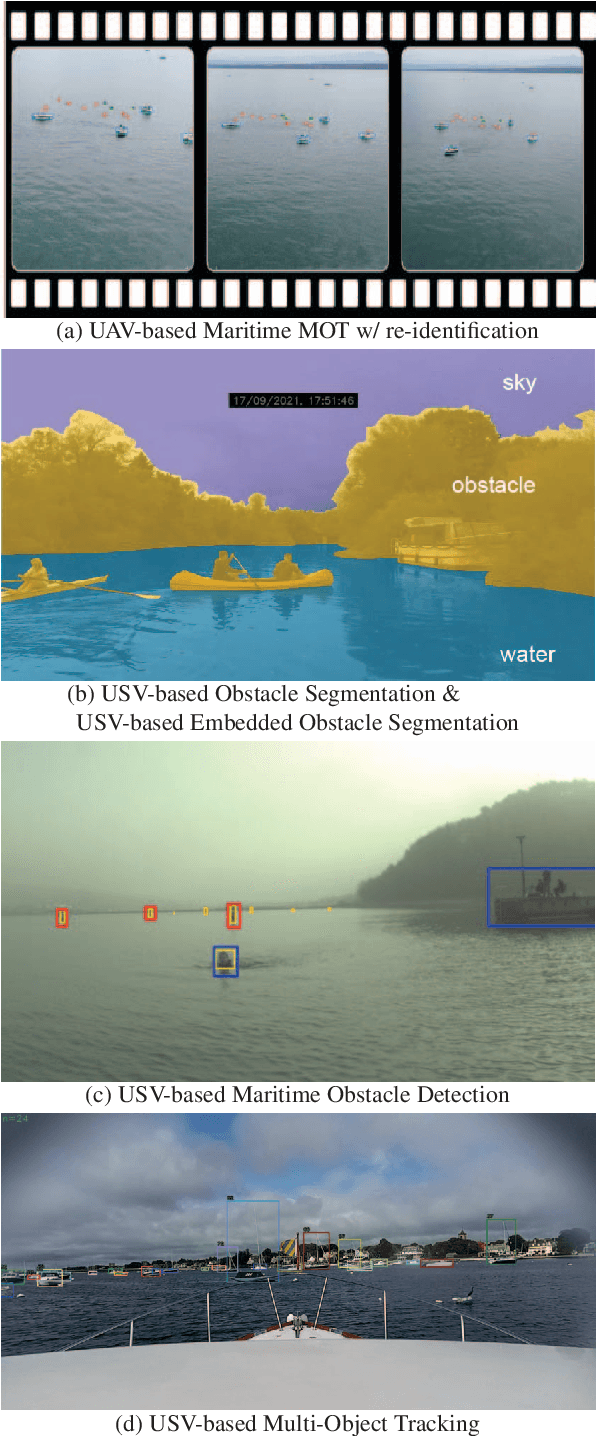
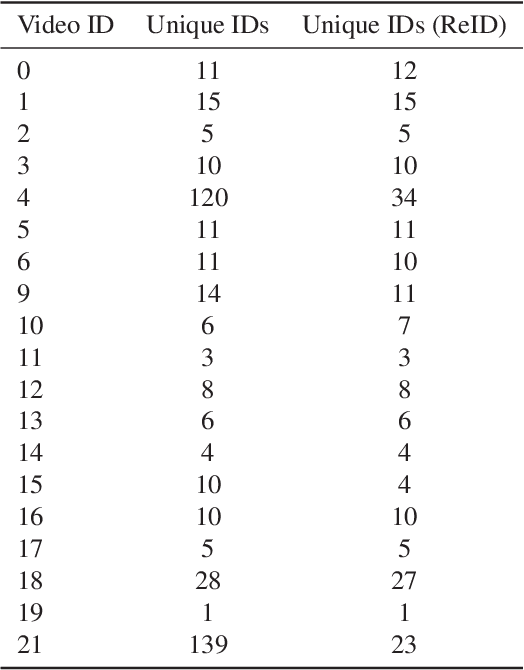

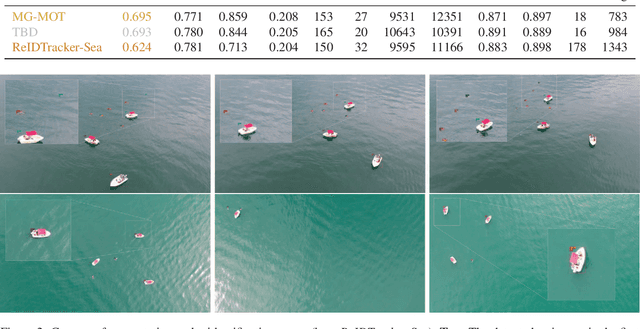
The 2nd Workshop on Maritime Computer Vision (MaCVi) 2024 addresses maritime computer vision for Unmanned Aerial Vehicles (UAV) and Unmanned Surface Vehicles (USV). Three challenges categories are considered: (i) UAV-based Maritime Object Tracking with Re-identification, (ii) USV-based Maritime Obstacle Segmentation and Detection, (iii) USV-based Maritime Boat Tracking. The USV-based Maritime Obstacle Segmentation and Detection features three sub-challenges, including a new embedded challenge addressing efficicent inference on real-world embedded devices. This report offers a comprehensive overview of the findings from the challenges. We provide both statistical and qualitative analyses, evaluating trends from over 195 submissions. All datasets, evaluation code, and the leaderboard are available to the public at https://macvi.org/workshop/macvi24.
UWA360CAM: A 360$^{\circ}$ 24/7 Real-Time Streaming Camera System for Underwater Applications
Sep 30, 2023
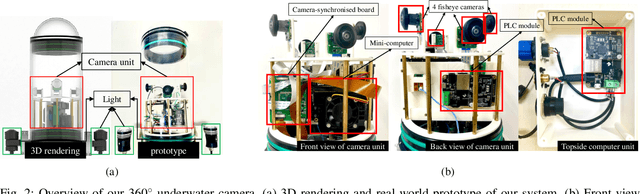
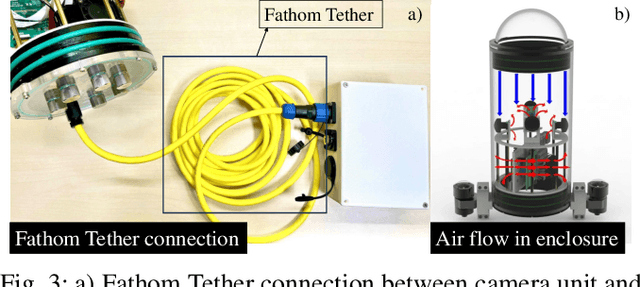
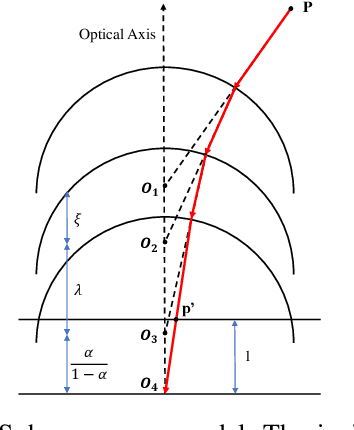
Omnidirectional camera is a cost-effective and information-rich sensor highly suitable for many marine applications and the ocean scientific community, encompassing several domains such as augmented reality, mapping, motion estimation, visual surveillance, and simultaneous localization and mapping. However, designing and constructing such a high-quality 360$^{\circ}$ real-time streaming camera system for underwater applications is a challenging problem due to the technical complexity in several aspects including sensor resolution, wide field of view, power supply, optical design, system calibration, and overheating management. This paper presents a novel and comprehensive system that addresses the complexities associated with the design, construction, and implementation of a fully functional 360$^{\circ}$ real-time streaming camera system specifically tailored for underwater environments. Our proposed system, UWA360CAM, can stream video in real time, operate in 24/7, and capture 360$^{\circ}$ underwater panorama images. Notably, our work is the pioneering effort in providing a detailed and replicable account of this system. The experiments provide a comprehensive analysis of our proposed system.
SegTransVAE: Hybrid CNN -- Transformer with Regularization for medical image segmentation
Jan 26, 2022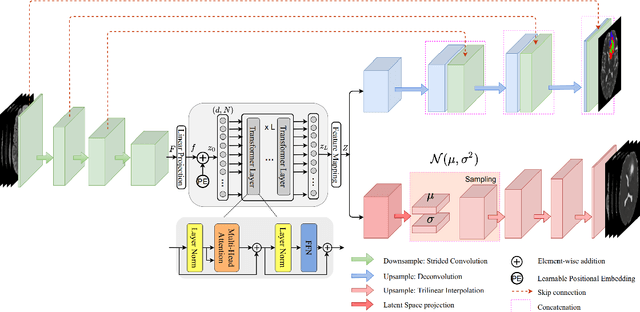
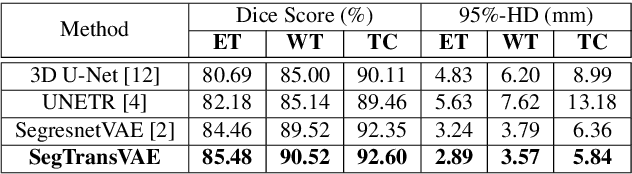
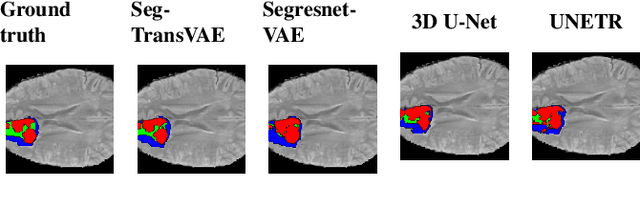
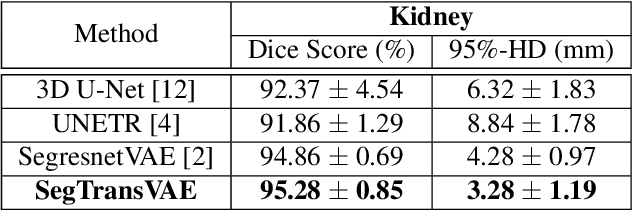
Current research on deep learning for medical image segmentation exposes their limitations in learning either global semantic information or local contextual information. To tackle these issues, a novel network named SegTransVAE is proposed in this paper. SegTransVAE is built upon encoder-decoder architecture, exploiting transformer with the variational autoencoder (VAE) branch to the network to reconstruct the input images jointly with segmentation. To the best of our knowledge, this is the first method combining the success of CNN, transformer, and VAE. Evaluation on various recently introduced datasets shows that SegTransVAE outperforms previous methods in Dice Score and $95\%$-Haudorff Distance while having comparable inference time to a simple CNN-based architecture network. The source code is available at: https://github.com/itruonghai/SegTransVAE.