 Add to Chrome
 Add to Firefox
 Add to Edge
Preserving Item Semantics for Free: Rethinking Token Initialization in LLM-Based Generative Recommendation
Aug 07, 2026
Recent advances in generative recommendation (GR) leverage large language models (LLMs) as recommender backbones, enabling LLMs to directly generate recommendations conditioned on item-interaction histories. In these systems, items are often represented through semantic IDs (SIDs) added to the LLM vocabulary as special tokens. Ideally, SIDs imbue item token representations with semantic priors, thereby improving model generalization. However, standard vocabulary expansion typically initializes these tokens as random Gaussian vectors, discarding the SIDs' underlying continuous geometry and forcing the LLM to relearn token relationships from interaction data. To demonstrate the consequences of this design, we first show that training from this initialization tends to organize SID embeddings around item popularity rather than semantics. We further show that, despite partially reducing the reliance on popularity and improving cold item performance, the computationally expensive process of continual pretraining (CPT) fails to reliably recover the original semantic geometry. To address these findings, we propose a simple, parameter-free intervention that initializes SID token embeddings directly from their corresponding centroids in the semantic embedding space. Requiring only a few lines of code and no additional training or inference overhead, this drop-in approach improves pure-SFT Recall@5 by up to 16%, reaches peak performance with up to 40% fewer SFT steps, and improves cold-item Recall@5 by up to 60%. Moreover, on datasets that benefit from additional CPT, centroid initialization reaches comparable performance while requiring half as many CPT epochs. Together, our findings show that preserving SID geometry, beyond shared-prefix structure, provides a simple and effective semantic prior for LLM-based GR.

LLM-Based Generative Retrieval for Snapchat Content Recommendation
Jul 30, 2026Pretrained large language models (LLMs) are promising retrieval engines because they combine rich semantic priors, strong sequence modeling capabilities, and favorable scaling behavior. However, turning a pretrained LLM into a generative retriever in production deployment raises several challenges: the model must learn an internal item vocabulary that was absent from pretraining, and generate valid item identifiers under strict latency and cost constraints. We address these challenges through the design and launch of SnapLGR, an LLM-based generative retrieval system for short-video recommendation at Snapchat. The system is built around three main designs. First, we construct semantic identifiers (SIDs) from multimodal item embeddings and enhance them with Personalized PageRank (PPR)-based co-engagement contrastive learning, resulting in improved codebook utilization, reduced collisions, and infused collaborative signal. Second, we use continued pretraining (CPT) to ground the introduced SID tokens before supervised fine-tuning (SFT) on user interaction sequences. Third, we make SnapLGR serving practical through TensorRT-LLM CUDA-backed beam search and a decentralized worker-loop architecture. In a live A/B test, the launched system increased View Time by 0.37%, Time Spent by 0.09%, Deep Sessions by 0.18%, and Deep Sessions Unique User by 0.11% relative to the existing TIGER-style generative retrieval baseline. We then decompose this offline gap under a fixed tokenizer and quantify the gains due to model architecture, scaling, and pretraining. Overall, our deployment shows that successful production SnapLGR requires joint design across representation learning, vocabulary grounding, and efficient training and serving.
On the Memorization Behavior of LLMs in Generative Recommendation: Observations, Implications, and Training Strategies
Jun 17, 2026Generative recommendation (GR) has emerged as a promising direction for recommender systems. Recently, large language models (LLMs) have been increasingly adopted for GR, as their rich pretrained knowledge is expected to help them generalize beyond common user behavior patterns that traditional memorization-oriented baselines can capture. However, existing LLM-based GR works largely ignore LLMs' well-known tendency to memorize, which, if present in LLMs fine-tuned for GR, would restrict their utilization of pretrained knowledge. In this work, we investigate this concern by examining one-hop memorization, where a model recommends items that are direct successors of items in the training data. We show that LLMs do this more than non-LLM-based GR models-in fact, the vast majority of their gains over GR baselines are actually on users whose target items can be predicted through one-hop memorization. We intuit that improving performance on the remaining users requires LLMs to learn richer item-item relations beyond one-hop transitions. To achieve this, we propose IIRG, a novel training strategy that teaches LLMs to capture: (1) collaborative relations derived from item co-occurrences across multiple hops in user sequences, and (2) semantic relations among items with similar themes, both of which can serve as useful recommendation signals. We show that IIRG significantly improves over LLMs trained solely with standard next-item prediction, with especially large gains for users whose test items are not covered by train-time one-hop transitions.
Formalizing and Mitigating Structural Distortion in LLM Attention for Graph Reasoning
Jun 17, 2026Large Language Models (LLMs) have shown promise for reasoning over Text-Attributed Graphs (TAGs). However, applying LLMs to graphs requires linearizing their structure into sequences, introducing distortion rooted in the graph bandwidth problem. While this distortion has been shown to degrade performance, it is often attributed to prompt design or model scale, leaving the underlying mechanism unclear. In this work, we show \textit{how} rotary positional embeddings turn graph linearization into bandwidth-dependent attention decay, suppressing attention between graph-adjacent nodes that are forced far apart in the serialized sequence. This shifts the focus of LLM-based graph reasoning from prompt engineering and scaling toward correcting attention misalignment. Motivated by this analysis, we propose \textbf{G}raph-\textbf{a}ligned \textbf{L}anguage \textbf{A}ttention (\textbf{GaLA}), a lightweight, inference-time modification for LLMs. GaLA biases attention toward graph-adjacent nodes while preserving the LLM's sequential inductive biases. Across TAG benchmarks, GaLA improves performance with negligible overhead, demonstrating that distortion is a correctable bottleneck in LLM-based graph reasoning.
Implicit Reasoning for Large Language Model-based Generative Recommendation
Jun 12, 2026Large Language Models (LLMs) are increasingly adopted as backbones for Generative Recommendation (GR), promising access to pretrained world knowledge. Yet reliably invoking this knowledge for GR remains poorly understood. A key obstacle is that LLM-based GR typically represents items with Semantic IDs (SIDs), disrupting LLMs' natural-language reasoning interface because these tokens are unseen by the LLM during pretraining. Existing approaches address this with expensive multi-stage pipelines that ground SIDs and elicit explicit rationales, but offer limited insight into when and why each stage is necessary. In this work, we systematically decompose explicit reasoning training pipelines for LLM-based GR, revealing three key limitations: weakened world-knowledge verbalization, misalignment between SID and natural-language token embedding spaces, and sensitivity to rationale quality, all of which hurt explicit reasoning performance. To circumvent these issues, we propose PauseRec, a lightweight implicit reasoning paradigm tailored for GR. PauseRec is exceptionally practical, avoiding costly reasoning trace acquisition and reasoning alignment training, leading to a multitude of benefits: (1) it outperforms standard explicit CoT methods by up to 6.22%, (2) it reduces training cost by up to 65% GPU hours, and (3) it speeds up inference by up to 71.3%. These results position PauseRec as a lightweight alternative to explicit rationale generation, enabling more effective and efficient LLM-based GR.
Plain Transformers are Surprisingly Powerful Link Predictors
Feb 02, 2026Link prediction is a core challenge in graph machine learning, demanding models that capture rich and complex topological dependencies. While Graph Neural Networks (GNNs) are the standard solution, state-of-the-art pipelines often rely on explicit structural heuristics or memory-intensive node embeddings -- approaches that struggle to generalize or scale to massive graphs. Emerging Graph Transformers (GTs) offer a potential alternative but often incur significant overhead due to complex structural encodings, hindering their applications to large-scale link prediction. We challenge these sophisticated paradigms with PENCIL, an encoder-only plain Transformer that replaces hand-crafted priors with attention over sampled local subgraphs, retaining the scalability and hardware efficiency of standard Transformers. Through experimental and theoretical analysis, we show that PENCIL extracts richer structural signals than GNNs, implicitly generalizing a broad class of heuristics and subgraph-based expressivity. Empirically, PENCIL outperforms heuristic-informed GNNs and is far more parameter-efficient than ID-embedding--based alternatives, while remaining competitive across diverse benchmarks -- even without node features. Our results challenge the prevailing reliance on complex engineering techniques, demonstrating that simple design choices are potentially sufficient to achieve the same capabilities.
Exploiting ID-Text Complementarity via Ensembling for Sequential Recommendation
Dec 19, 2025
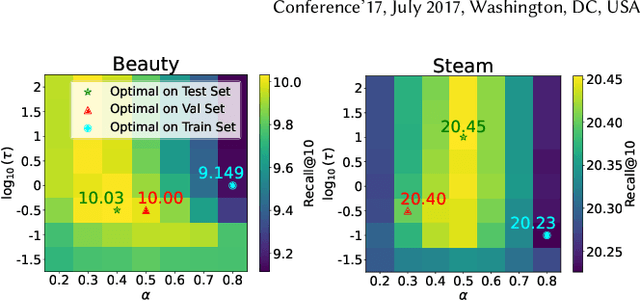
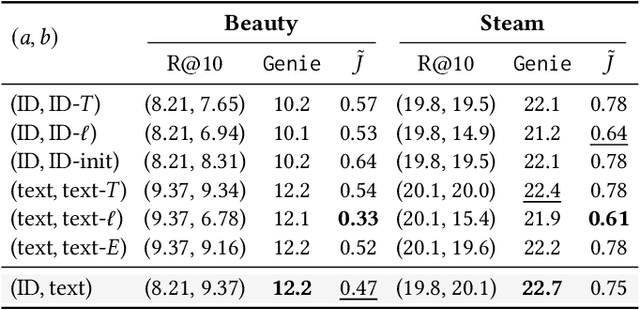
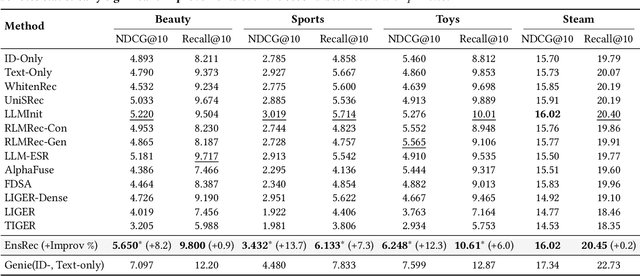
Modern Sequential Recommendation (SR) models commonly utilize modality features to represent items, motivated in large part by recent advancements in language and vision modeling. To do so, several works completely replace ID embeddings with modality embeddings, claiming that modality embeddings render ID embeddings unnecessary because they can match or even exceed ID embedding performance. On the other hand, many works jointly utilize ID and modality features, but posit that complex fusion strategies, such as multi-stage training and/or intricate alignment architectures, are necessary for this joint utilization. However, underlying both these lines of work is a lack of understanding of the complementarity of ID and modality features. In this work, we address this gap by studying the complementarity of ID- and text-based SR models. We show that these models do learn complementary signals, meaning that either should provide performance gain when used properly alongside the other. Motivated by this, we propose a new SR method that preserves ID-text complementarity through independent model training, then harnesses it through a simple ensembling strategy. Despite this method's simplicity, we show it outperforms several competitive SR baselines, implying that both ID and text features are necessary to achieve state-of-the-art SR performance but complex fusion architectures are not.
On the Role of Weight Decay in Collaborative Filtering: A Popularity Perspective
May 16, 2025Collaborative filtering (CF) enables large-scale recommendation systems by encoding information from historical user-item interactions into dense ID-embedding tables. However, as embedding tables grow, closed-form solutions become impractical, often necessitating the use of mini-batch gradient descent for training. Despite extensive work on designing loss functions to train CF models, we argue that one core component of these pipelines is heavily overlooked: weight decay. Attaining high-performing models typically requires careful tuning of weight decay, regardless of loss, yet its necessity is not well understood. In this work, we question why weight decay is crucial in CF pipelines and how it impacts training. Through theoretical and empirical analysis, we surprisingly uncover that weight decay's primary function is to encode popularity information into the magnitudes of the embedding vectors. Moreover, we find that tuning weight decay acts as a coarse, non-linear knob to influence preference towards popular or unpopular items. Based on these findings, we propose PRISM (Popularity-awaRe Initialization Strategy for embedding Magnitudes), a straightforward yet effective solution to simplify the training of high-performing CF models. PRISM pre-encodes the popularity information typically learned through weight decay, eliminating its necessity. Our experiments show that PRISM improves performance by up to 4.77% and reduces training times by 38.48%, compared to state-of-the-art training strategies. Additionally, we parameterize PRISM to modulate the initialization strength, offering a cost-effective and meaningful strategy to mitigate popularity bias.
GraphHash: Graph Clustering Enables Parameter Efficiency in Recommender Systems
Dec 23, 2024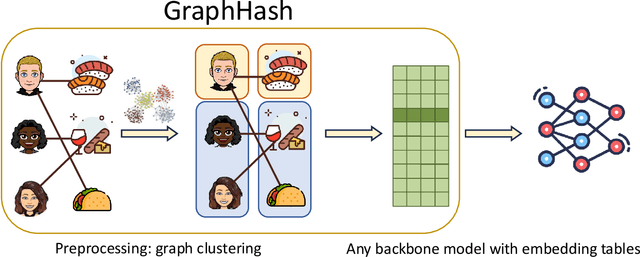
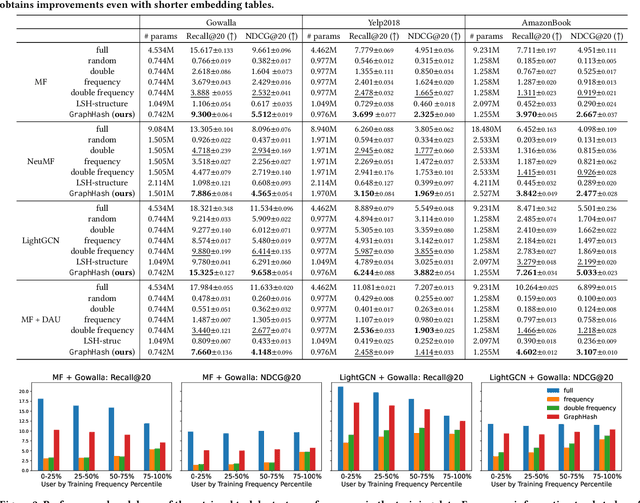
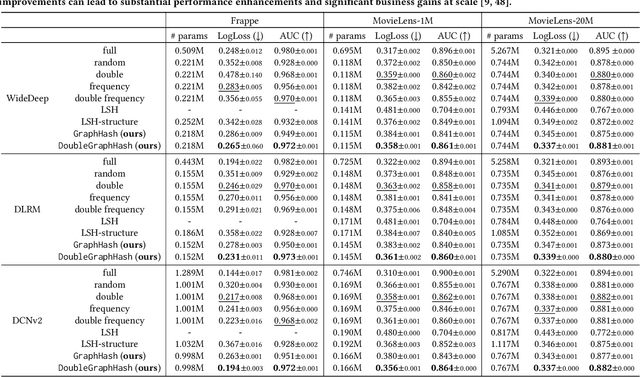
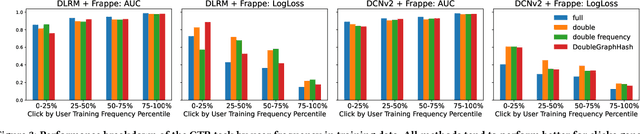
Deep recommender systems rely heavily on large embedding tables to handle high-cardinality categorical features such as user/item identifiers, and face significant memory constraints at scale. To tackle this challenge, hashing techniques are often employed to map multiple entities to the same embedding and thus reduce the size of the embedding tables. Concurrently, graph-based collaborative signals have emerged as powerful tools in recommender systems, yet their potential for optimizing embedding table reduction remains unexplored. This paper introduces GraphHash, the first graph-based approach that leverages modularity-based bipartite graph clustering on user-item interaction graphs to reduce embedding table sizes. We demonstrate that the modularity objective has a theoretical connection to message-passing, which provides a foundation for our method. By employing fast clustering algorithms, GraphHash serves as a computationally efficient proxy for message-passing during preprocessing and a plug-and-play graph-based alternative to traditional ID hashing. Extensive experiments show that GraphHash substantially outperforms diverse hashing baselines on both retrieval and click-through-rate prediction tasks. In particular, GraphHash achieves on average a 101.52% improvement in recall when reducing the embedding table size by more than 75%, highlighting the value of graph-based collaborative information for model reduction.
Unveiling the Impact of Local Homophily on GNN Fairness: In-Depth Analysis and New Benchmarks
Oct 05, 2024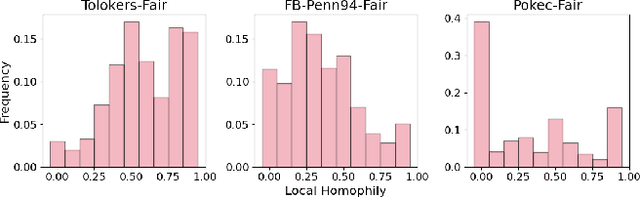
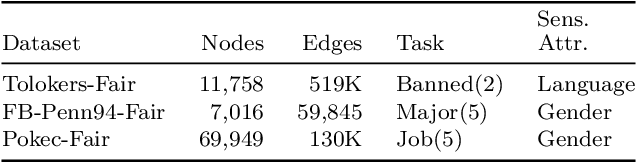
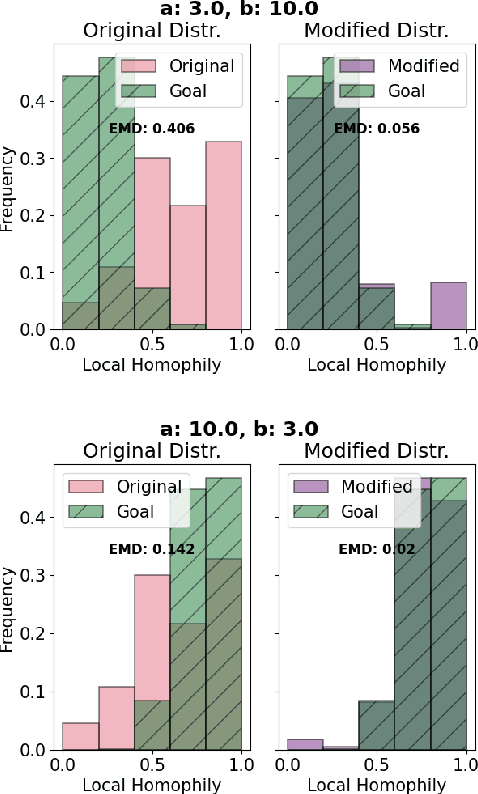
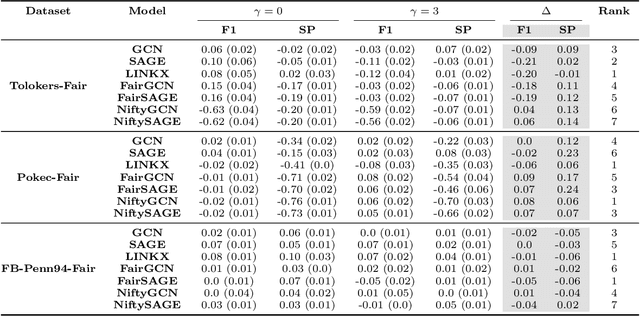
Graph Neural Networks (GNNs) often struggle to generalize when graphs exhibit both homophily (same-class connections) and heterophily (different-class connections). Specifically, GNNs tend to underperform for nodes with local homophily levels that differ significantly from the global homophily level. This issue poses a risk in user-centric applications where underrepresented homophily levels are present. Concurrently, fairness within GNNs has received substantial attention due to the potential amplification of biases via message passing. However, the connection between local homophily and fairness in GNNs remains underexplored. In this work, we move beyond global homophily and explore how local homophily levels can lead to unfair predictions. We begin by formalizing the challenge of fair predictions for underrepresented homophily levels as an out-of-distribution (OOD) problem. We then conduct a theoretical analysis that demonstrates how local homophily levels can alter predictions for differing sensitive attributes. We additionally introduce three new GNN fairness benchmarks, as well as a novel semi-synthetic graph generator, to empirically study the OOD problem. Across extensive analysis we find that two factors can promote unfairness: (a) OOD distance, and (b) heterophilous nodes situated in homophilous graphs. In cases where these two conditions are met, fairness drops by up to 24% on real world datasets, and 30% in semi-synthetic datasets. Together, our theoretical insights, empirical analysis, and algorithmic contributions unveil a previously overlooked source of unfairness rooted in the graph's homophily information.