 Add to Chrome
 Add to Firefox
 Add to Edge
ALKEMIE Agent: an autonomous platform for computational materials design
Aug 16, 2026
Despite the powerful multi-scale modeling methods and high-throughput infrastructures established in the materials community, real material computation workflows remain fragmented and heavily manual, requiring researchers to constantly bridge software tools, data analysis, and intermediate decisions. This growing gap between methodological capability and practical execution highlights the need for a new kind of autonomous computational framework, one that can coordinate tools, knowledge, and workflows in a more unified and adaptive way. Here, we introduce ALKEMIE Agent, an agentic platform in which retrieval-augmented generation, a materials-computation knowledge base, registered skills, database-supported provenance, AI-assisted structure modeling, bounded task execution, tool-calling iteration, and error-diagnostic assistance are integrated within a traceable control loop. The capabilities of ALKEMIE Agent are demonstrated through applications including materials recommendation, structure modeling, phonon calculations, machine-learned interatomic potential training, LAMMPS simulations, Ab Initio Monte Carlo (AIMC) sampling, and active-learning-based materials screening. Finally, we outline the future directions and challenges for the development of agentic platforms for computational materials design.

Deep Learning Models for Colloidal Nanocrystal Synthesis
Dec 14, 2024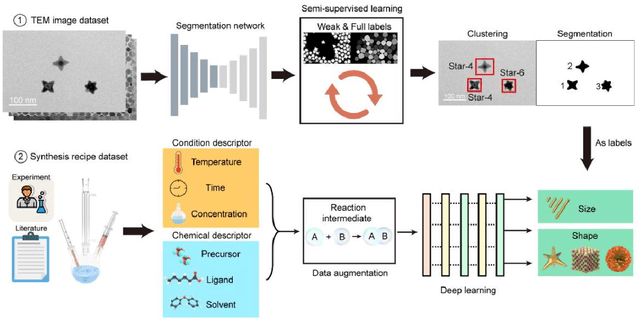
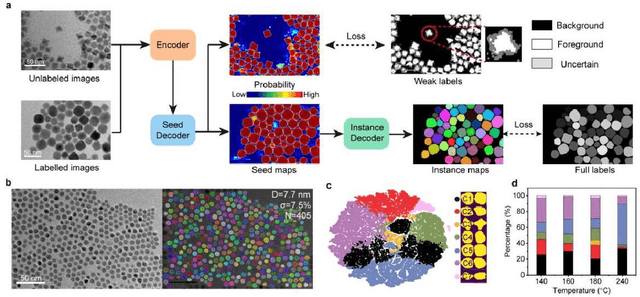
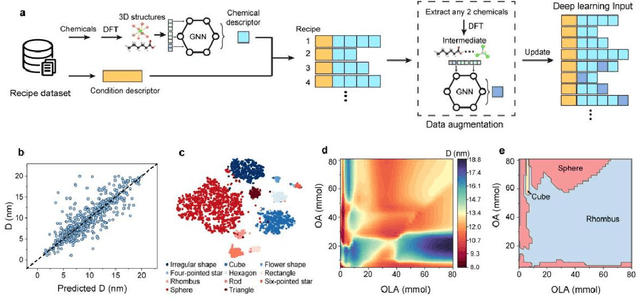
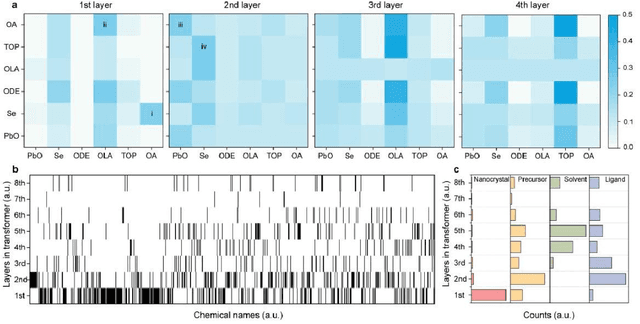
Colloidal synthesis of nanocrystals usually includes complex chemical reactions and multi-step crystallization processes. Despite the great success in the past 30 years, it remains challenging to clarify the correlations between synthetic parameters of chemical reaction and physical properties of nanocrystals. Here, we developed a deep learning-based nanocrystal synthesis model that correlates synthetic parameters with the final size and shape of target nanocrystals, using a dataset of 3500 recipes covering 348 distinct nanocrystal compositions. The size and shape labels were obtained from transmission electron microscope images using a segmentation model trained with a semi-supervised algorithm on a dataset comprising 1.2 million nanocrystals. By applying the reaction intermediate-based data augmentation method and elaborated descriptors, the synthesis model was able to predict nanocrystal's size with a mean absolute error of 1.39 nm, while reaching an 89% average accuracy for shape classification. The synthesis model shows knowledge transfer capabilities across different nanocrystals with inputs of new recipes. With that, the influence of chemicals on the final size of nanocrystals was further evaluated, revealing the importance order of nanocrystal composition, precursor or ligand, and solvent. Overall, the deep learning-based nanocrystal synthesis model offers a powerful tool to expedite the development of high-quality nanocrystals.