 Add to Chrome
 Add to Firefox
 Add to Edge
Mind the Gap: Can Frontier LLMs Pass a Standardized Office Proficiency Exam?
Jun 09, 2026
The deployment of Large Language Model (LLM) agents for computer automation is accelerating, yet their ability to navigate complex, professional-grade productivity software is largely untested. We argue that Office automation is an ideal environment for benchmarking document-automation capability, as it requires long-horizon planning and reasoning, precise parameter configuration, and multi-application integration. To quantify this capability, we introduce an evaluation based on China's National Computer Rank Examination (NCRE), featuring 200 comprehensive practical-operation tasks across Word, Excel, and PowerPoint. Each task is scored on a 100-point rubric scale using 7,118 machine-gradable criteria, and Score Rate (SR) denotes the mean percentage of rubric points earned across these tasks. We benchmark 7 frontier LLMs and observe stark limitations: single-turn models score a maximum of 36.6%. A stronger agentic system with execution feedback, iterative repair, and broader Office automation access reaches 68.8%, but remains below the 95.5% community-reference score used as a scoring sanity check. Ultimately, our experiments demonstrate that despite recent advancements in code generation, achieving reliable fine-grained Office document automation remains a significant challenge for current code-generating LLM and agent systems.

HI-TOM: A Benchmark for Evaluating Higher-Order Theory of Mind Reasoning in Large Language Models
Oct 25, 2023
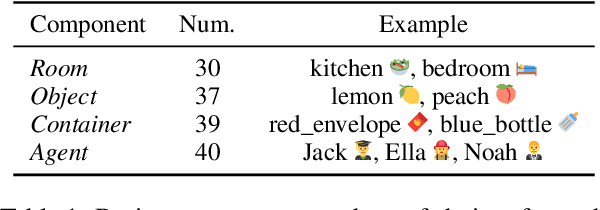
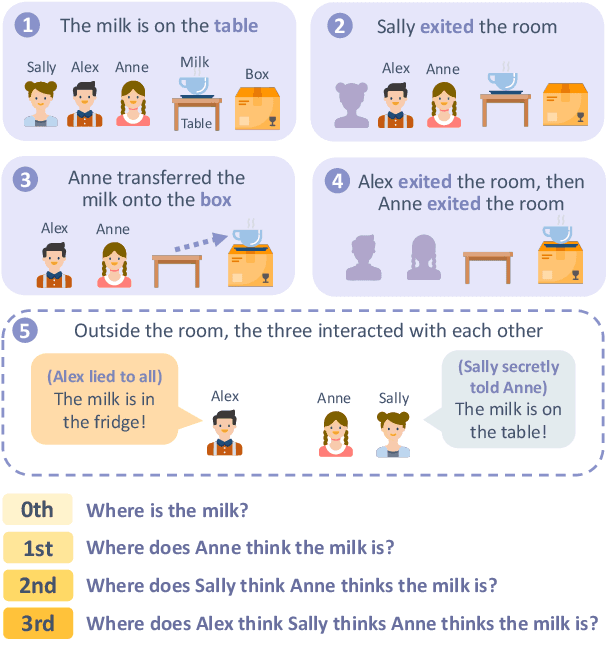

Theory of Mind (ToM) is the ability to reason about one's own and others' mental states. ToM plays a critical role in the development of intelligence, language understanding, and cognitive processes. While previous work has primarily focused on first and second-order ToM, we explore higher-order ToM, which involves recursive reasoning on others' beliefs. We introduce HI-TOM, a Higher Order Theory of Mind benchmark. Our experimental evaluation using various Large Language Models (LLMs) indicates a decline in performance on higher-order ToM tasks, demonstrating the limitations of current LLMs. We conduct a thorough analysis of different failure cases of LLMs, and share our thoughts on the implications of our findings on the future of NLP.
* Accepted at Findings of EMNLP 2023
Enhancing Long-form Text Generation Efficacy with Task-adaptive Tokenization
Oct 23, 2023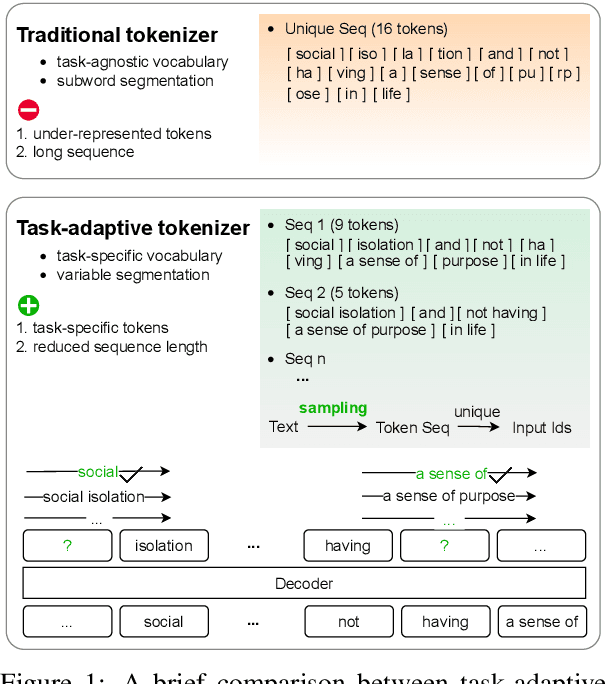
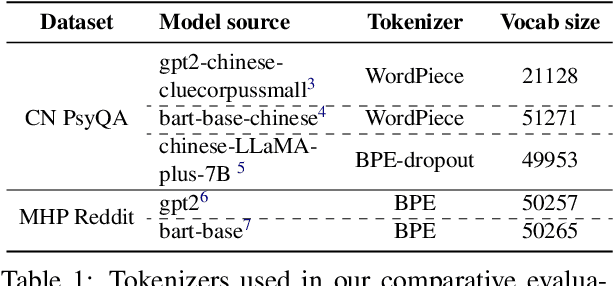
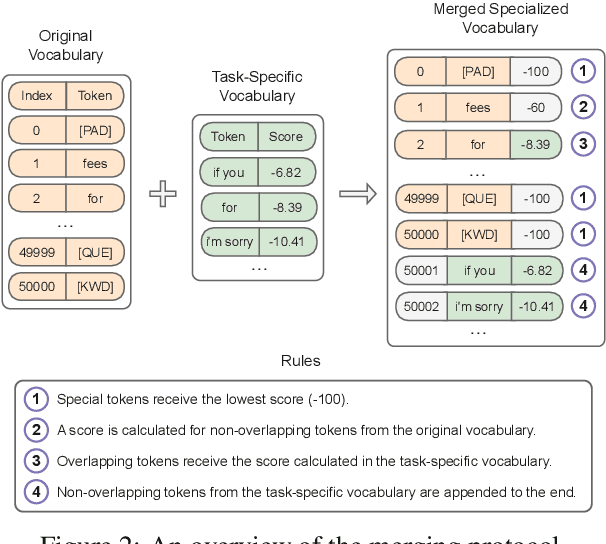
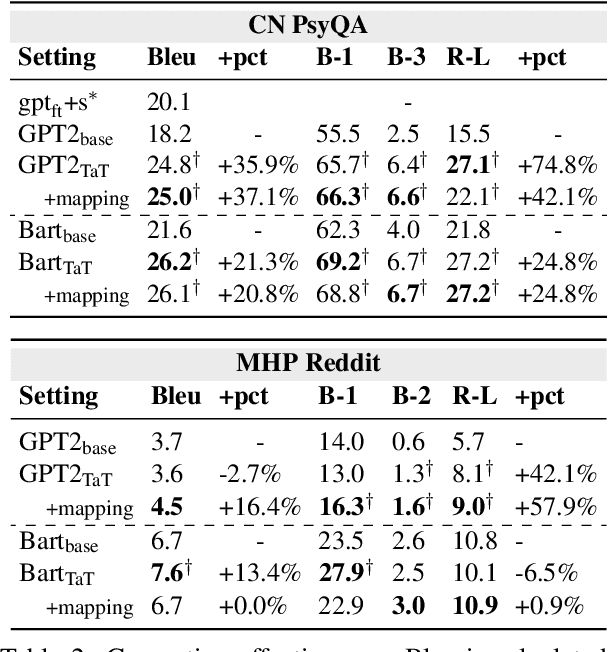
We propose task-adaptive tokenization as a way to adapt the generation pipeline to the specifics of a downstream task and enhance long-form generation in mental health. Inspired by insights from cognitive science, our task-adaptive tokenizer samples variable segmentations from multiple outcomes, with sampling probabilities optimized based on task-specific data. We introduce a strategy for building a specialized vocabulary and introduce a vocabulary merging protocol that allows for the integration of task-specific tokens into the pre-trained model's tokenization step. Through extensive experiments on psychological question-answering tasks in both Chinese and English, we find that our task-adaptive tokenization approach brings a significant improvement in generation performance while using up to 60% fewer tokens. Preliminary experiments point to promising results when using our tokenization approach with very large language models.
* Accepted at the main conference of The 2023 Conference on Empirical Methods in Natural Language Processing; 8 pages