 Add to Chrome
 Add to Firefox
 Add to Edge
Towards Autonomous Formulaic Alpha Discovery: An Evolutionary Computation Perspective
Aug 03, 2026
Automated formulaic alpha discovery aims to generate predictive and interpretable trading signals from large symbolic factor spaces. Its effectiveness is constrained by noisy fitness estimates, market nonstationarity, costly backtesting, semantic redundancy, and conflicting practical objectives. Existing studies employ diverse techniques, including genetic programming (GP), evolutionary algorithms (EAs), reinforcement learning (RL), generative flow networks (GFlowNets), Monte Carlo tree search (MCTS), large language models (LLMs), and agentic workflows, but generally examine them as separate algorithmic families. This article introduces, for the first time, a unified evolutionary computation (EC) perspective on automated formulaic alpha discovery, formulating it as a noisy, dynamic, and multiobjective symbolic evolutionary optimization problem. A six-component analytical framework is developed to characterize existing methods through representation, variation, fitness evaluation, selection, memory, and adaptation. Furthermore, an eight-dimensional, autonomy-oriented evaluation framework is proposed, covering search efficiency, fitness reliability, residual alpha quality, economic diversity, tradability, evolutionary autonomy, robustness to nonstationarity, and reproducibility. Together, these frameworks provide a systematic foundation for unifying heterogeneous approaches, diagnosing component-level limitations, and guiding the development of reliable, adaptive, interpretable, and reproducible autonomous alpha discovery systems.

Multimodal Continuous Reasoning via Asymmetric Mutual Variational Learning
Jul 01, 2026Multimodal Large Language Models (MLLMs) are often constrained by a language-space bottleneck, forcing complex visual reasoning into discrete tokens which can lose perceptual nuance. A promising alternative is continuous latent reasoning, where the goal is to discover implicit reasoning pathways that bridge the multimodal query and the final answer. However, this introduces a severe train-inference mismatch: a training-time posterior, conditioned on the ground-truth answer, can exploit answer-dependent shortcuts. Standard variational training then forces the inference-time prior to mimic a posterior that has access to information unavailable at test time, leading to poor performance. To address this, we propose Asymmetric Mutual Variational Learning (AMVL), a framework that resolves this mismatch via a bidirectional calibration objective. A forward KL divergence trains the target-agnostic prior to match the posterior, while a novel reverse KL divergence simultaneously regularizes the posterior, preventing it from collapsing into inference-incompatible regions and mitigating this ``answer leakage''. We provide theoretical analysis formalizing this leakage as prior contamination and prove that our dual-KL objective reduces it. We instantiate AMVL in a latent-integrated MLLM and show that it consistently outperforms strong discrete and latent-reasoning baselines, improving the average score on the complex BLINK benchmark by +10.83 and achieving gains of up to +32.00 on individual reasoning tasks, with analyses confirming improved latent-space stability.
DDStereo: Efficient Dual Decoder Transformers for Stereo 3D Road Anomaly Detection
Jun 23, 2026Stereo-based 3D object detection still faces two critical safety challenges: real-time performance and open-set generalization. Existing stereo 3D methods typically achieve twice the accuracy of monocular methods but suffer from significantly lower inference speeds, making them unsuitable for real-time applications. Meanwhile, recent advances in open-world detection have introduced open-set and open-vocabulary algorithms in monocular 2D and 3D settings, yet stereo-based open-set detection remains largely unexplored. To bridge this gap, we propose DDStereo, a novel Dual-Decoder Stereo Transformer for real-time open-set 3D object detection. DDStereo features two lightweight decoder branches: one for open-set foreground 2D detection and the other for 3D attribute regression. These decoders share object-level queries to achieve unified target-level alignment. To enhance inference efficiency, we designed a compact disparity feature extractor and a streamlined decoder architecture. Experiments on public stereo 3D benchmarks demonstrate that DDStereo achieves state-of-the-art accuracy under both closed-set and open-set protocols. Notably, our method surpasses existing stereo 3D detectors in inference speed and, for the first time, achieves real-time performance comparable to monocular approaches.
ReGLA: Efficient Receptive-Field Modeling with Gated Linear Attention Network
Feb 05, 2026Balancing accuracy and latency on high-resolution images is a critical challenge for lightweight models, particularly for Transformer-based architectures that often suffer from excessive latency. To address this issue, we introduce \textbf{ReGLA}, a series of lightweight hybrid networks, which integrates efficient convolutions for local feature extraction with ReLU-based gated linear attention for global modeling. The design incorporates three key innovations: the Efficient Large Receptive Field (ELRF) module for enhancing convolutional efficiency while preserving a large receptive field; the ReLU Gated Modulated Attention (RGMA) module for maintaining linear complexity while enhancing local feature representation; and a multi-teacher distillation strategy to boost performance on downstream tasks. Extensive experiments validate the superiority of ReGLA; particularly the ReGLA-M achieves \textbf{80.85\%} Top-1 accuracy on ImageNet-1K at $224px$, with only \textbf{4.98 ms} latency at $512px$. Furthermore, ReGLA outperforms similarly scaled iFormer models in downstream tasks, achieving gains of \textbf{3.1\%} AP on COCO object detection and \textbf{3.6\%} mIoU on ADE20K semantic segmentation, establishing it as a state-of-the-art solution for high-resolution visual applications.
Visual Bridge: Universal Visual Perception Representations Generating
Nov 11, 2025Recent advances in diffusion models have achieved remarkable success in isolated computer vision tasks such as text-to-image generation, depth estimation, and optical flow. However, these models are often restricted by a ``single-task-single-model'' paradigm, severely limiting their generalizability and scalability in multi-task scenarios. Motivated by the cross-domain generalization ability of large language models, we propose a universal visual perception framework based on flow matching that can generate diverse visual representations across multiple tasks. Our approach formulates the process as a universal flow-matching problem from image patch tokens to task-specific representations rather than an independent generation or regression problem. By leveraging a strong self-supervised foundation model as the anchor and introducing a multi-scale, circular task embedding mechanism, our method learns a universal velocity field to bridge the gap between heterogeneous tasks, supporting efficient and flexible representation transfer. Extensive experiments on classification, detection, segmentation, depth estimation, and image-text retrieval demonstrate that our model achieves competitive performance in both zero-shot and fine-tuned settings, outperforming prior generalist and several specialist models. Ablation studies further validate the robustness, scalability, and generalization of our framework. Our work marks a significant step towards general-purpose visual perception, providing a solid foundation for future research in universal vision modeling.
AI-driven Wireless Positioning: Fundamentals, Standards, State-of-the-art, and Challenges
Jan 24, 2025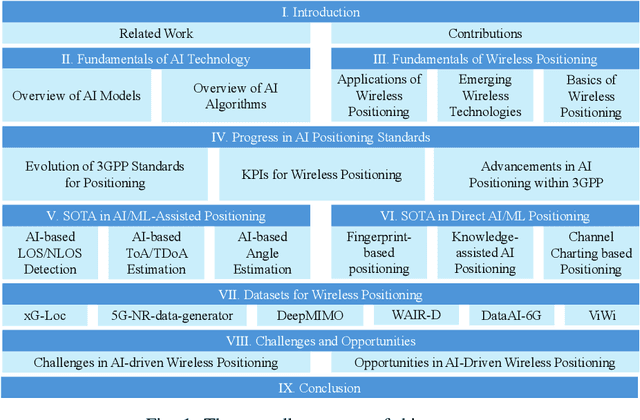

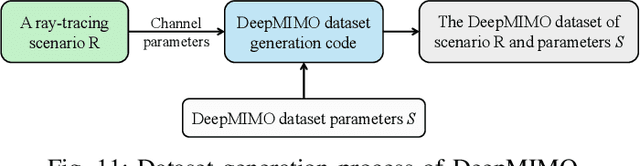
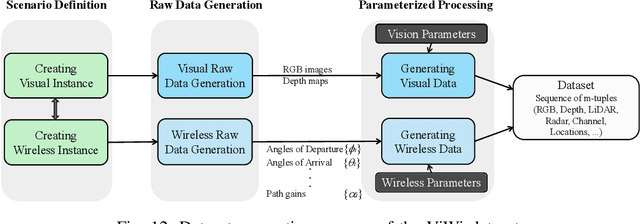
Wireless positioning technologies hold significant value for applications in autonomous driving, extended reality (XR), unmanned aerial vehicles (UAVs), and more. With the advancement of artificial intelligence (AI), leveraging AI to enhance positioning accuracy and robustness has emerged as a field full of potential. Driven by the requirements and functionalities defined in the 3rd Generation Partnership Project (3GPP) standards, AI/machine learning (ML)-based positioning is becoming a key technology to overcome the limitations of traditional methods. This paper begins with an introduction to the fundamentals of AI and wireless positioning, covering AI models, algorithms, positioning applications, emerging wireless technologies, and the basics of positioning techniques. Subsequently, focusing on standardization progress, we provide a comprehensive review of the evolution of 3GPP positioning standards, with an emphasis on the integration of AI/ML technologies in recent and upcoming releases. Based on the AI/ML-assisted positioning and direct AI/ML positioning schemes outlined in the standards, we conduct an in-depth investigation of related research. we focus on state-of-the-art (SOTA) research in AI-based line-of-sight (LOS)/non-line-of-sight (NLOS) detection, time of arrival (TOA)/time difference of arrival (TDOA) estimation, and angle estimation techniques. For Direct AI/ML Positioning, we explore SOTA advancements in fingerprint-based positioning, knowledge-assisted AI positioning, and channel charting-based positioning. Furthermore, we introduce publicly available datasets for wireless positioning and conclude by summarizing the challenges and opportunities of AI-driven wireless positioning.
Imagen 3
Aug 13, 2024We introduce Imagen 3, a latent diffusion model that generates high quality images from text prompts. We describe our quality and responsibility evaluations. Imagen 3 is preferred over other state-of-the-art (SOTA) models at the time of evaluation. In addition, we discuss issues around safety and representation, as well as methods we used to minimize the potential harm of our models.
Improving the Capabilities of Large Language Model Based Marketing Analytics Copilots With Semantic Search And Fine-Tuning
Apr 16, 2024Artificial intelligence (AI) is widely deployed to solve problems related to marketing attribution and budget optimization. However, AI models can be quite complex, and it can be difficult to understand model workings and insights without extensive implementation teams. In principle, recently developed large language models (LLMs), like GPT-4, can be deployed to provide marketing insights, reducing the time and effort required to make critical decisions. In practice, there are substantial challenges that need to be overcome to reliably use such models. We focus on domain-specific question-answering, SQL generation needed for data retrieval, and tabular analysis and show how a combination of semantic search, prompt engineering, and fine-tuning can be applied to dramatically improve the ability of LLMs to execute these tasks accurately. We compare both proprietary models, like GPT-4, and open-source models, like Llama-2-70b, as well as various embedding methods. These models are tested on sample use cases specific to marketing mix modeling and attribution.
* 16 pages, 5 figures, presented at the 2nd International Conference on NLP & AI (NLPAI 2024)