 Add to Chrome
 Add to Firefox
 Add to Edge
Ling and Ring 2.6 Technical Report: Efficient and Instant Agentic Intelligence at Trillion-Parameter Scale
Jun 13, 2026
Efficient and scalable agentic intelligence requires models that can deliver both low-latency responses and strong reasoning capabilities while remaining practical to train, serve, and deploy. In this report, we present Ling-2.6 and Ring-2.6, a family of models designed to address this challenge at scale. Ling-2.6 is optimized for instant response generation and high capability per output token, whereas Ring-2.6 is tailored for deeper reasoning and more advanced agentic workflows. Instead of training from scratch, we upgrade the Ling-2.0 base model through architectural migration pre-training and large-scale post-training. This upgrade is guided by a unified co-design of model architecture, optimization objectives, serving systems, and agent training environments, enabling improvements in both model capability and deployment efficiency. At the architectural level, we introduce a hybrid linear attention design that integrates Lightning Attention with MLA, improving the efficiency of long-context training and decoding. To further enhance token efficiency, we optimize capability per output token through Evolutionary Chain-of-Thought, Linguistic Unit Policy Optimization, bidirectional preference alignment, and shortest-correct-response distillation. For agentic capabilities, we propose KPop, a reinforcement learning framework designed to support stable training of Ring-2.6-1T on large-scale environment-grounded data. KPop improves training efficiency through asynchronous scheduling across coding, search, tool use, and workflow execution, enabling scalable learning from complex agent-environment interactions. Together, Ling-2.6 and Ring-2.6 provide a practical pathway toward efficient, scalable, and open agentic systems. We open-source all checkpoints in the 2.6 family to support further research and development in practical agentic intelligence.

Pruning Large Language Models via Accuracy Predictor
Sep 18, 2023Large language models(LLMs) containing tens of billions of parameters (or even more) have demonstrated impressive capabilities in various NLP tasks. However, substantial model size poses challenges to training, inference, and deployment so that it is necessary to compress the model. At present, most model compression for LLMs requires manual design of pruning features, which has problems such as complex optimization pipeline and difficulty in retaining the capabilities of certain parts of the model.Therefore, we propose a novel pruning approach: firstly, a training set of a certain number of architecture-accuracy pairs is established, and then a non-neural model is trained as an accuracy predictor. Using the accuracy predictor to further optimize the search space and search, the optimal model can be automatically selected. Experiments show that our proposed approach is effective and efficient. Compared with the baseline, the perplexity(PPL) on Wikitext2 and PTB dropped by 9.48% and 5,76% respectively, and the average accuracy of MMLU increased by 6.28%.
FusionMapping: Learning Depth Prediction with Monocular Images and 2D Laser Scans
Nov 29, 2019
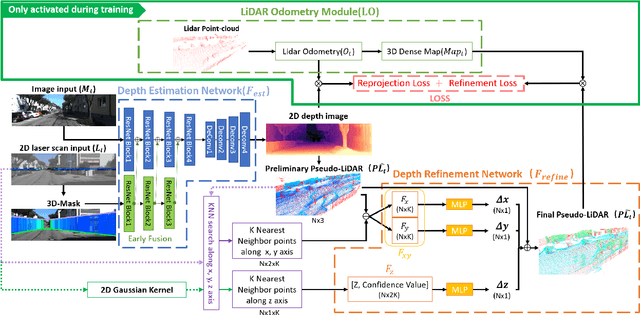

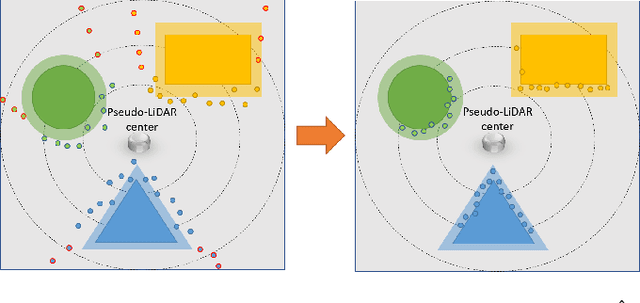
Acquiring accurate three-dimensional depth information conventionally requires expensive multibeam LiDAR devices. Recently, researchers have developed a less expensive option by predicting depth information from two-dimensional color imagery. However, there still exists a substantial gap in accuracy between depth information estimated from two-dimensional images and real LiDAR point-cloud. In this paper, we introduce a fusion-based depth prediction method, called FusionMapping. This is the first method that fuses colored imagery and two-dimensional laser scan to estimate depth in-formation. More specifically, we propose an autoencoder-based depth prediction network and a novel point-cloud refinement network for depth estimation. We analyze the performance of our FusionMapping approach on the KITTI LiDAR odometry dataset and an indoor mobile robot system. The results show that our introduced approach estimates depth with better accuracy when compared to existing methods.