 Add to Chrome
 Add to Firefox
 Add to Edge
UniSem: Generalizable Semantic 3D Reconstruction from Sparse Unposed Images
Mar 18, 2026
Semantic-aware 3D reconstruction from sparse, unposed images remains challenging for feed-forward 3D Gaussian Splatting (3DGS). Existing methods often predict an over-complete set of Gaussian primitives under sparse-view supervision, leading to unstable geometry and inferior depth quality. Meanwhile, they rely solely on 2D segmenter features for semantic lifting, which provides weak 3D-level and limited generalizable supervision, resulting in incomplete 3D semantics in novel scenes. To address these issues, we propose UniSem, a unified framework that jointly improves depth accuracy and semantic generalization via two key components. First, Error-aware Gaussian Dropout (EGD) performs error-guided capacity control by suppressing redundancy-prone Gaussians using rendering error cues, producing meaningful, geometrically stable Gaussian representations for improved depth estimation. Second, we introduce a Mix-training Curriculum (MTC) that progressively blends 2D segmenter-lifted semantics with the model's own emergent 3D semantic priors, implemented with object-level prototype alignment to enhance semantic coherence and completeness. Extensive experiments on ScanNet and Replica show that UniSem achieves superior performance in depth prediction and open-vocabulary 3D segmentation across varying numbers of input views. Notably, with 16-view inputs, UniSem reduces depth Rel by 15.2% and improves open-vocabulary segmentation mAcc by 3.7% over strong baselines.

RetinaGS: Scalable Training for Dense Scene Rendering with Billion-Scale 3D Gaussians
Jun 17, 2024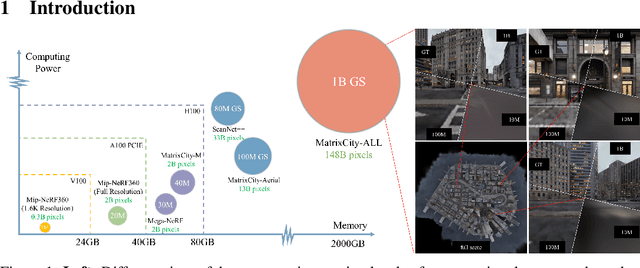

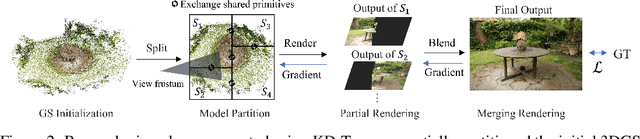
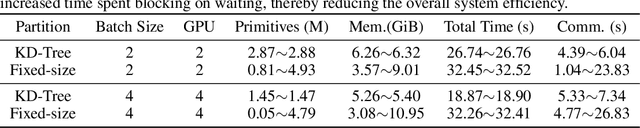
In this work, we explore the possibility of training high-parameter 3D Gaussian splatting (3DGS) models on large-scale, high-resolution datasets. We design a general model parallel training method for 3DGS, named RetinaGS, which uses a proper rendering equation and can be applied to any scene and arbitrary distribution of Gaussian primitives. It enables us to explore the scaling behavior of 3DGS in terms of primitive numbers and training resolutions that were difficult to explore before and surpass previous state-of-the-art reconstruction quality. We observe a clear positive trend of increasing visual quality when increasing primitive numbers with our method. We also demonstrate the first attempt at training a 3DGS model with more than one billion primitives on the full MatrixCity dataset that attains a promising visual quality.