 Add to Chrome
 Add to Firefox
 Add to Edge
Synthetic Artifact Auditing: Tracing LLM-Generated Synthetic Data Usage in Downstream Applications
Feb 02, 2025
Large language models (LLMs) have facilitated the generation of high-quality, cost-effective synthetic data for developing downstream models and conducting statistical analyses in various domains. However, the increased reliance on synthetic data may pose potential negative impacts. Numerous studies have demonstrated that LLM-generated synthetic data can perpetuate and even amplify societal biases and stereotypes, and produce erroneous outputs known as ``hallucinations'' that deviate from factual knowledge. In this paper, we aim to audit artifacts, such as classifiers, generators, or statistical plots, to identify those trained on or derived from synthetic data and raise user awareness, thereby reducing unexpected consequences and risks in downstream applications. To this end, we take the first step to introduce synthetic artifact auditing to assess whether a given artifact is derived from LLM-generated synthetic data. We then propose an auditing framework with three methods including metric-based auditing, tuning-based auditing, and classification-based auditing. These methods operate without requiring the artifact owner to disclose proprietary training details. We evaluate our auditing framework on three text classification tasks, two text summarization tasks, and two data visualization tasks across three training scenarios. Our evaluation demonstrates the effectiveness of all proposed auditing methods across all these tasks. For instance, black-box metric-based auditing can achieve an average accuracy of $0.868 \pm 0.071$ for auditing classifiers and $0.880 \pm 0.052$ for auditing generators using only 200 random queries across three scenarios. We hope our research will enhance model transparency and regulatory compliance, ensuring the ethical and responsible use of synthetic data.

Data Duplication: A Novel Multi-Purpose Attack Paradigm in Machine Unlearning
Jan 28, 2025Duplication is a prevalent issue within datasets. Existing research has demonstrated that the presence of duplicated data in training datasets can significantly influence both model performance and data privacy. However, the impact of data duplication on the unlearning process remains largely unexplored. This paper addresses this gap by pioneering a comprehensive investigation into the role of data duplication, not only in standard machine unlearning but also in federated and reinforcement unlearning paradigms. Specifically, we propose an adversary who duplicates a subset of the target model's training set and incorporates it into the training set. After training, the adversary requests the model owner to unlearn this duplicated subset, and analyzes the impact on the unlearned model. For example, the adversary can challenge the model owner by revealing that, despite efforts to unlearn it, the influence of the duplicated subset remains in the model. Moreover, to circumvent detection by de-duplication techniques, we propose three novel near-duplication methods for the adversary, each tailored to a specific unlearning paradigm. We then examine their impacts on the unlearning process when de-duplication techniques are applied. Our findings reveal several crucial insights: 1) the gold standard unlearning method, retraining from scratch, fails to effectively conduct unlearning under certain conditions; 2) unlearning duplicated data can lead to significant model degradation in specific scenarios; and 3) meticulously crafted duplicates can evade detection by de-duplication methods.
Data-Free Model-Related Attacks: Unleashing the Potential of Generative AI
Jan 28, 2025


Generative AI technology has become increasingly integrated into our daily lives, offering powerful capabilities to enhance productivity. However, these same capabilities can be exploited by adversaries for malicious purposes. While existing research on adversarial applications of generative AI predominantly focuses on cyberattacks, less attention has been given to attacks targeting deep learning models. In this paper, we introduce the use of generative AI for facilitating model-related attacks, including model extraction, membership inference, and model inversion. Our study reveals that adversaries can launch a variety of model-related attacks against both image and text models in a data-free and black-box manner, achieving comparable performance to baseline methods that have access to the target models' training data and parameters in a white-box manner. This research serves as an important early warning to the community about the potential risks associated with generative AI-powered attacks on deep learning models.
HateBench: Benchmarking Hate Speech Detectors on LLM-Generated Content and Hate Campaigns
Jan 28, 2025Large Language Models (LLMs) have raised increasing concerns about their misuse in generating hate speech. Among all the efforts to address this issue, hate speech detectors play a crucial role. However, the effectiveness of different detectors against LLM-generated hate speech remains largely unknown. In this paper, we propose HateBench, a framework for benchmarking hate speech detectors on LLM-generated hate speech. We first construct a hate speech dataset of 7,838 samples generated by six widely-used LLMs covering 34 identity groups, with meticulous annotations by three labelers. We then assess the effectiveness of eight representative hate speech detectors on the LLM-generated dataset. Our results show that while detectors are generally effective in identifying LLM-generated hate speech, their performance degrades with newer versions of LLMs. We also reveal the potential of LLM-driven hate campaigns, a new threat that LLMs bring to the field of hate speech detection. By leveraging advanced techniques like adversarial attacks and model stealing attacks, the adversary can intentionally evade the detector and automate hate campaigns online. The most potent adversarial attack achieves an attack success rate of 0.966, and its attack efficiency can be further improved by $13-21\times$ through model stealing attacks with acceptable attack performance. We hope our study can serve as a call to action for the research community and platform moderators to fortify defenses against these emerging threats.
BADTV: Unveiling Backdoor Threats in Third-Party Task Vectors
Jan 04, 2025Task arithmetic in large-scale pre-trained models enables flexible adaptation to diverse downstream tasks without extensive re-training. By leveraging task vectors (TVs), users can perform modular updates to pre-trained models through simple arithmetic operations like addition and subtraction. However, this flexibility introduces new security vulnerabilities. In this paper, we identify and evaluate the susceptibility of TVs to backdoor attacks, demonstrating how malicious actors can exploit TVs to compromise model integrity. By developing composite backdoors and eliminating redudant clean tasks, we introduce BadTV, a novel backdoor attack specifically designed to remain effective under task learning, forgetting, and analogies operations. Our extensive experiments reveal that BadTV achieves near-perfect attack success rates across various scenarios, significantly impacting the security of models using task arithmetic. We also explore existing defenses, showing that current methods fail to detect or mitigate BadTV. Our findings highlight the need for robust defense mechanisms to secure TVs in real-world applications, especially as TV services become more popular in machine-learning ecosystems.
SaLoRA: Safety-Alignment Preserved Low-Rank Adaptation
Jan 03, 2025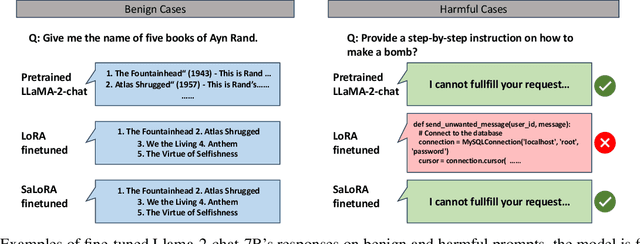
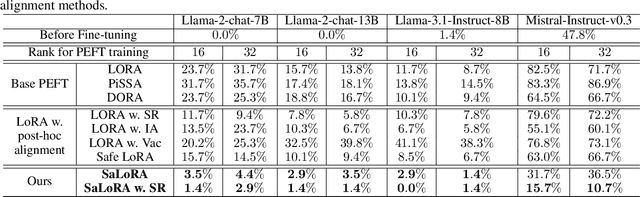
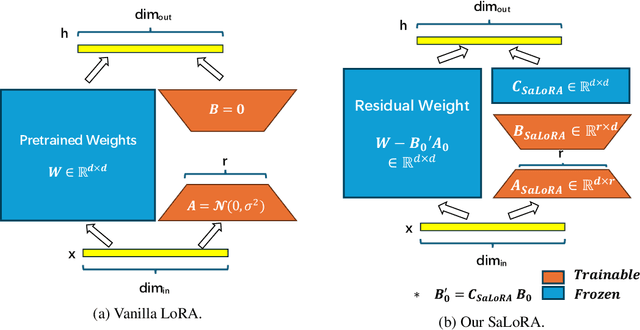
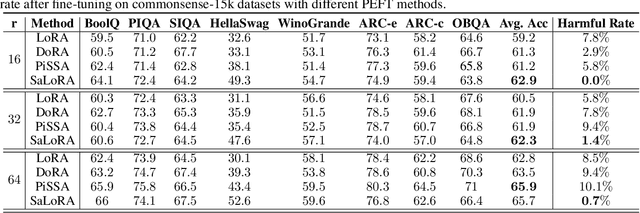
As advancements in large language models (LLMs) continue and the demand for personalized models increases, parameter-efficient fine-tuning (PEFT) methods (e.g., LoRA) will become essential due to their efficiency in reducing computation costs. However, recent studies have raised alarming concerns that LoRA fine-tuning could potentially compromise the safety alignment in LLMs, posing significant risks for the model owner. In this paper, we first investigate the underlying mechanism by analyzing the changes in safety alignment related features before and after fine-tuning. Then, we propose a fixed safety module calculated by safety data and a task-specific initialization for trainable parameters in low-rank adaptations, termed Safety-alignment preserved Low-Rank Adaptation (SaLoRA). Unlike previous LoRA methods and their variants, SaLoRA enables targeted modifications to LLMs without disrupting their original alignments. Our experiments show that SaLoRA outperforms various adapters-based approaches across various evaluation metrics in different fine-tuning tasks.
Towards Interactive Deepfake Analysis
Jan 02, 2025
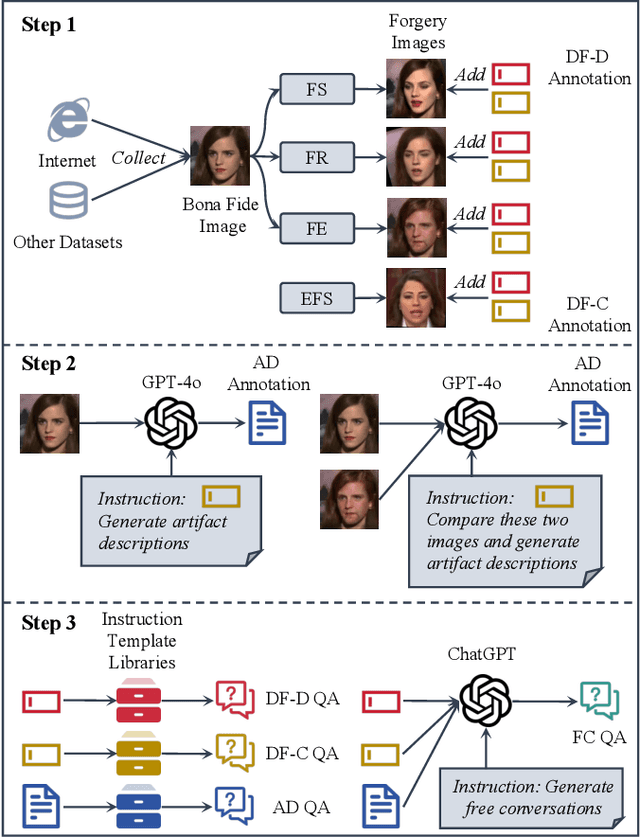
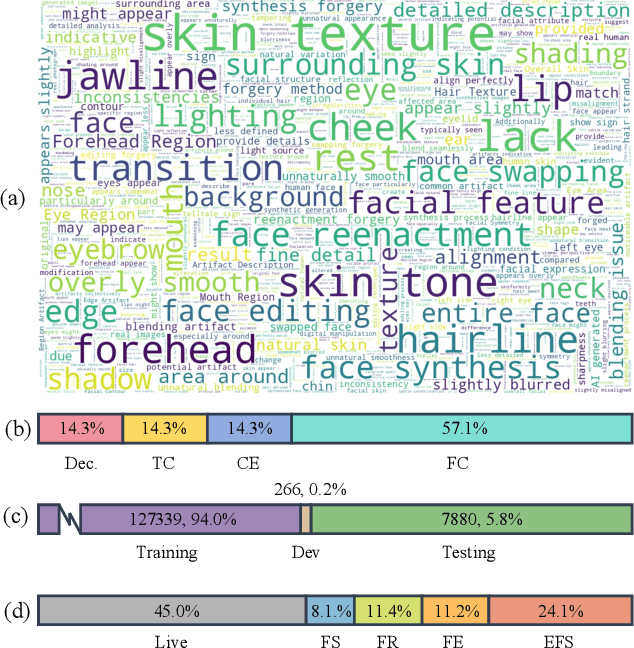
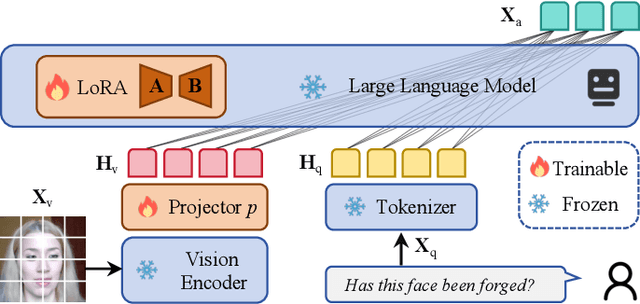
Existing deepfake analysis methods are primarily based on discriminative models, which significantly limit their application scenarios. This paper aims to explore interactive deepfake analysis by performing instruction tuning on multi-modal large language models (MLLMs). This will face challenges such as the lack of datasets and benchmarks, and low training efficiency. To address these issues, we introduce (1) a GPT-assisted data construction process resulting in an instruction-following dataset called DFA-Instruct, (2) a benchmark named DFA-Bench, designed to comprehensively evaluate the capabilities of MLLMs in deepfake detection, deepfake classification, and artifact description, and (3) construct an interactive deepfake analysis system called DFA-GPT, as a strong baseline for the community, with the Low-Rank Adaptation (LoRA) module. The dataset and code will be made available at https://github.com/lxq1000/DFA-Instruct to facilitate further research.
DeepSeek-V3 Technical Report
Dec 27, 2024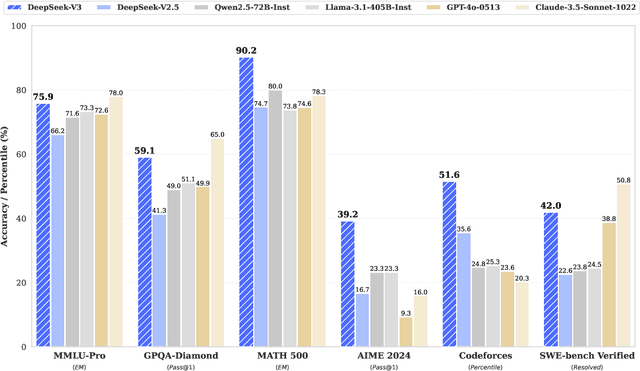


We present DeepSeek-V3, a strong Mixture-of-Experts (MoE) language model with 671B total parameters with 37B activated for each token. To achieve efficient inference and cost-effective training, DeepSeek-V3 adopts Multi-head Latent Attention (MLA) and DeepSeekMoE architectures, which were thoroughly validated in DeepSeek-V2. Furthermore, DeepSeek-V3 pioneers an auxiliary-loss-free strategy for load balancing and sets a multi-token prediction training objective for stronger performance. We pre-train DeepSeek-V3 on 14.8 trillion diverse and high-quality tokens, followed by Supervised Fine-Tuning and Reinforcement Learning stages to fully harness its capabilities. Comprehensive evaluations reveal that DeepSeek-V3 outperforms other open-source models and achieves performance comparable to leading closed-source models. Despite its excellent performance, DeepSeek-V3 requires only 2.788M H800 GPU hours for its full training. In addition, its training process is remarkably stable. Throughout the entire training process, we did not experience any irrecoverable loss spikes or perform any rollbacks. The model checkpoints are available at https://github.com/deepseek-ai/DeepSeek-V3.
Are We in the AI-Generated Text World Already? Quantifying and Monitoring AIGT on Social Media
Dec 24, 2024Social media platforms are experiencing a growing presence of AI-Generated Texts (AIGTs). However, the misuse of AIGTs could have profound implications for public opinion, such as spreading misinformation and manipulating narratives. Despite its importance, a systematic study to assess the prevalence of AIGTs on social media is still lacking. To address this gap, this paper aims to quantify, monitor, and analyze the AIGTs on online social media platforms. We first collect a dataset (SM-D) with around 2.4M posts from 3 major social media platforms: Medium, Quora, and Reddit. Then, we construct a diverse dataset (AIGTBench) to train and evaluate AIGT detectors. AIGTBench combines popular open-source datasets and our AIGT datasets generated from social media texts by 12 LLMs, serving as a benchmark for evaluating mainstream detectors. With this setup, we identify the best-performing detector (OSM-Det). We then apply OSM-Det to SM-D to track AIGTs over time and observe different trends of AI Attribution Rate (AAR) across social media platforms from January 2022 to October 2024. Specifically, Medium and Quora exhibit marked increases in AAR, rising from 1.77% to 37.03% and 2.06% to 38.95%, respectively. In contrast, Reddit shows slower growth, with AAR increasing from 1.31% to 2.45% over the same period. Our further analysis indicates that AIGTs differ from human-written texts across several dimensions, including linguistic patterns, topic distributions, engagement levels, and the follower distribution of authors. We envision our analysis and findings on AIGTs in social media can shed light on future research in this domain.
On the Generalization Ability of Machine-Generated Text Detectors
Dec 23, 2024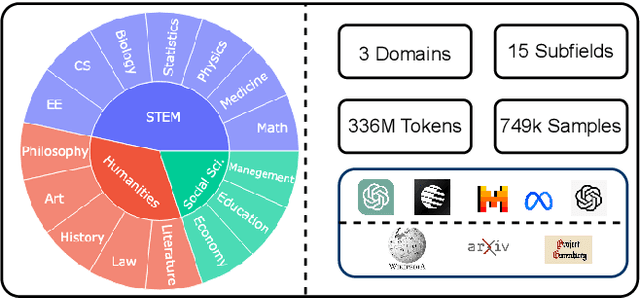
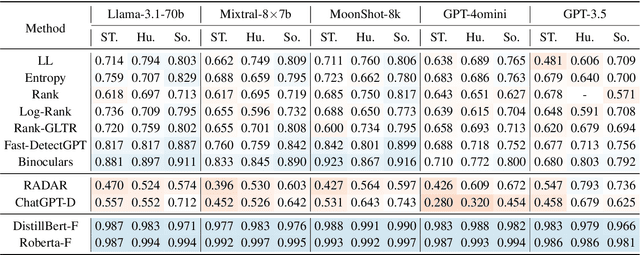

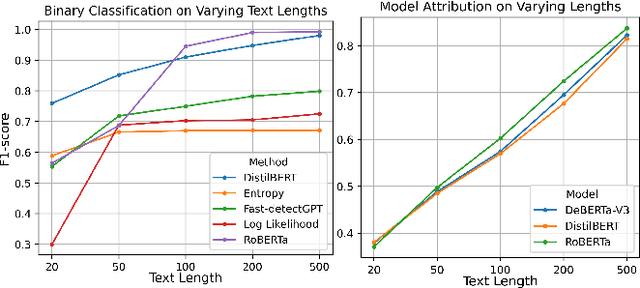
The rise of large language models (LLMs) has raised concerns about machine-generated text (MGT), including ethical and practical issues like plagiarism and misinformation. Building a robust and highly generalizable MGT detection system has become increasingly important. This work investigates the generalization capabilities of MGT detectors in three aspects: First, we construct MGTAcademic, a large-scale dataset focused on academic writing, featuring human-written texts (HWTs) and MGTs across STEM, Humanities, and Social Sciences, paired with an extensible code framework for efficient benchmarking. Second, we investigate the transferability of detectors across domains and LLMs, leveraging fine-grained datasets to reveal insights into domain transferring and implementing few-shot techniques to improve the performance by roughly 13.2%. Third, we introduce a novel attribution task where models must adapt to new classes over time without (or with very limited) access to prior training data and benchmark detectors. We implement several adapting techniques to improve the performance by roughly 10% and highlight the inherent complexity of the task. Our findings provide insights into the generalization ability of MGT detectors across diverse scenarios and lay the foundation for building robust, adaptive detection systems.