 Add to Chrome
 Add to Firefox
 Add to Edge
Evaluation Cards: An Interpretive Layer for AI Evaluation Reporting
Jun 09, 2026
AI evaluation results are produced at scale but reported inconsistently across leaderboards, model cards, benchmark papers, and company blogs. The cost is interpretive: readers cannot reliably compare results across sources, identify what a report omits, or trace an aggregate claim to its underlying evidence. Recent efforts address isolated components but leave three gaps: they cover only narrow slices of the evaluation lifecycle and do not compose into a single interpretable record; they specify static representations that do not differentiate the questions different stakeholders bring to the same evidence; and they remain proposals on paper, lacking the extraction infrastructure required for adoption at scale. We present \EvalCards{}, an operational reporting layer that composes benchmark metadata, evaluation run data, and model metadata into a unified record. We (1) derive a reporting schema from a structured review of 52 papers and 10 stakeholder interviews, (2) implement four interpretive signals (reproducibility, documentation completeness, provenance and risk, and score comparability), rendered through reader modes calibrated to research and non-research audiences, and (3) deploy a monitoring tool that applies \EvalCards{} across 5,816 models, 635 benchmarks, and 101,843 results, surfacing systematic gaps in current reporting practice.

Fast and Precise: Adjusting Planning Horizon with Adaptive Subgoal Search
Jun 01, 2022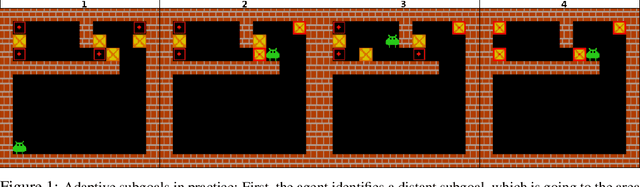
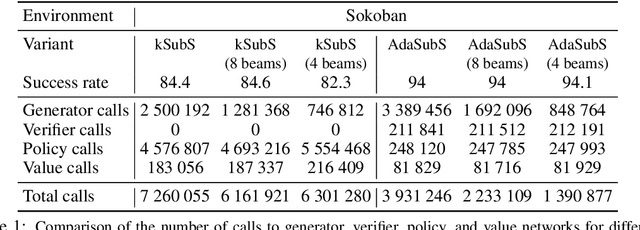
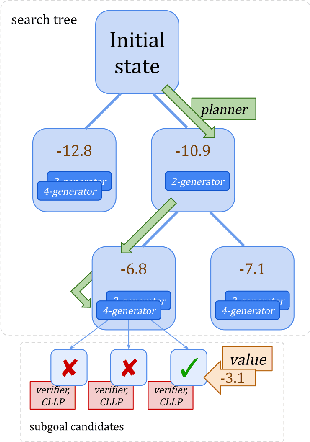
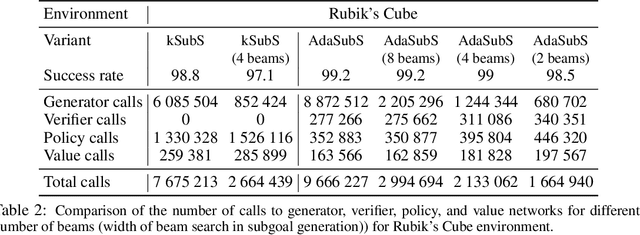
Complex reasoning problems contain states that vary in the computational cost required to determine a good action plan. Taking advantage of this property, we propose Adaptive Subgoal Search (AdaSubS), a search method that adaptively adjusts the planning horizon. To this end, AdaSubS generates diverse sets of subgoals at different distances. A verification mechanism is employed to filter out unreachable subgoals swiftly and thus allowing to focus on feasible further subgoals. In this way, AdaSubS benefits from the efficiency of planning with longer subgoals and the fine control with the shorter ones. We show that AdaSubS significantly surpasses hierarchical planning algorithms on three complex reasoning tasks: Sokoban, the Rubik's Cube, and inequality proving benchmark INT, setting new state-of-the-art on INT.