 Add to Chrome
 Add to Firefox
 Add to Edge
Dual-Domain Manifold Modeling for Hyperspectral Image Fusion
Jul 28, 2026
Achieving a coherent integration of spectral richness and spatial fidelity remains a central objective in hyperspectral image fusion. However, existing hyperspectral image fusion methods struggle to effectively model geometric constraints. In the spatial domain, weak spatial-spectral interaction limits geometry-aware feature learning and suppresses high-frequency structural information, resulting in low-frequency bias and structural degradation. In the spectral domain, local manifold structures induced by spectral similarity are insufficiently exploited, limiting intrinsic pixel relationship modeling and fine-grained spectral reconstruction. To address these challenges, we propose a dual-domain manifold modeling (DDMM) framework. Specifically, we introduce a Topology-Aware Transformer (TPFormer) that combines global attention with neighborhood propagation, jointly modeling spatial topology and pixel-level feature manifold relationships to capture intrinsic spatial-spectral structures and improve topology-aware representation learning. Furthermore, a Frequency-Decoupled Spatial-Spectral Collaborative Fusion (FDSCF) module is devised, in which features are projected into the frequency domain via the discrete cosine transform and explicitly decoupled into low- and high-frequency components. Guided by a low-rank structural prior and spectral-driven spatial enhancement, FDSCF selectively enhances geometry-aware high-frequency features, strengthening spatia-spectral coupling and recovering sharper edges and finer textures. Extensive experiments on multiple benchmark datasets demonstrate that DDMM achieves superior overall performance over SoTA methods in terms of spatial structure preservation and spectral reconstruction.

Multimodal Large Language Models for Remote Sensing Image Understanding: Domain-Specific or General-Purpose?
Jul 22, 2026The rapid development of multimodal large language models (MLLMs) has introduced a flexible paradigm for remote sensing image scene understanding (RSISU), enabling natural-language interaction with remote sensing imagery. However, a systematic understanding of the capability boundaries, cross-task generalization, and task-specific limitations of existing remote sensing MLLMs (RS-MLLMs) is still lacking. This paper presents a systematic survey and diagnostic evaluation of MLLMs for RSISU. We review the technical evolution of RS-MLLMs, focusing on model design, multimodal learning, training data, and downstream capabilities. We further compare RS-MLLMs with general-purpose computer vision MLLMs (CV-MLLMs) across diverse RSISU tasks and benchmarks. RS-MLLMs remain competitive in domain-specific settings, particularly remote sensing visual grounding and high-resolution visual question answering. More notably, general-purpose CV-MLLMs can match or even outperform these specialized models on several RSISU tasks without remote sensing-specific fine-tuning. These findings demonstrate the strong transferability of general-purpose CV-MLLMs and show that current RS-MLLMs do not consistently outperform them across diverse RSISU tasks. Current MLLMs also face limitations in spatial and relational reasoning, fine-grained visual understanding, instruction diversity, and generalization across heterogeneous task formats. Based on these findings, we outline future directions toward reliable evaluation, multimodal and high-resolution reasoning, efficient deployment, and tool-augmented remote sensing agents. This survey provides a systematic reference for developing robust, generalizable, and practical MLLMs for RSISU.
Not All Patches are Equal: Sampling Matters for Visible-Infrared Pre-Training
Jul 22, 2026Visible-infrared (VIS-IR) alignment is a key pre-training task for robust multi-sensor perception. Most existing methods use uniform patch-wise contrastive learning, but this can be unreliable in VIS-IR data because imaging-physics differences make some spatially paired regions inherently less comparable, and aligning them with equal strength hinders representation learning and downstream transfer. In this paper, we revisit VIS-IR pre-training from a sampling perspective and propose Importance-Aware Sampling (IAS), which adjusts training emphasis based on patch reliability. Specifically, IAS (i) derives patch weights from infrared structural cues and uses them to reweight the contrastive objective; (ii) learns a soft importance mask with a lightweight sampler, optionally warm-started from the hand-crafted prior; and (iii) employs a patch curriculum learning strategy that gradually expands from high-reliability regions to harder patches. It is worth noting that IAS is plug-and-play and works with both patch-/correlation-level alignment (e.g., UNIV-style) and image-level contrastive baselines (e.g., ImageBind-style). Extensive experiments on multiple VIS-IR benchmarks demonstrate consistent improvements over strong baselines, including for IR semantic segmentation, IR object detection and VIS semantic segmentation and cross-modal retrieval task. Code will be released on https://github.com/KlayMa527/IAS.
2nd of the 5th PVUW MeViS-Audio Track: ASR-SaSaSa2VA
Apr 27, 2026Audio-based video object segmentation aims to locate and segment objects in videos conditioned on audio cues, requiring precise understanding of both appearance and motion. Recent audio-driven video segmentation methods extend MLLMs by fusing audio and visual features for end-to-end localization. Despite their promise, these approaches are computationally intensive, struggle with aligning temporal audio cues to dynamic video content, and depend on large paired audio-video datasets. To address these challenges, we present ASR-SaSaSa2VA, a resource-efficient framework for audio-guided video segmentation. The key idea is to convert audio inputs into textual motion descriptions via automatic speech recognition (ASR) models and then leverage pre-trained text-based referring video segmentation models (e.g., SaSaSa2VA) for pixel-level predictions. To further enhance robustness, we incorporate a no-target expression detection module, implemented by a fine-tuned audio-based MLLM, which filters out audio clips that do not refer to any target object. This design allows the system to exploit strong pre-trained models while effectively handling ambiguous or irrelevant audio inputs. Our approach achieves a final score of 80.7 in the 5th PVUW Challenge (MeViS-v2-Audio track), earning the second-place ranking.
Robust Remote Sensing Image-Text Retrieval with Noisy Correspondence
Mar 30, 2026As a pivotal task that bridges remote visual and linguistic understanding, Remote Sensing Image-Text Retrieval (RSITR) has attracted considerable research interest in recent years. However, almost all RSITR methods implicitly assume that image-text pairs are matched perfectly. In practice, acquiring a large set of well-aligned data pairs is often prohibitively expensive or even infeasible. In addition, we also notice that the remote sensing datasets (e.g., RSITMD) truly contain some inaccurate or mismatched image text descriptions. Based on the above observations, we reveal an important but untouched problem in RSITR, i.e., Noisy Correspondence (NC). To overcome these challenges, we propose a novel Robust Remote Sensing Image-Text Retrieval (RRSITR) paradigm that designs a self-paced learning strategy to mimic human cognitive learning patterns, thereby learning from easy to hard from multi-modal data with NC. Specifically, we first divide all training sample pairs into three categories based on the loss magnitude of each pair, i.e., clean sample pairs, ambiguous sample pairs, and noisy sample pairs. Then, we respectively estimate the reliability of each training pair by assigning a weight to each pair based on the values of the loss. Further, we respectively design a new multi-modal self-paced function to dynamically regulate the training sequence and weights of the samples, thus establishing a progressive learning process. Finally, for noisy sample pairs, we present a robust triplet loss to dynamically adjust the soft margin based on semantic similarity, thereby enhancing the robustness against noise. Extensive experiments on three popular benchmark datasets demonstrate that the proposed RRSITR significantly outperforms the state-of-the-art methods, especially in high noise rates. The code is available at: https://github.com/MSFLabX/RRSITR
SARCLIP: A Vision Language Foundation Model for Semantic Understanding and Target Recognition in SAR Imagery
Oct 26, 2025Synthetic Aperture Radar (SAR) has emerged as a crucial imaging modality due to its all-weather capabilities. While recent advancements in self-supervised learning and Masked Image Modeling (MIM) have paved the way for SAR foundation models, these approaches primarily focus on low-level visual features, often overlooking multimodal alignment and zero-shot target recognition within SAR imagery. To address this limitation, we construct SARCLIP-1M, a large-scale vision language dataset comprising over one million text-image pairs aggregated from existing datasets. We further introduce SARCLIP, the first vision language foundation model tailored for the SAR domain. Our SARCLIP model is trained using a contrastive vision language learning approach by domain transferring strategy, enabling it to bridge the gap between SAR imagery and textual descriptions. Extensive experiments on image-text retrieval and zero-shot classification tasks demonstrate the superior performance of SARCLIP in feature extraction and interpretation, significantly outperforming state-of-the-art foundation models and advancing the semantic understanding of SAR imagery. The code and datasets will be released soon.
MARS2 2025 Challenge on Multimodal Reasoning: Datasets, Methods, Results, Discussion, and Outlook
Sep 17, 2025
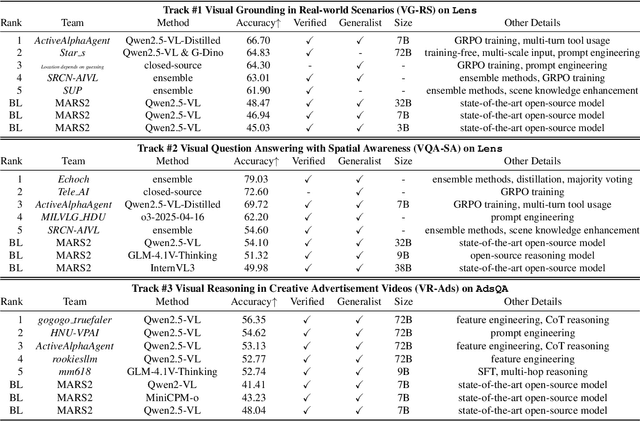

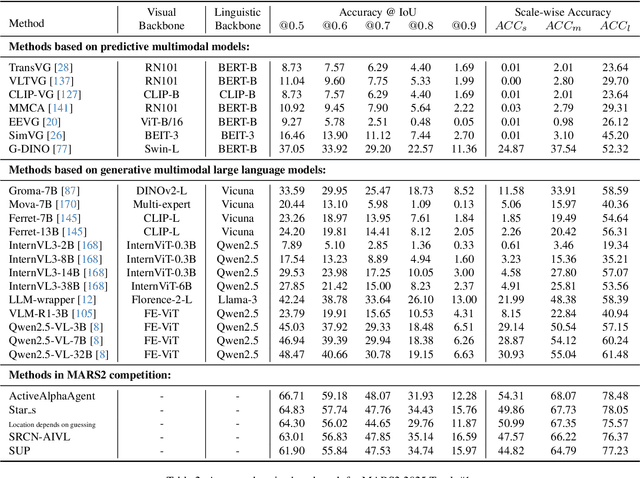
This paper reviews the MARS2 2025 Challenge on Multimodal Reasoning. We aim to bring together different approaches in multimodal machine learning and LLMs via a large benchmark. We hope it better allows researchers to follow the state-of-the-art in this very dynamic area. Meanwhile, a growing number of testbeds have boosted the evolution of general-purpose large language models. Thus, this year's MARS2 focuses on real-world and specialized scenarios to broaden the multimodal reasoning applications of MLLMs. Our organizing team released two tailored datasets Lens and AdsQA as test sets, which support general reasoning in 12 daily scenarios and domain-specific reasoning in advertisement videos, respectively. We evaluated 40+ baselines that include both generalist MLLMs and task-specific models, and opened up three competition tracks, i.e., Visual Grounding in Real-world Scenarios (VG-RS), Visual Question Answering with Spatial Awareness (VQA-SA), and Visual Reasoning in Creative Advertisement Videos (VR-Ads). Finally, 76 teams from the renowned academic and industrial institutions have registered and 40+ valid submissions (out of 1200+) have been included in our ranking lists. Our datasets, code sets (40+ baselines and 15+ participants' methods), and rankings are publicly available on the MARS2 workshop website and our GitHub organization page https://github.com/mars2workshop/, where our updates and announcements of upcoming events will be continuously provided.
NTIRE 2025 challenge on Text to Image Generation Model Quality Assessment
May 22, 2025This paper reports on the NTIRE 2025 challenge on Text to Image (T2I) generation model quality assessment, which will be held in conjunction with the New Trends in Image Restoration and Enhancement Workshop (NTIRE) at CVPR 2025. The aim of this challenge is to address the fine-grained quality assessment of text-to-image generation models. This challenge evaluates text-to-image models from two aspects: image-text alignment and image structural distortion detection, and is divided into the alignment track and the structural track. The alignment track uses the EvalMuse-40K, which contains around 40K AI-Generated Images (AIGIs) generated by 20 popular generative models. The alignment track has a total of 371 registered participants. A total of 1,883 submissions are received in the development phase, and 507 submissions are received in the test phase. Finally, 12 participating teams submitted their models and fact sheets. The structure track uses the EvalMuse-Structure, which contains 10,000 AI-Generated Images (AIGIs) with corresponding structural distortion mask. A total of 211 participants have registered in the structure track. A total of 1155 submissions are received in the development phase, and 487 submissions are received in the test phase. Finally, 8 participating teams submitted their models and fact sheets. Almost all methods have achieved better results than baseline methods, and the winning methods in both tracks have demonstrated superior prediction performance on T2I model quality assessment.
Learning from Noisy Pseudo-labels for All-Weather Land Cover Mapping
Apr 18, 2025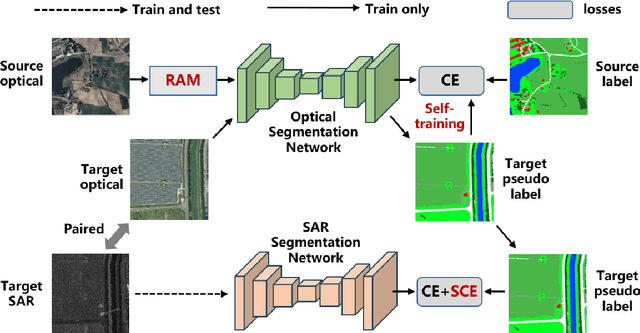
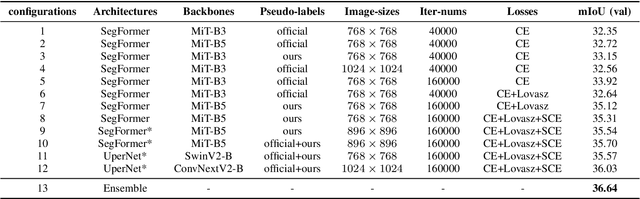
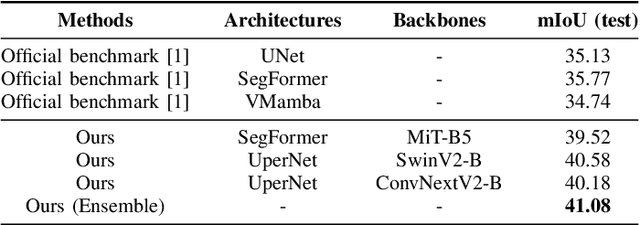
Semantic segmentation of SAR images has garnered significant attention in remote sensing due to the immunity of SAR sensors to cloudy weather and light conditions. Nevertheless, SAR imagery lacks detailed information and is plagued by significant speckle noise, rendering the annotation or segmentation of SAR images a formidable task. Recent efforts have resorted to annotating paired optical-SAR images to generate pseudo-labels through the utilization of an optical image segmentation network. However, these pseudo-labels are laden with noise, leading to suboptimal performance in SAR image segmentation. In this study, we introduce a more precise method for generating pseudo-labels by incorporating semi-supervised learning alongside a novel image resolution alignment augmentation. Furthermore, we introduce a symmetric cross-entropy loss to mitigate the impact of noisy pseudo-labels. Additionally, a bag of training and testing tricks is utilized to generate better land-cover mapping results. Our experiments on the GRSS data fusion contest indicate the effectiveness of the proposed method, which achieves first place. The code is available at https://github.com/StuLiu/DFC2025Track1.git.
Agriculture-Vision Challenge 2024 -- The Runner-Up Solution for Agricultural Pattern Recognition via Class Balancing and Model Ensemble
Jun 18, 2024
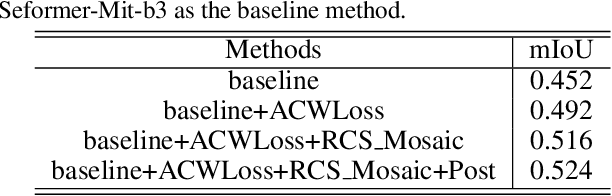

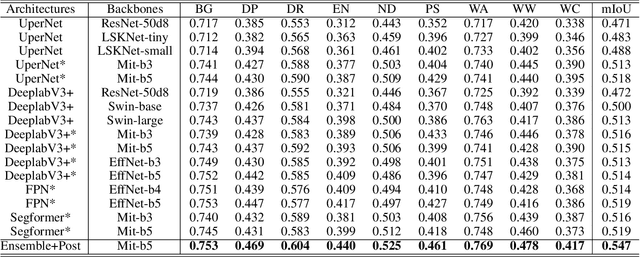
The Agriculture-Vision Challenge at CVPR 2024 aims at leveraging semantic segmentation models to produce pixel level semantic segmentation labels within regions of interest for multi-modality satellite images. It is one of the most famous and competitive challenges for global researchers to break the boundary between computer vision and agriculture sectors. However, there is a serious class imbalance problem in the agriculture-vision dataset, which hinders the semantic segmentation performance. To solve this problem, firstly, we propose a mosaic data augmentation with a rare class sampling strategy to enrich long-tail class samples. Secondly, we employ an adaptive class weight scheme to suppress the contribution of the common classes while increasing the ones of rare classes. Thirdly, we propose a probability post-process to increase the predicted value of the rare classes. Our methodology achieved a mean Intersection over Union (mIoU) score of 0.547 on the test set, securing second place in this challenge.