 Add to Chrome
 Add to Firefox
 Add to Edge
Morphing into Hybrid Attention Models
Jun 29, 2026
Hybrid attention models improve long-context efficiency by retaining only a subset of full-attention layers and replacing the remaining layers with linear attention. However, the effectiveness of Transformer-to-hybrid conversion critically depends on which layers preserve full attention. Existing hybrid layer selection methods typically rely on heuristic strategies such as fixed placement patterns or layerwise scoring, implicitly treating layer importance as isolated and overlooking the interdependent layer effect under a global hybrid configuration. In this work, we formulate hybrid layer selection as a budget-constrained subset optimization problem. We further propose FlashMorph (Fast LAyer Selection for Hybrid MORPHing), an effective, efficient and scalable layer selection method for Transformer-to-hybrid conversion. FlashMorph first constructs a morphable model by equipping each full-attention layer with a converted linear-attention branch. It then freezes all model weights and jointly optimizes layerwise gates on synthetic long-context retrieval data, with a linearization regularization that encourages the model to rely on linear attention for efficiency. The learned gates are discretized under a preset full-attention budget to instantiate the hybrid architecture, followed by standard logits distillation and long-context finetuning. Extensive experiments show that FlashMorph discovers more effective hybrid configurations, preserves strong long-context recall and general benchmark performance while substantially reducing layer selection cost compared with existing layer selection methods, demonstrating its effectiveness, efficiency, and scalability.

Seedance 2.0: Advancing Video Generation for World Complexity
Apr 15, 2026Seedance 2.0 is a new native multi-modal audio-video generation model, officially released in China in early February 2026. Compared with its predecessors, Seedance 1.0 and 1.5 Pro, Seedance 2.0 adopts a unified, highly efficient, and large-scale architecture for multi-modal audio-video joint generation. This allows it to support four input modalities: text, image, audio, and video, by integrating one of the most comprehensive suites of multi-modal content reference and editing capabilities available in the industry to date. It delivers substantial, well-rounded improvements across all key sub-dimensions of video and audio generation. In both expert evaluations and public user tests, the model has demonstrated performance on par with the leading levels in the field. Seedance 2.0 supports direct generation of audio-video content with durations ranging from 4 to 15 seconds, with native output resolutions of 480p and 720p. For multi-modal inputs as reference, its current open platform supports up to 3 video clips, 9 images, and 3 audio clips. In addition, we provide Seedance 2.0 Fast version, an accelerated variant of Seedance 2.0 designed to boost generation speed for low-latency scenarios. Seedance 2.0 has delivered significant improvements to its foundational generation capabilities and multi-modal generation performance, bringing an enhanced creative experience for end users.
Does Your Reasoning Model Implicitly Know When to Stop Thinking?
Feb 09, 2026Recent advancements in large reasoning models (LRMs) have greatly improved their capabilities on complex reasoning tasks through Long Chains of Thought (CoTs). However, this approach often results in substantial redundancy, impairing computational efficiency and causing significant delays in real-time applications. Recent studies show that longer reasoning chains are frequently uncorrelated with correctness and can even be detrimental to accuracy. In a further in-depth analysis of this phenomenon, we surprisingly uncover and empirically verify that LRMs implicitly know the appropriate time to stop thinking, while this capability is obscured by current sampling paradigms. Motivated by this, we introduce SAGE (Self-Aware Guided Efficient Reasoning), a novel sampling paradigm that unleashes this efficient reasoning potential. Furthermore, integrating SAGE as mixed sampling into group-based reinforcement learning (SAGE-RL) enables SAGE-RL to effectively incorporate SAGE-discovered efficient reasoning patterns into standard pass@1 inference, markedly enhancing both the reasoning accuracy and efficiency of LRMs across multiple challenging mathematical benchmarks.
Seedream 3.0 Technical Report
Apr 16, 2025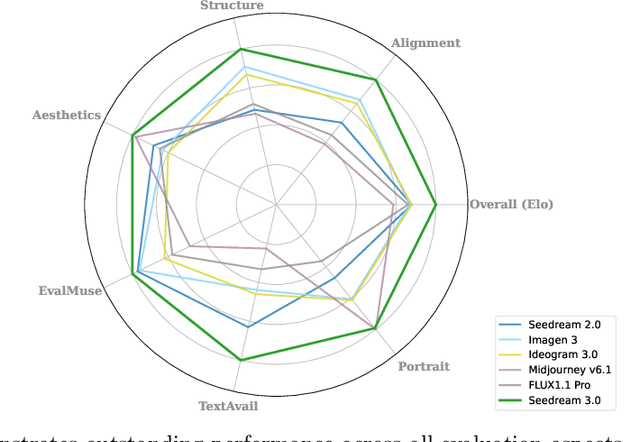


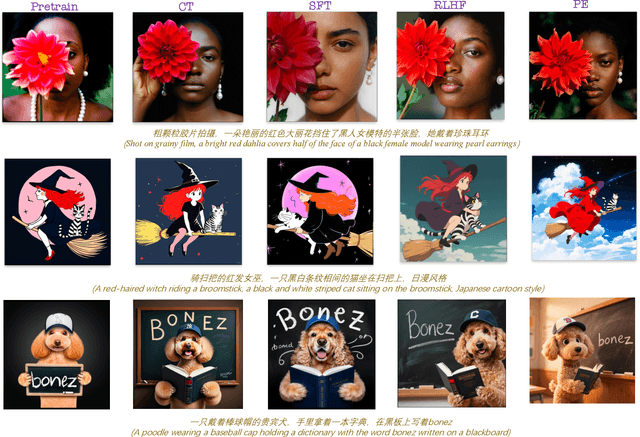
We present Seedream 3.0, a high-performance Chinese-English bilingual image generation foundation model. We develop several technical improvements to address existing challenges in Seedream 2.0, including alignment with complicated prompts, fine-grained typography generation, suboptimal visual aesthetics and fidelity, and limited image resolutions. Specifically, the advancements of Seedream 3.0 stem from improvements across the entire pipeline, from data construction to model deployment. At the data stratum, we double the dataset using a defect-aware training paradigm and a dual-axis collaborative data-sampling framework. Furthermore, we adopt several effective techniques such as mixed-resolution training, cross-modality RoPE, representation alignment loss, and resolution-aware timestep sampling in the pre-training phase. During the post-training stage, we utilize diversified aesthetic captions in SFT, and a VLM-based reward model with scaling, thereby achieving outputs that well align with human preferences. Furthermore, Seedream 3.0 pioneers a novel acceleration paradigm. By employing consistent noise expectation and importance-aware timestep sampling, we achieve a 4 to 8 times speedup while maintaining image quality. Seedream 3.0 demonstrates significant improvements over Seedream 2.0: it enhances overall capabilities, in particular for text-rendering in complicated Chinese characters which is important to professional typography generation. In addition, it provides native high-resolution output (up to 2K), allowing it to generate images with high visual quality.